Walk down Jersey Street on a September morning and you will find a line outside Gate D that has nothing to do with a game — no game is scheduled, the gates will not open to spectators for another two days, and the people in the line are paying $30 each to stand on the warning track of a ballpark built in 1912. That is the thing about Boston sports that surprises visitors: the buildings are attractions in their own right, and you can get into most of them on a day when nothing is happening, for a fraction of what a ticket costs.
This guide covers all five professional teams and where they play, the stadium tours worth paying for and the one that no longer exists, how to get tickets without being fleeced, what the college and amateur calendar adds, and how to reach each venue on public transport. Prices were checked in September 2026; confirm before you book, because ticket pricing here is dynamic and moves week to week.
The five teams, in one table
| Team | Sport | Venue | Season | Getting there |
|---|---|---|---|---|
| Boston Red Sox | Baseball (MLB) | Fenway Park | Late March – September, plus playoffs | Green Line B/C/D to Kenmore, or Fenway on the D |
| Boston Celtics | Basketball (NBA) | TD Garden | October – April, plus playoffs | Green or Orange Line to North Station — the arena is on top of it |
| Boston Bruins | Ice hockey (NHL) | TD Garden | October – April, plus playoffs | Same — North Station |
| New England Patriots | American football (NFL) | Gillette Stadium, Foxborough | September – January | Special event trains from South Station to Foxboro, or drive 22 miles |
| New England Revolution | Soccer (MLS) | Gillette Stadium, Foxborough | February – October | Same as the Patriots |
Two of those are in the city, two are in Foxborough twenty-two miles away, and the difference matters more than people expect. A Celtics or Bruins game is something you can decide to do at 5pm and be inside by 7. A Patriots game is a day out with logistics.
Fenway Park: the tour, and the game
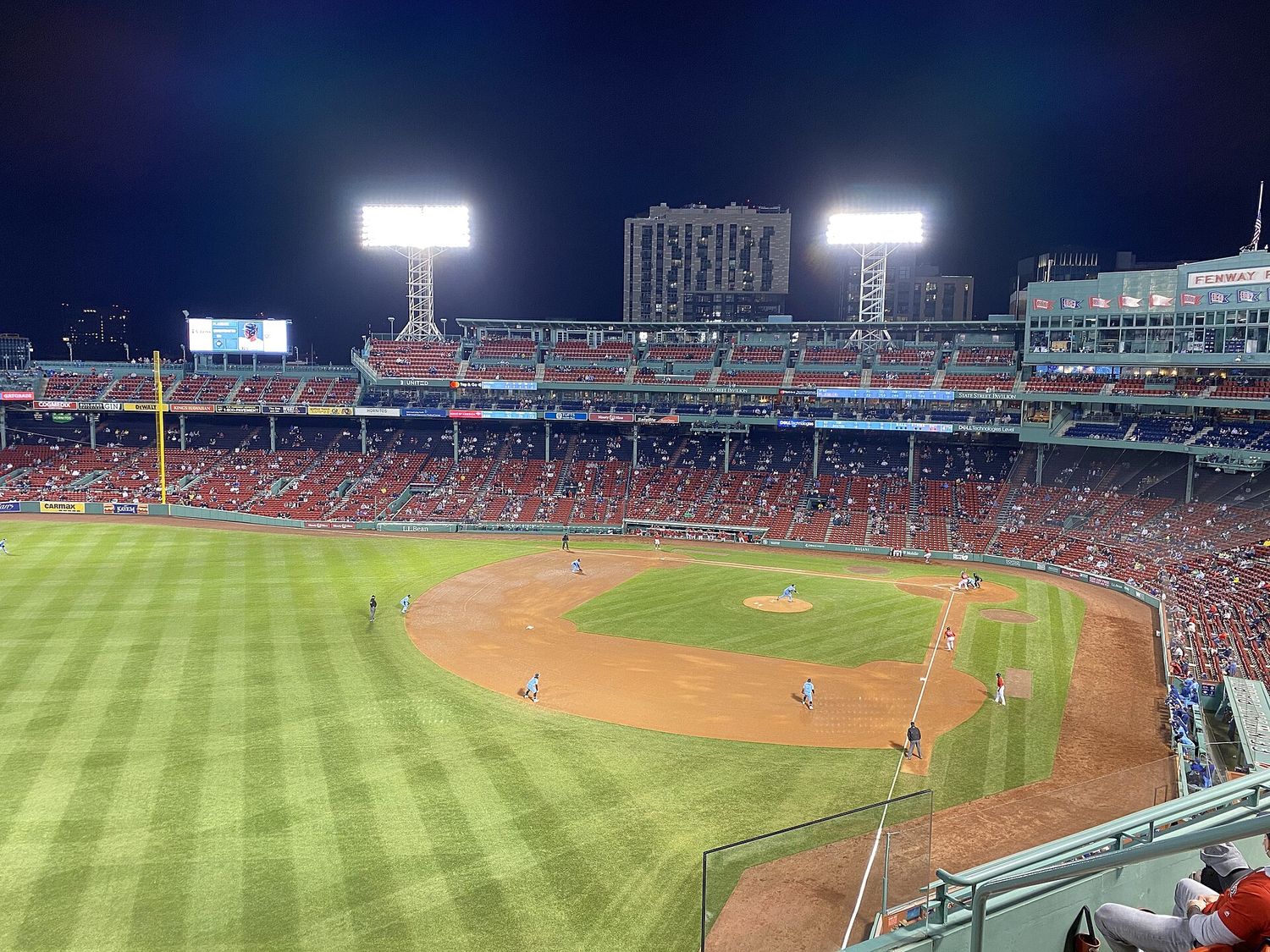
Fenway Park is the oldest park in Major League Baseball, opened in 1912, and it is odd-shaped because it was squeezed into an existing city block rather than dropped onto a parking lot. The left field wall is 37 feet high because there was no room to put the seats further back, and it has been called the Green Monster since it was painted green in 1947. Capacity is around 37,000, which is small for a modern major-league venue and is the reason a Fenway crowd sounds the way it does.
The tour — $30 adult, $21 child
The tour is the best sports experience in Boston for anyone who does not have a game ticket, and arguably for some people who do. It costs $30 for adults and $21 for children aged 3 to 12, runs hourly from Gate D on Jersey Street, and operates 9am to 5pm from April to October and 10am to 5pm from November to March. On game days the last tour leaves three hours before first pitch. It takes about an hour.
You get taken through the grandstand, out onto the warning track when the ground crew allow it, up to the Green Monster seats on top of the wall, and through the press areas. Guides are generally excellent and the history is genuinely interesting rather than corporate — the park’s awkwardness is the story, and the good guides lean into it.
Book ahead in summer. Tours sell out on game days and on any weekend from June onwards, and turning up at Gate D at 11am in July expecting a spot is optimistic. The current schedule is on the Red Sox’s own tours page.
Getting a ticket to an actual game
Red Sox tickets are dynamically priced and range enormously — a Tuesday night in April against a poor visiting team is a different market from a Saturday against the Yankees. Some honest guidance:
- Weeknight games in April, May and September are the cheap ones. The weather in April is genuinely unpleasant and prices reflect it; bring more layers than you think.
- Yankees, Dodgers and interleague marquee games are the expensive ones, often two to three times the price of the same seat a week earlier.
- Bleacher seats are the cheapest way in and the most fun section in the park, but they are uncovered, they are in full sun for most of an afternoon game, and they are a long way from the plate.
- Standing room is released for sold-out games and is genuinely good value if you do not mind standing for three hours.
- Obstructed-view seats exist and are labeled. Fenway has structural columns holding up the grandstand roof. Read the seat description; an unusually cheap seat behind the plate is cheap for a reason.
Be careful with resale. Massachusetts has a licensed resale market and the club runs its own official exchange; buy through that or through a major platform with a guarantee, and treat a stranger on Lansdowne Street with a spare as exactly the risk it looks like.
Eating inside the park
Fenway concessions are better than they were and still not good value. The Fenway Frank is the institution — a boiled-then-grilled hot dog in a New England-style split-top bun — and it is worth having once for the sake of it rather than because it is a good hot dog. The sausage carts on Lansdowne and Jersey Street outside the gates, with peppers and onions, are the better food and about half the price, and there is nothing stopping you eating before you go in.
The park allows sealed water bottles and small bags within the published size limit, and the bag policy is enforced properly at the gates — check the current dimensions on the club’s site before you arrive with a backpack, because the bag check adds twenty minutes you had not planned for. Beer sales stop partway through the game, which catches visitors out.
The neighborhood around the park
Lansdowne Street behind the Green Monster is the pre-game street, and it is loud, crowded and expensive on game nights. Jersey Street closes to traffic before games and becomes a market of sorts. The honest verdict on eating here: the bars immediately around Fenway charge a premium for proximity and the food is uniformly average. Walk ten minutes into the Fenway neighborhood or take the Green Line one stop and you will eat considerably better for less. Our Boston food and restaurants guide has the alternatives.
TD Garden: Celtics, Bruins and the Sports Museum
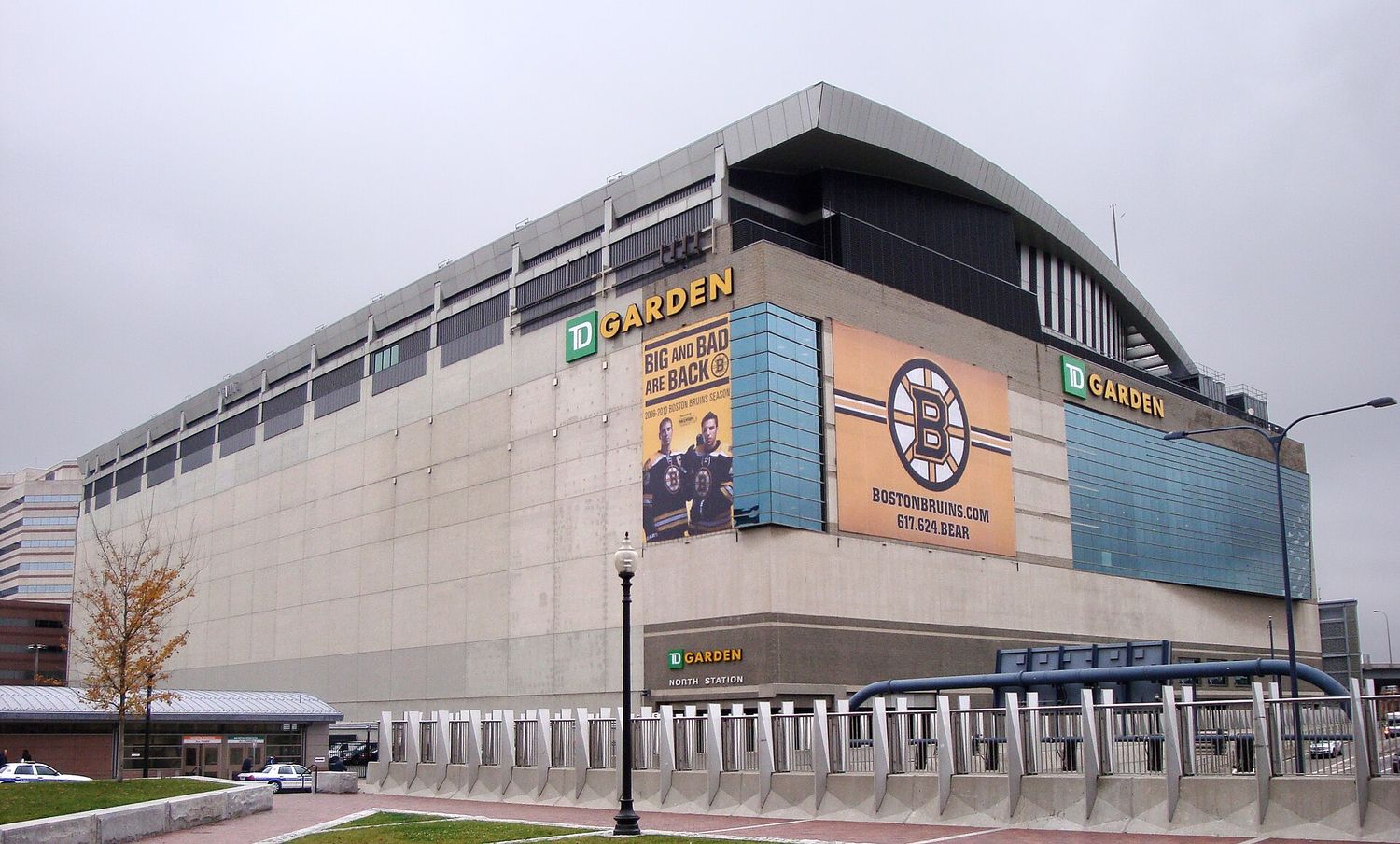
TD Garden is one building doing three jobs: an NBA arena, an NHL arena, and the roof of a railway station. North Station is underneath it, served by the Green and Orange Lines and by commuter rail out to the north shore. You come up the escalator and you are at the door. Nothing else in American professional sport is quite this convenient.
The Celtics have won more NBA championships than any other franchise and the banners hanging from the roof are the point of the building. The Bruins are one of the NHL’s Original Six. Between them the Garden has something on most nights from October to April, and the two seasons overlap almost exactly, so a week-long visit in winter will almost certainly have a game available.
The Sports Museum — $30 adult, $20 child
The Sports Museum occupies levels 5 and 6 of the Garden and is toured rather than wandered: guided tours of about sixty minutes, capped at 25 people, departing every half hour with the first at 11am and the last at 5pm, and the museum open daily from 10:30am to 5pm. Adults pay $30, seniors over 65 pay $25, children aged 2 to 12 pay $20, and military with ID pay $15. TD Bank customers get in free with their card, subject to availability, which is an unusually generous piece of sponsorship and worth knowing if it applies to you.
You check in at the Sports Museum and Heritage Hall desk outside the Pro Shop in North Station, not at the arena’s main doors. Arrive ten minutes early. Book in advance, because tour schedules bend around whatever the arena is doing that day and a big event can shut them down entirely.
The honest verdict: this is a good museum for people who care about Boston sport specifically, and a fairly thin one for anyone who does not. If you have no attachment to the Celtics or the Bruins, $30 buys a nicer hour at the Museum of Science. If you grew up watching either team, it is the best hour in the city.
Getting a ticket
Celtics tickets are the hardest to get cheaply of any Boston team; the arena is small, the demand is constant, and the resale floor for a decent seat sits high all season. Bruins tickets are somewhat easier. For both, midweek games against non-marquee opponents in November and December are the value window, and the upper bowl at TD Garden has a genuinely good sightline — it is a steep arena, which works in a spectator’s favour.
Gillette Stadium: what you can and cannot do in 2026
This is where we have to correct something most guides still say. Gillette Stadium no longer runs public tours. As of 2026, stadium tours are available only as an add-on to a private event booking — there is no public tour product, no daily schedule and no ticket you can buy online. If you have read elsewhere that you can tour the Patriots’ home, that information is out of date.
What you can do, on a non-game day, is visit Patriot Place, the retail and entertainment development wrapped around the stadium. It holds the Patriots Hall of Fame, the Tom Brady statue outside it, and The Lighthouse — an observation deck built into the stadium’s north end during the 2023 renovation, which costs $5 for adults and is free for children aged 10 and under, as well as for active military, veterans, first responders and season ticket members. At $5 that is one of the better-value views in Massachusetts, though it is a view of Foxborough rather than of Boston.
Admission to the Patriots Hall of Fame changes and was not verifiable at the time of writing, so check the current price on the venue’s own site before you travel rather than taking a number from a third party. The stadium switchboard is 508-543-8200.
Getting to Foxborough
Gillette Stadium is about twenty-two miles southwest of downtown Boston, and the transport situation is entirely different on game days and non-game days. On Patriots and Revolution match days the MBTA runs special event trains from South Station directly to Foxboro station, which sits at the stadium; these are the sane way to attend and they are announced fixture by fixture rather than running to a standing timetable. Check mbta.com for the specific game.
On a non-game day there is no useful public transport to Patriot Place, and you will need a car. Factor in that a $5 observation deck becomes a $60 day once you have hired a vehicle for it. Unless you are already driving through, this is a trip for committed fans only.
Gillette also hosted matches during the 2026 World Cup, which has now passed. If you are reading old coverage of Boston as a tournament city, note that the fan-zone infrastructure and temporary services described in it were temporary and have gone.
The Boston Marathon
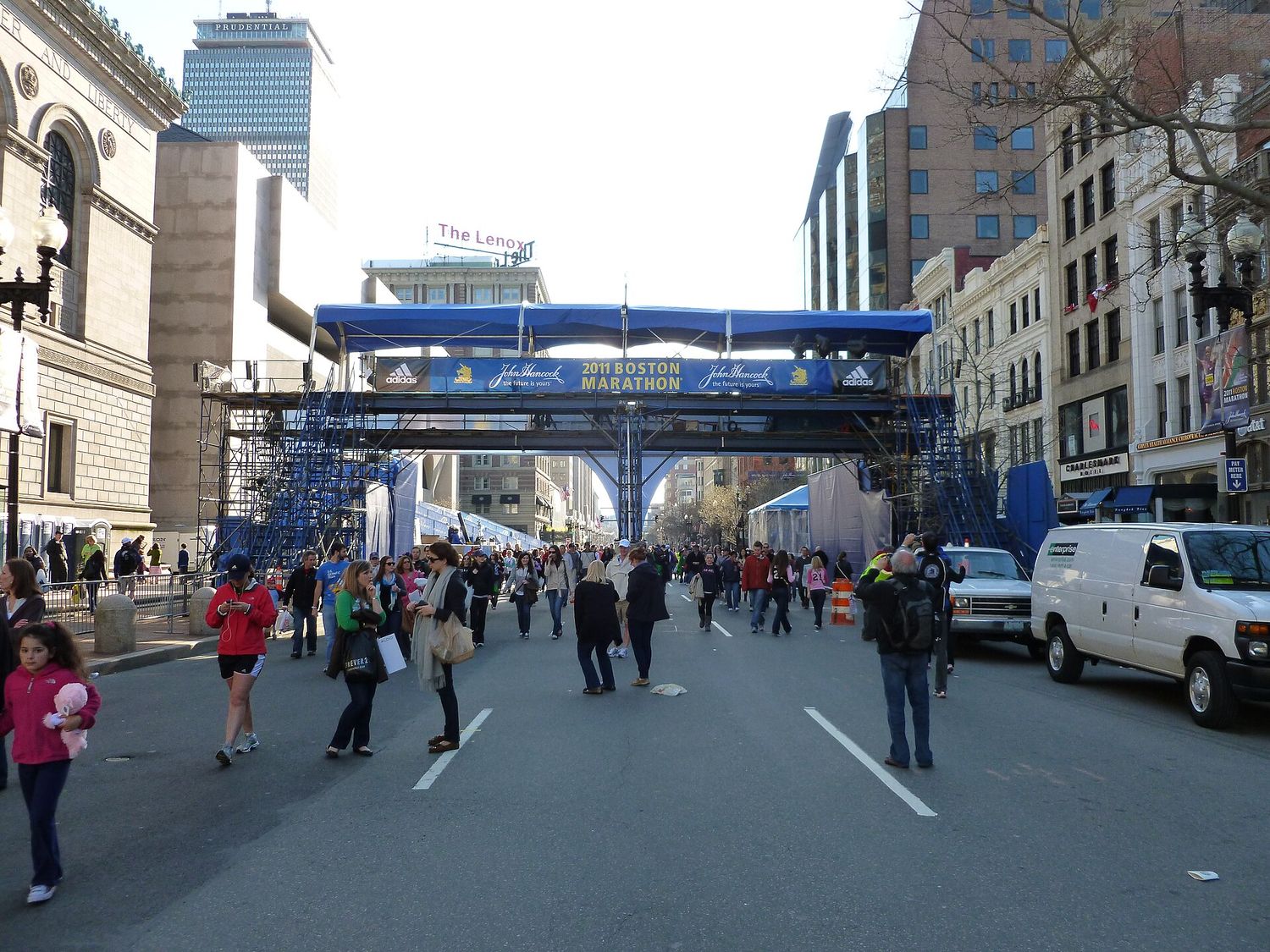
The Boston Marathon is run on Patriots’ Day, the third Monday in April — 19 April 2027 is the next one. It is the oldest annual marathon in the world, it runs point-to-point from Hopkinton to Boylston Street, and on the day it effectively shuts down a corridor across the western suburbs and half of Back Bay.
As a spectator you have choices. The finish line on Boylston Street is the most crowded and hardest to see anything from unless you arrive very early. Heartbreak Hill in Newton, around mile 20, is where the race is decided and where the crowd is loudest; the Green Line D branch runs alongside much of that stretch, though it will be packed. The Wellesley College scream tunnel around the halfway point is the famous one and is a long way out.
Also on Patriots’ Day: the Red Sox play a home game with an 11am first pitch, which is unique in baseball, and the crowd spills out of Fenway onto Kenmore Square just as the leading runners come through. If you are in Boston on that Monday you are not going to get much else done, and you should not try.
The finish line itself is painted permanently across Boylston Street outside the Boston Public Library and is worth two minutes on any other day of the year. It is free, and it is a more affecting thing to stand on than you might expect.
Head of the Charles Regatta
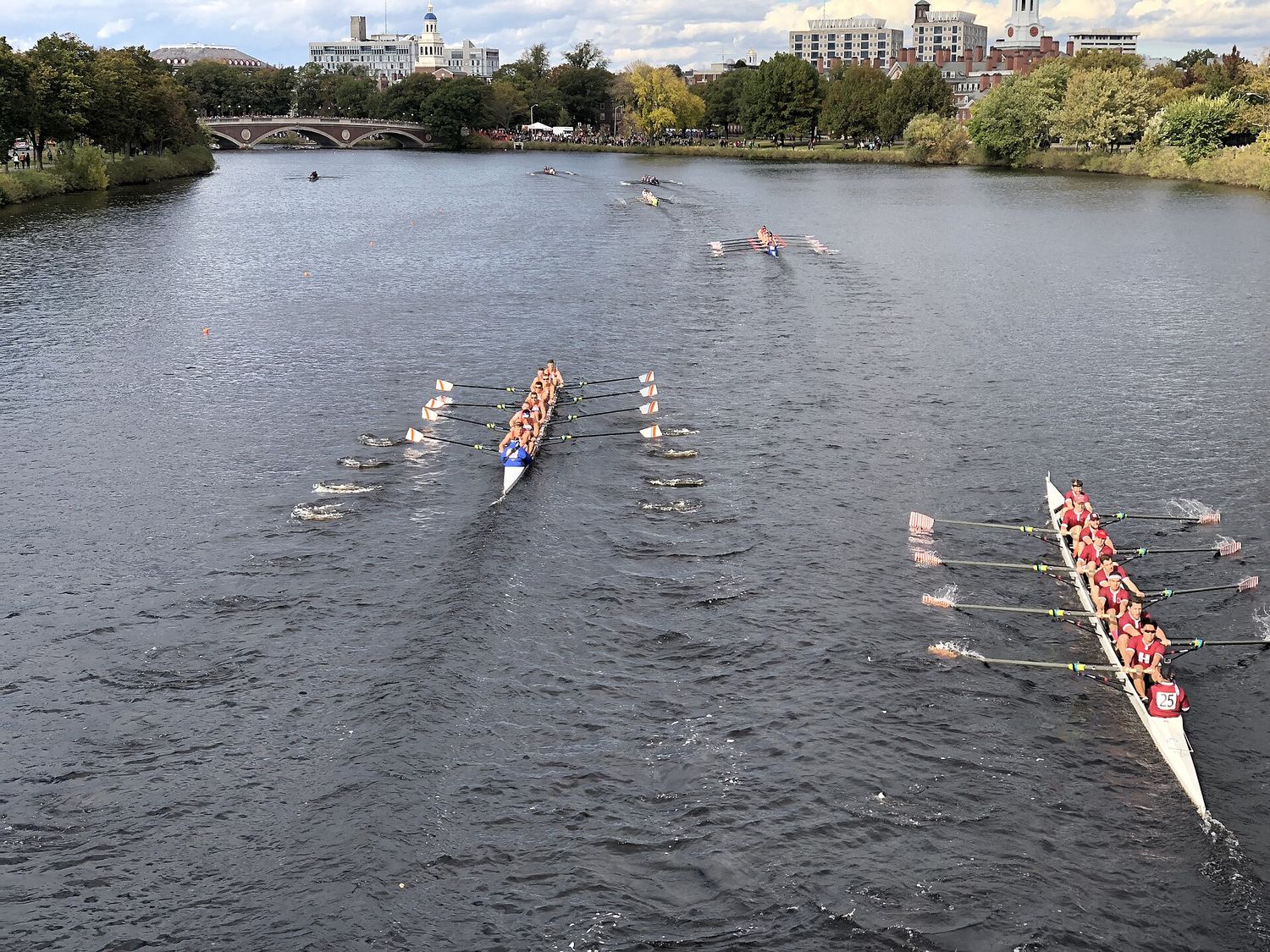
The Head of the Charles runs 16–18 October 2026 and is the largest three-day regatta in the world, with crews from across the United States and abroad racing a three-mile course up the Charles from the Boston University boathouse to Herter Park. It is free to watch, the banks are open, and the atmosphere is closer to a very large picnic than a sporting event.
The best free vantage points are the bridges. The Weeks Footbridge in Cambridge is the classic — crews come around a bend and pass directly beneath you — and Anderson Memorial Bridge next to it is nearly as good. Both are crowded by mid-morning on the Saturday and Sunday. The Cambridge bank between them is the place to spread out a blanket.
The timing is a genuine bonus: mid-to-late October is when Boston’s city foliage peaks, later than in the mountains, so the regatta weekend usually lands in the best week of the year to be outdoors along the river. Confirm the schedule on hocr.org, since the racing order changes each year.
College and amateur sport, which Boston has more of than anywhere
There are more universities in this metropolitan area than in almost any comparable American city, and college sport is genuinely part of the calendar rather than an afterthought.
The Beanpot
An ice hockey tournament held on the first two Mondays of February at TD Garden, between Boston College, Boston University, Harvard and Northeastern. It has run since the 1950s, it is fiercely contested, and tickets cost a fraction of an NHL game in the same building. If you are in Boston in early February and want to understand something about the city, this is more revealing than a Bruins game.
Harvard and BU sport
Harvard’s Lavietes Pavilion and Bright-Landry Hockey Center in Allston, and Boston University’s Agganis Arena on Commonwealth Avenue, all sell inexpensive tickets to a decent standard of play. Harvard Stadium, opened in 1903, is the oldest permanent concrete stadium in the country and is worth looking at even when nothing is on. The Harvard–Yale football game — always just “The Game” — alternates between Cambridge and New Haven in late November.
Boston’s newer clubs
The city’s National Women’s Soccer League club began play in 2026 at a rebuilt White Stadium in Franklin Park, and as a new team in a new home the schedule and ticketing arrangements are still settling. Check the club’s own site rather than a third-party listing if you want to go. Franklin Park is on the Orange Line via Forest Hills, or the Fairmount commuter rail line.
Why Boston takes this quite so seriously
It is worth understanding the temperature before you walk into a bar in Charlestown and offer an opinion. Boston’s relationship with its teams is unusually intense even by American standards, and the reasons are historical rather than temperamental.
The Red Sox went from 1918 to 2004 without winning a World Series, a gap long enough that an entire mythology grew up around it, and the city spent most of the twentieth century as a place where sport was something that happened to you rather than something you won. The Celtics were the exception — the franchise has more NBA championships than any other, most of them clustered in a mid-century run that older Bostonians still measure everything against. The Bruins are one of the NHL’s Original Six, the six clubs that made up the league from 1942 to 1967, and the hockey audience here is knowledgeable in a way that catches visitors from non-hockey countries off guard.
Then between 2001 and 2019 the four teams won a combined dozen championships, which is the most concentrated run of success any American city has had, and it recalibrated everything. The practical consequence for a visitor is that the fan culture assumes a level of knowledge. Nobody will mind you not having it; they will mind you pretending to. Ask a question in a bar and you will get twenty minutes of answer.
The other consequence is geographic. Because the venues are old and embedded in neighborhoods rather than parked in a suburban complex — Fenway is in a residential street grid, the Garden is on top of a railway station — game day changes the character of whole districts in a way it does not in cities with ring-road stadiums. If you are staying near Kenmore on a Saturday in July, you will know about it.
Playing rather than watching
Boston is a good city to be active in, and most of it costs nothing.
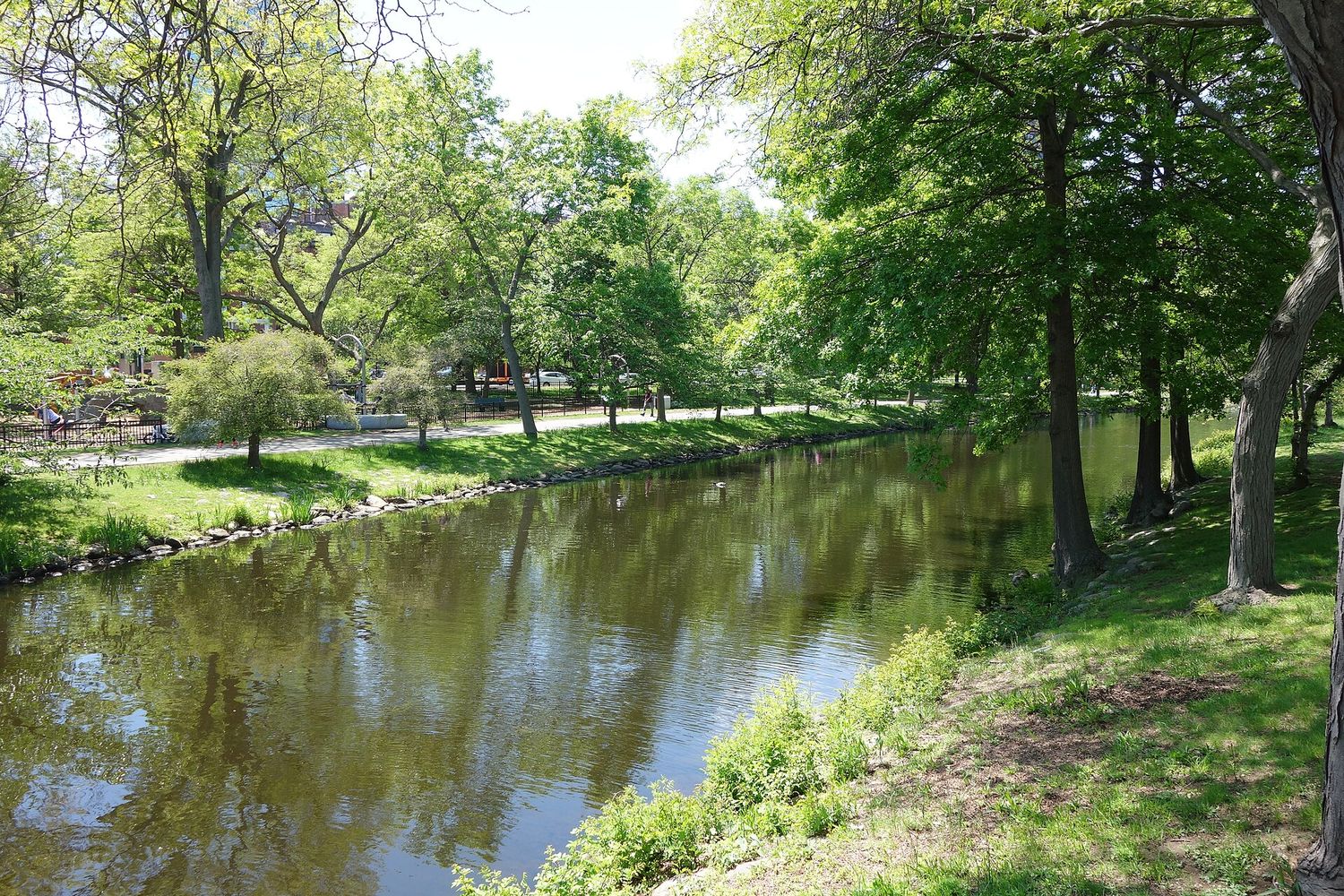
Running is the obvious one. The Charles River paths run for miles on both banks and are the default route for half the city; the Esplanade on the Boston side is flat, paved and lit, and the loop from the Museum of Science to the Boston University Bridge and back is about six miles. The Emerald Necklace — Frederick Law Olmsted’s roughly 1,100 acres and seven miles of connected parkland from Boston Common out to Franklin Park — is the longer option, and Jamaica Pond has a well-used 1.5-mile loop.
Cycling works through Bluebikes, the city’s docked bike-share, with stations across Boston, Cambridge, Somerville and Brookline. Single trips and day passes are both available at the dock. Boston traffic is not gentle and the painted bike lanes are inconsistent, but the river paths and the Southwest Corridor are genuinely pleasant riding.
Skating at the Frog Pond on Boston Common runs from mid-November to March, at $10 for adults and free for children under 58 inches, with skate hire at $15 adult and $10 child. It is a small rink in the middle of a public park and it is one of the better winter hours in the city.
On the water, the Charles has kayak and paddleboard rental in season along the Esplanade and in Cambridge, and community sailing operates out of the Esplanade lagoon in summer. Swimming in the Charles is legal at organized events only and is not something to attempt casually.
The sporting year, month by month
| Month | What is on |
|---|---|
| January | Celtics and Bruins in full swing; Patriots playoffs if the season has gone well; college hockey |
| February | The Beanpot on the first two Mondays at TD Garden. Celtics and Bruins nightly. The snowiest month, so indoor sport is the sport |
| March | Red Sox spring training in Florida; NBA and NHL run-in; college tournaments; Red Sox home opener late in the month or early April |
| April | Boston Marathon on Patriots’ Day, with an 11am Red Sox game the same morning. NBA and NHL playoffs begin. Cheap, cold baseball |
| May–June | Baseball settles in; playoff runs at the Garden; Revolution season under way at Gillette |
| July–August | Red Sox at home constantly, and the most expensive tickets of the year. Hot, crowded, excellent atmosphere |
| September | Baseball run-in with cheaper midweek tickets; Patriots season opens; the best month to combine a tour and a game |
| October | Head of the Charles, 16–18 October 2026, free. Red Sox playoffs if applicable. Celtics and Bruins seasons start. Peak foliage |
| November | Value window for Bruins and Celtics tickets; Harvard–Yale late in the month; Patriots at home |
| December | Garden every other night; cheapest hockey of the season midweek; Patriots run-in |
What it costs
The figures below are the September 2026 gate or list prices for one adult. Game tickets are dynamically priced and given as realistic ranges rather than fixed numbers.
| Experience | Adult price | What you get | Worth it? |
|---|---|---|---|
| Fenway Park tour | $30 ($21 child 3–12) | One hour, warning track, Green Monster seats | Yes — the best-value sports experience in the city |
| The Sports Museum, TD Garden | $30 ($25 senior, $20 child 2–12, $15 military) | One-hour guided tour of levels 5 and 6 | Only if you care about the Celtics or Bruins specifically |
| The Lighthouse, Gillette Stadium | $5 (free under 10) | Observation deck over the stadium and Foxborough | Good value, bad location — only if you are already there |
| Gillette Stadium tour | Not available to the public in 2026 | — | Do not plan around it |
| Red Sox ticket | Roughly $25 upwards midweek; far more for marquee games | Three hours plus | Yes, if you pick a midweek game in April, May or September |
| Celtics ticket | High all season; upper bowl is the value option | Around two and a half hours | Only with a real interest — the price floor is unforgiving |
| Bruins ticket | Easier than the Celtics, midweek best | Around two and a half hours | Yes — hockey in a full arena is a good night out even for novices |
| Beanpot session | Well under NHL prices | Two college games in one evening at TD Garden | Yes — the local’s answer |
| Head of the Charles | Free | Three days of racing, free riverbanks | Yes — and the foliage is at its peak |
| Boston Marathon | Free to watch | A city-wide public holiday | Yes, if you are here on the day; do not travel for it alone |
What is not worth it
Three honest warnings, because this is a category with more marketing than most.
Third-party “VIP stadium experiences” sold through tour aggregators are almost always the standard Fenway tour with a transfer and a markup. The tour costs $30 at the gate. If a package costs $95 and includes “hotel pickup”, you are paying $65 for a bus you did not need in a city where the Green Line goes to the same door.
Sports bars marketed to tourists around Fenway and North Station charge a premium on game nights for a television you could watch anywhere. If you cannot get into a game, the neighborhood bars in Southie, Charlestown or Somerville will show it, cost less, and have a better crowd.
Planning a trip around a Patriots game from a Boston base is harder than it sounds. Eight home games a season, most on a Sunday, twenty-two miles out, with dedicated trains that run only on match days. It is a great day if the fixture happens to fall in your window. It is a bad reason to choose your dates.
How to build a sporting day in Boston
A day with no tickets at all
Fenway Park tour at 10am — Green Line to Kenmore, ten minutes’ walk. Lunch in the Fenway neighborhood rather than on Lansdowne Street. Green Line back to Government Center and walk to North Station for the 2pm Sports Museum tour. Finish on Boylston Street at the Marathon finish line, which is a five-minute walk from Copley and costs nothing. That is $60 of admissions, two of the city’s three sporting landmarks, and no game ticket required.
A winter evening with a Garden ticket
Bruins or Celtics tickets for a midweek game, and eat in the North End first — it is a fifteen-minute walk from Hanover Street to the Garden doors, which is the single best pre-game dinner arrangement in American sport. Note that the T is not a 24-hour system: last trains leave downtown roughly between 12.30 and 1am, which is fine for a 7pm puck drop and tighter than you would like if the game goes to overtime.
An October weekend
The Head of the Charles on the Saturday from the Weeks Footbridge, walking the Cambridge bank between bridges. Harvard Yard and the free Harvard Art Museums in the afternoon, ten minutes away. A Red Sox playoff game in the evening if the year has gone well, and the foliage along the river either way. Our best time to visit Boston guide has more on what October does.
Getting to every venue on the T
A subway single is $2.40 and a local bus is $1.70, with a $11 day pass and a $22.50 seven-day pass. From 1 September 2026 the MBTA is piloting unlimited transfers within a two-hour window on the same payment method, so a bus-then-subway trip to a venue now costs the higher of the two fares rather than both.
- Fenway Park — Kenmore on the Green Line B, C and D branches, or Fenway on the D. Both are a short walk. Expect crush loading on the Green Line for an hour before and after a game.
- TD Garden — North Station, on the Green and Orange Lines. The arena is directly above the station concourse.
- Gillette Stadium — special event trains from South Station to Foxboro on match days only. No useful service otherwise.
- Harvard Stadium and Harvard’s arenas — Harvard on the Red Line, then a walk across the river into Allston.
- Agganis Arena, Boston University — Green Line B branch along Commonwealth Avenue.
- White Stadium, Franklin Park — Orange Line to Forest Hills then a bus, or Fairmount line commuter rail.
Driving to any of the city venues is a poor idea. Fenway has almost no parking and what exists is priced accordingly on game nights; the Garden’s garage fills early. Our getting around Boston guide covers fares, passes and step-free access in full.
Frequently asked questions
Can you tour Fenway Park without going to a game?
Yes, and it is the main way most visitors see it. Tours run hourly from Gate D on Jersey Street year-round — 9am to 5pm April to October, 10am to 5pm November to March — at $30 for adults and $21 for children aged 3 to 12. On game days the last tour departs three hours before first pitch. Book ahead in summer.
Can you tour Gillette Stadium?
Not as a member of the public in 2026. Stadium tours are offered only as an add-on to private event bookings, and there is no public ticket. You can visit Patriot Place, the Patriots Hall of Fame and The Lighthouse observation deck at $5, but there is no walk-up stadium tour, whatever older guides say.
What is the cheapest way to see a professional game in Boston?
A midweek Red Sox game in April, May or September, in the bleachers or standing room. A close second is a Bruins game against a non-marquee opponent in November or December, upper bowl. The genuine cheapest live sport in the city, though, is college hockey — the Beanpot in February, or any BU or BC home game.
How do you get to a Patriots game from Boston?
Take the MBTA special event train from South Station to Foxboro, which runs for Patriots and Revolution matches only and is announced fixture by fixture. Driving means twenty-two miles each way plus stadium parking and a long exit queue. Check mbta.com for your specific date.
When is the Boston Marathon?
Patriots’ Day, the third Monday in April. The next running is 19 April 2027. The route ends on Boylston Street; Heartbreak Hill in Newton around mile 20 is the best spectating, and the Red Sox play an 11am home game the same morning.
Is the Sports Museum worth $30?
If you have a real attachment to the Celtics or the Bruins, yes — it is an hour of well-told history inside the building itself, with access to levels you cannot otherwise reach. If you do not follow either team, it is a fairly narrow museum for the money and the Fenway tour is the better $30.
When is the Head of the Charles Regatta in 2026?
16 to 18 October 2026. It is free to watch from both banks of the river; the Weeks Footbridge and Anderson Memorial Bridge in Cambridge are the best free vantage points, and they fill up by mid-morning at weekends.
Do the Celtics and Bruins ever play on the same day?
They share TD Garden and their seasons run almost in parallel from October to April, so the arena hosts one or the other most nights, occasionally with a matinee and an evening game on the same date. It also means the ice or the floor is swapped out overnight, which is a piece of arena logistics the Sports Museum tour covers well.
Is it worth visiting Boston specifically for sport?
For the Marathon or the Head of the Charles, arguably yes — both are genuine occasions and both are free. For a single game, no: dynamic pricing means you may pay a lot for a fixture that turns out to be ordinary. The better plan is to visit Boston for Boston and pick up whatever is on while you are here, which given five teams and an overlapping calendar is usually something.