Stand in the cobbled plaza between Faneuil Hall and Quincy Market on a summer afternoon and you will see Boston at its most touristy: a juggler on a unicycle, a crowd around him, lines at the chowder counters, and shopping bags from stores you could find at home. It is easy to be cynical about Faneuil Hall Marketplace. But the cynics miss the best part. Upstairs in the red-brick hall that gives the place its name is one of the most important rooms in American history, free to enter, with a park ranger ready to tell you why — and the granite market hall across the plaza turns 200 this year.
This guide separates what is worth your time at Faneuil Hall Marketplace from what is not: the history and the free ranger talks, the four buildings and what is in them, an honest guide to eating here and nearby, the street performers, the shops, when to go and how to fit it into a day. Hours and schedules were checked with the marketplace and the National Park Service in September 2026; check before you go, since holiday and restaurant hours vary.
Faneuil Hall Marketplace at a glance
| Detail | What to know |
|---|---|
| What it is | Four historic buildings — Faneuil Hall, Quincy Market, North Market and South Market — around cobbled plazas in downtown Boston |
| Cost | Free to walk around; Faneuil Hall’s Great Hall and the ranger talks are free |
| Marketplace hours | Monday–Saturday 10am–9pm; Sunday 11am–7pm (restaurants and holidays vary) |
| Ranger talks | Wednesday–Sunday, every hour from 10:30am to 3:30pm, about 15 minutes, in the Great Hall |
| What’s inside | More than 25 eateries in Quincy Market and more than 40 shops |
| Street performers | Daily, 11am–9pm |
| Freedom Trail | Faneuil Hall is stop 11 of 16 |
| Nearest T | Government Center (Green, Blue), Haymarket (Orange, Green), State (Orange, Blue), Aquarium (Blue) |
What’s actually here
“Faneuil Hall” gets used loosely to mean the whole area, but the marketplace is really four buildings.
Faneuil Hall
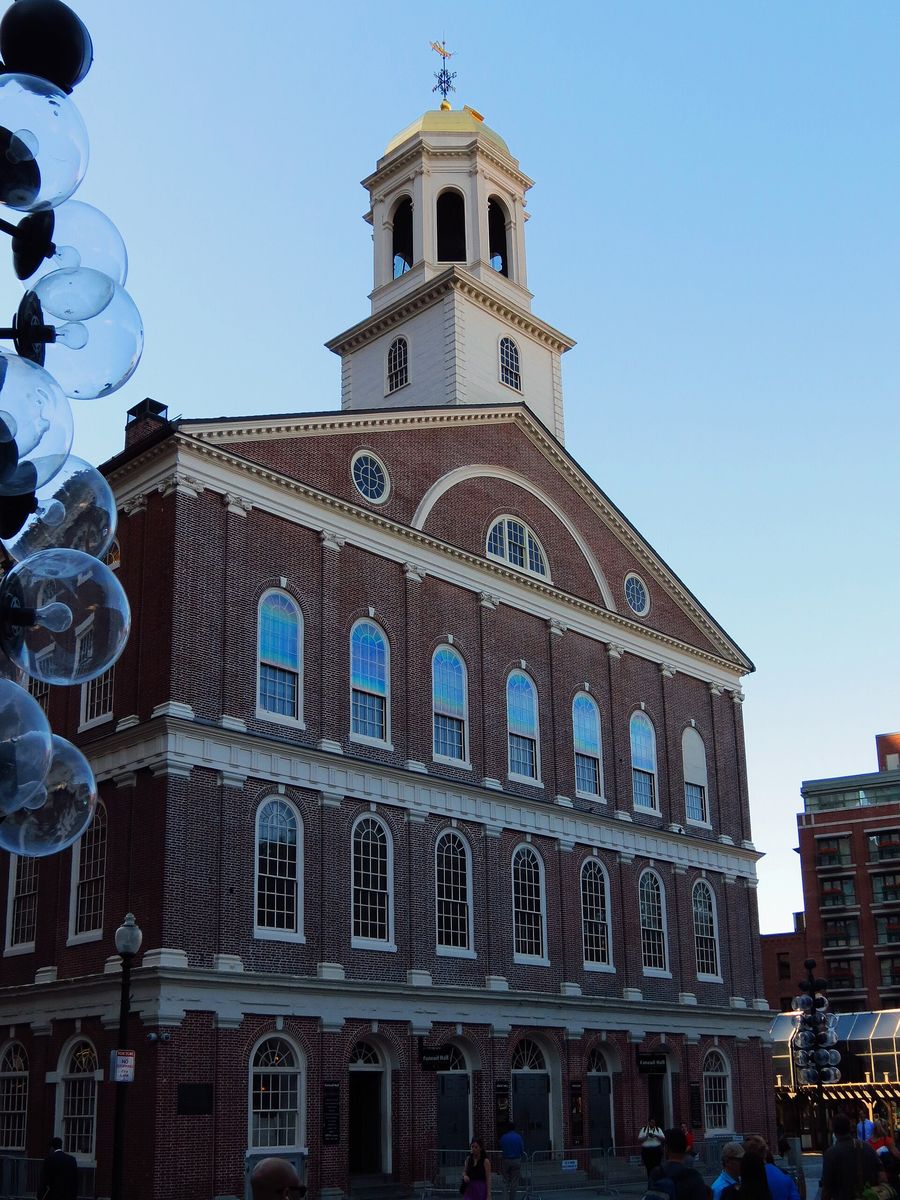
The red-brick hall with the gilded grasshopper on its cupola, facing Congress Street. Its ground floor is still a market, as it was in the 1740s, with shops and stalls; the first floor has the National Park Service visitor center; the second floor is the Great Hall, where Bostonians have been meeting and arguing for nearly three centuries; and the top floor holds the museum and armory of the Ancient and Honorable Artillery Company.
Quincy Market
The long granite building with Greek columns at each end, running east from Faneuil Hall. Built in 1826, it holds a central food hall — the Colonnade, with more than 25 counters selling chowder, lobster rolls, pizza, sandwiches, desserts and much else — and restaurants and bars at each end and along its sides.
North Market and South Market
The two long brick-and-granite buildings that flank Quincy Market on either side, built at the same time. They hold shops, restaurants and offices. Between them and Quincy Market run the pedestrian streets where the pushcarts and the street performers are.
The plazas
The open cobbled spaces around the buildings — Dock Square in front of Faneuil Hall, with the statue of Samuel Adams, and the wider plazas at the east end of Quincy Market toward the harbor — are where most of the life of the place happens, especially in summer.
Faneuil Hall: the part worth your time
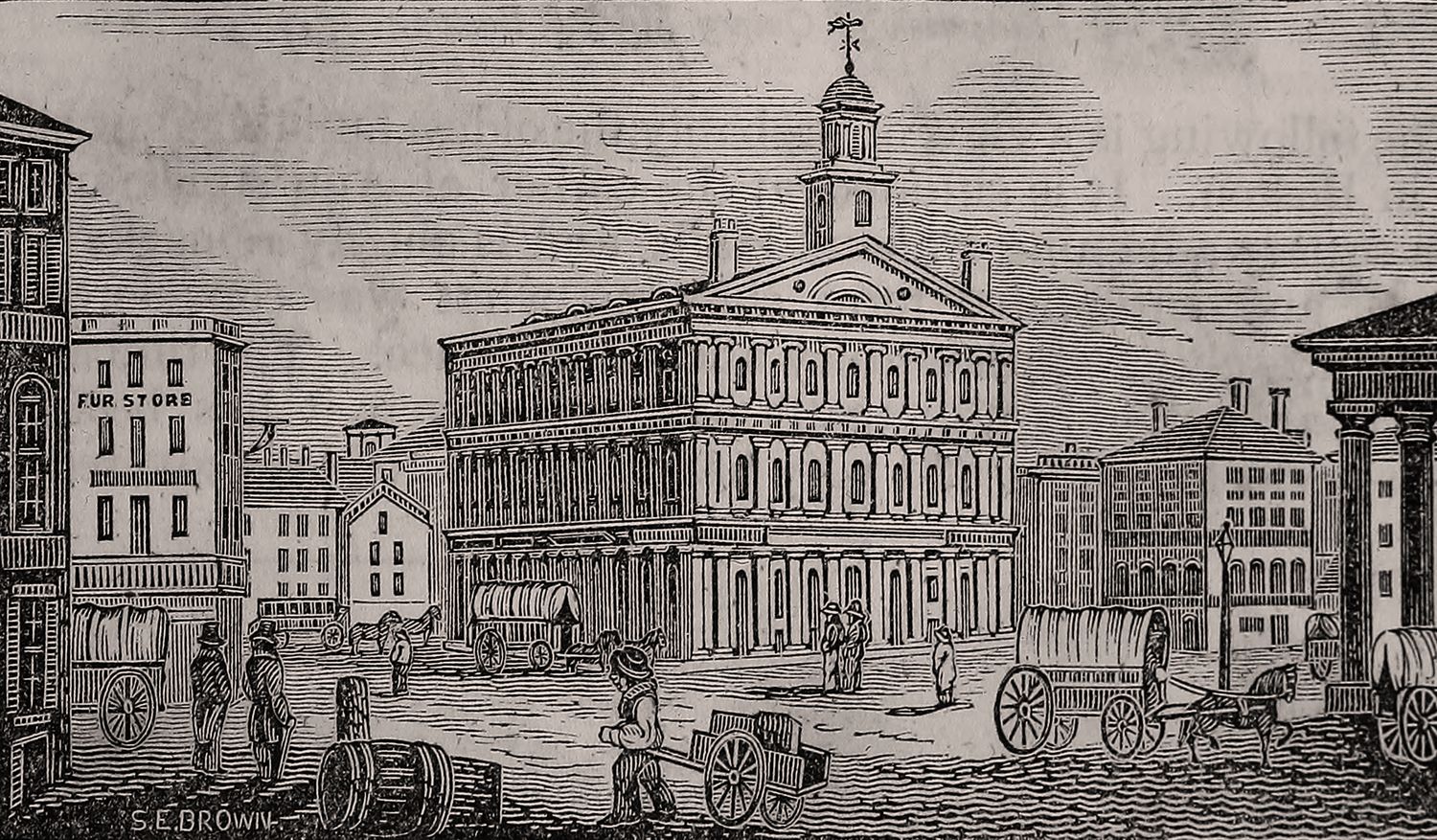
A short history of the Cradle of Liberty
Faneuil Hall was built in 1742 as a market house and meeting hall, paid for by the wealthy merchant Peter Faneuil and given to the town. It burned in 1761 and was rebuilt the following year, and in 1805–06 the architect Charles Bulfinch doubled its width and added a third story, giving it essentially the shape it has today.
Its nickname, the Cradle of Liberty, comes from the town meetings held in the Great Hall in the years before the Revolution. It was here that Samuel Adams, James Otis and others argued against the Sugar Act and the Stamp Act in the 1760s, and here that the town’s resistance to British taxation was organized. The hall stayed at the center of Boston’s public life long after: abolitionists including Frederick Douglass spoke here, suffragists rallied here, and John F. Kennedy closed his 1960 presidential campaign with an election-eve address from the hall.
There is a harder side to the story, too. Peter Faneuil’s fortune came in part from trade connected to slavery, and he himself owned enslaved people. In recent years activists have campaigned for the building to be renamed, and the question of how to remember him is still debated. The rangers in the Great Hall will talk about it if you ask.
The Great Hall and the free ranger talks
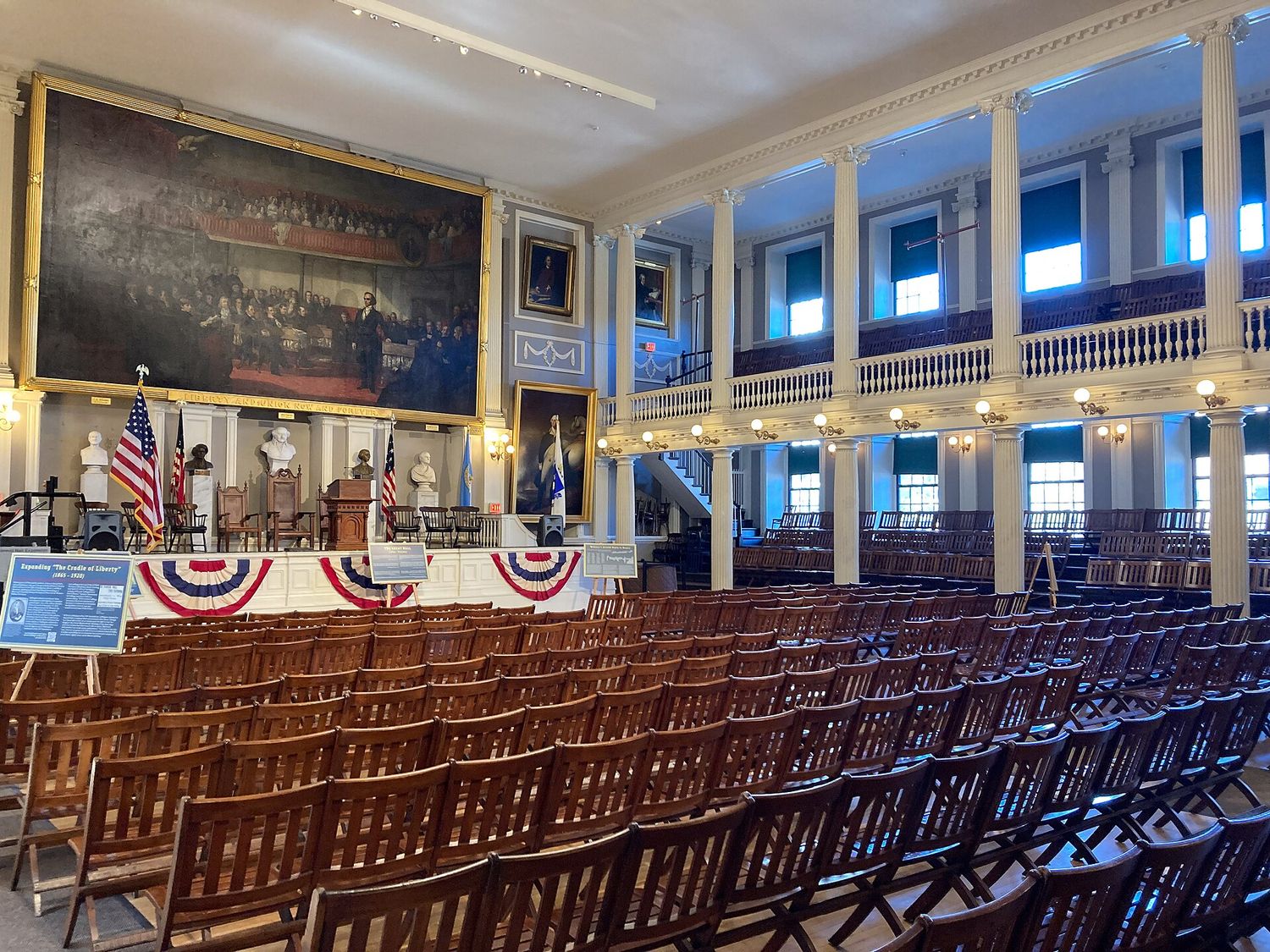
Climb the stairs to the second floor and you are in the Great Hall, a bright room with galleries on three sides, rows of chairs, portraits of American statesmen on the walls, and behind the stage an enormous painting by George P. A. Healy of Daniel Webster addressing the Senate. It still hosts citizenship ceremonies, debates and public meetings.
National Park Service rangers give free Faneuil Hall Talks in the Great Hall, lasting about fifteen minutes, about the history of the building and the people who have spoken in it. No registration is needed. They are the best fifteen minutes you will spend in the marketplace, and far better than anything the Freedom Trail’s paid tours say about the building in passing.
| Ranger talks | When |
|---|---|
| Days | Wednesday to Sunday |
| Times | 10:30am, 11:30am, 12:30pm, 1:30pm, 2:30pm, 3:30pm |
| Length | About 15 minutes |
| Cost | Free, no registration |
The visitor center
On the first floor, the National Park Service visitor center has maps, advice and restrooms. It is typically open Tuesday to Sunday from Memorial Day to the end of September and Wednesday to Sunday for the rest of the year, and it is closed on Thanksgiving, Christmas and New Year’s Day. Call 617-429-6760 or check nps.gov/bost for the current schedule. If you are walking the Freedom Trail, this is a good place to pick up information for the North End and Charlestown stretches ahead.
The Ancient and Honorable Artillery Company museum
On the top floor is the armory and museum of the Ancient and Honorable Artillery Company, chartered in 1638 and the oldest chartered military organization in the Western Hemisphere. Its collection of weapons, uniforms, flags and artifacts runs from the colonial era to the present. It is free, with donations welcome, open Wednesday to Friday, 9am to 3pm, and reachable by an elevator from the ground floor. Few visitors know it is there. See ahac.us.com.
The grasshopper
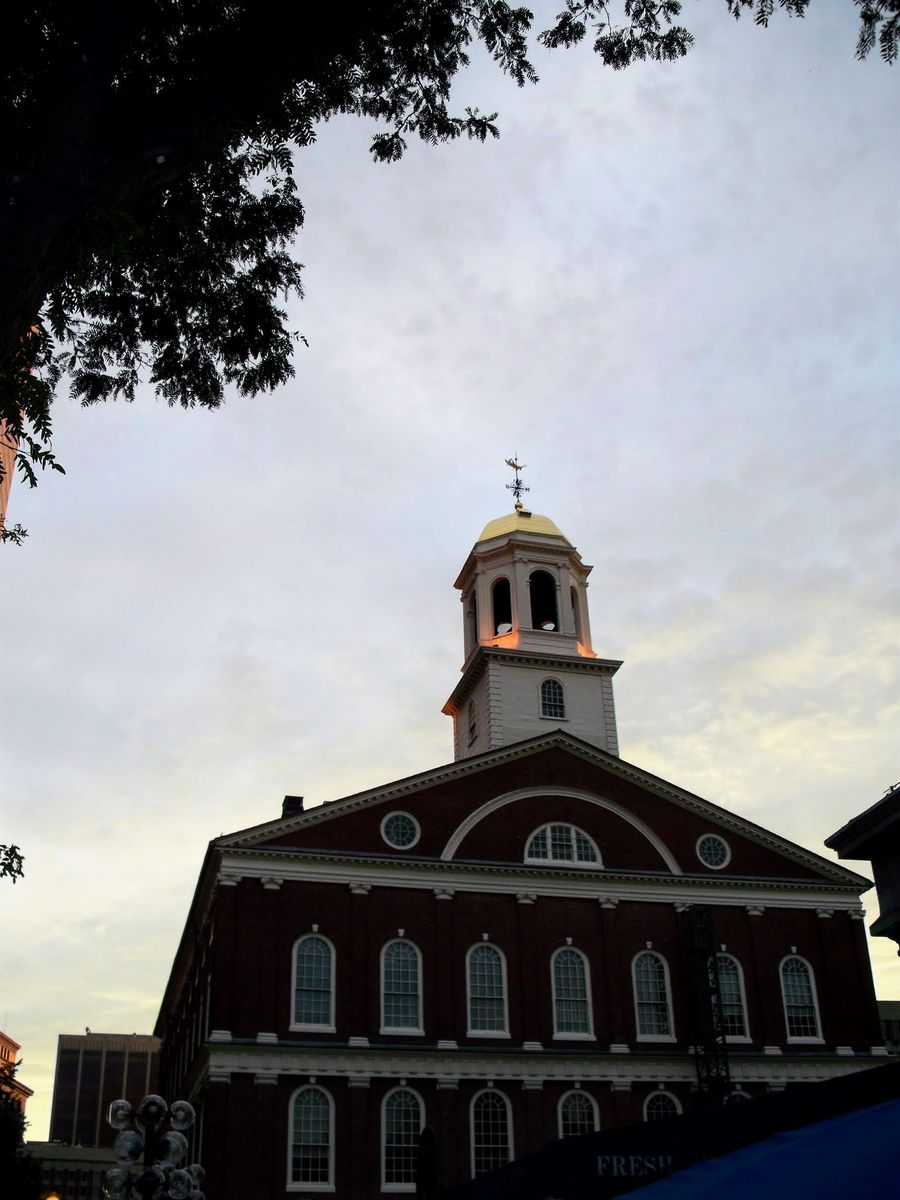
Look up at the cupola. The weathervane is a gilded copper grasshopper made in 1742 by Shem Drowne, a local craftsman, and it has been on top of the building ever since. It is one of the oldest weathervanes in the country. According to local legend, during the War of 1812 people suspected of being British spies were asked what was on top of Faneuil Hall; anyone who did not know the answer was not a real Bostonian. In 1974 the grasshopper was stolen, and it turned up a few days later hidden in the cupola itself.
Samuel Adams
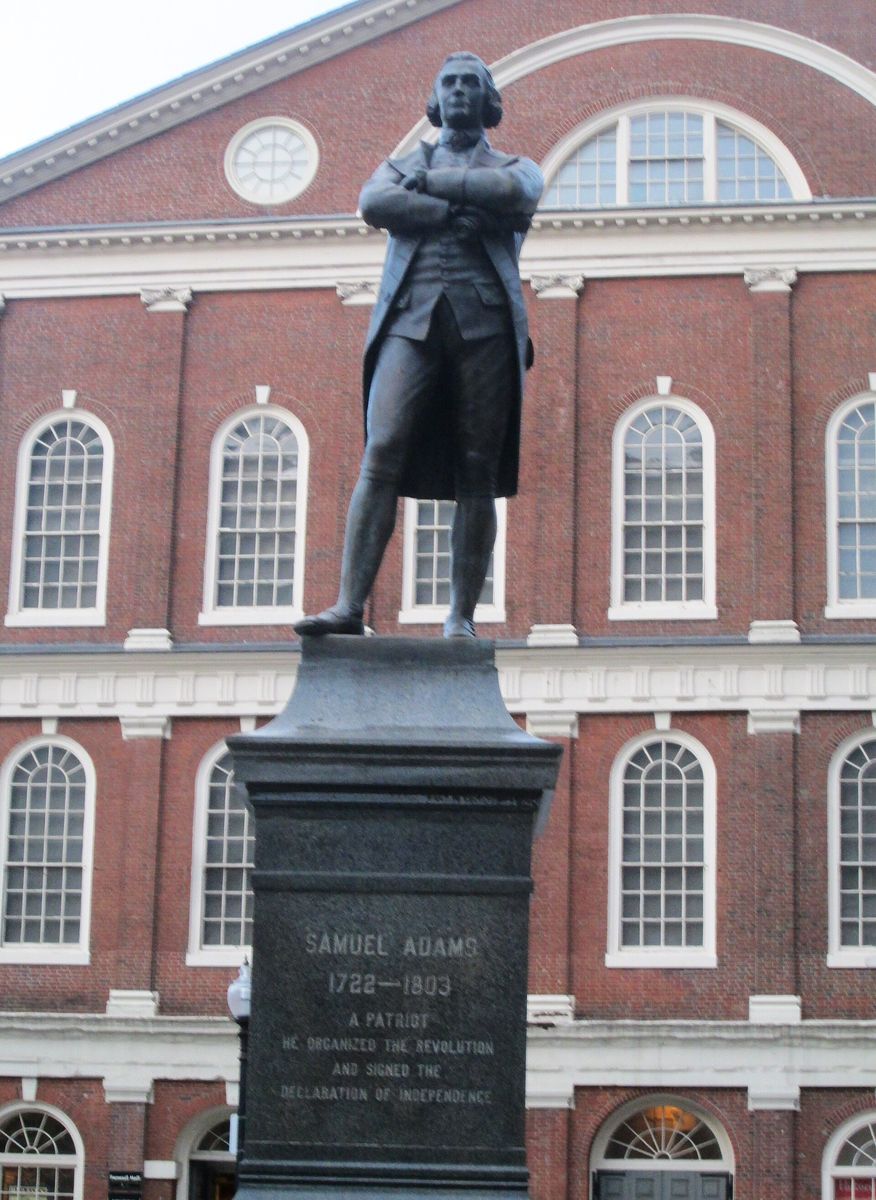
In Dock Square, in front of Faneuil Hall, stands a bronze of Samuel Adams, arms folded, by the sculptor Anne Whitney. The inscription on the pedestal is blunt: he organized the Revolution and signed the Declaration of Independence. It is the classic photograph of Faneuil Hall, and it is worth taking a moment to think about what happened in the building behind him.
Nearly three centuries in the Great Hall
The reason to go upstairs is what has happened in that room. A short timeline:
| Year | What happened |
|---|---|
| 1742 | Faneuil Hall opens as a market and meeting hall, a gift to the town from Peter Faneuil |
| 1761–62 | Destroyed by fire and rebuilt by the town |
| 1764 | Town meetings here are among the first to protest Parliament’s Sugar Act |
| 1772 | Samuel Adams and others form Boston’s Committee of Correspondence at a town meeting in the hall |
| 1773 | Meetings over the East India Company’s tea ships grow too big for the hall and move to Old South Meeting House, days before the Tea Party |
| 1805–06 | Charles Bulfinch doubles the building’s width and adds a third story |
| 1837 | The young Wendell Phillips makes his name as an abolitionist with a speech here after the murder of the antislavery editor Elijah Lovejoy |
| 1854 | A mass meeting protests the arrest of Anthony Burns, a man who had escaped slavery, under the Fugitive Slave Act |
| 1960 | John F. Kennedy’s election-eve address closes his presidential campaign |
| Today | The hall still hosts public forums, debates and ceremonies at which new Americans take the oath of citizenship |
That last line is worth dwelling on. The building is not a museum preserved behind ropes. It is a working civic hall, and when you sit in its chairs you are sitting where Bostonians have argued about liberty, slavery, war and the vote for nearly three hundred years.
Quincy Market at 200
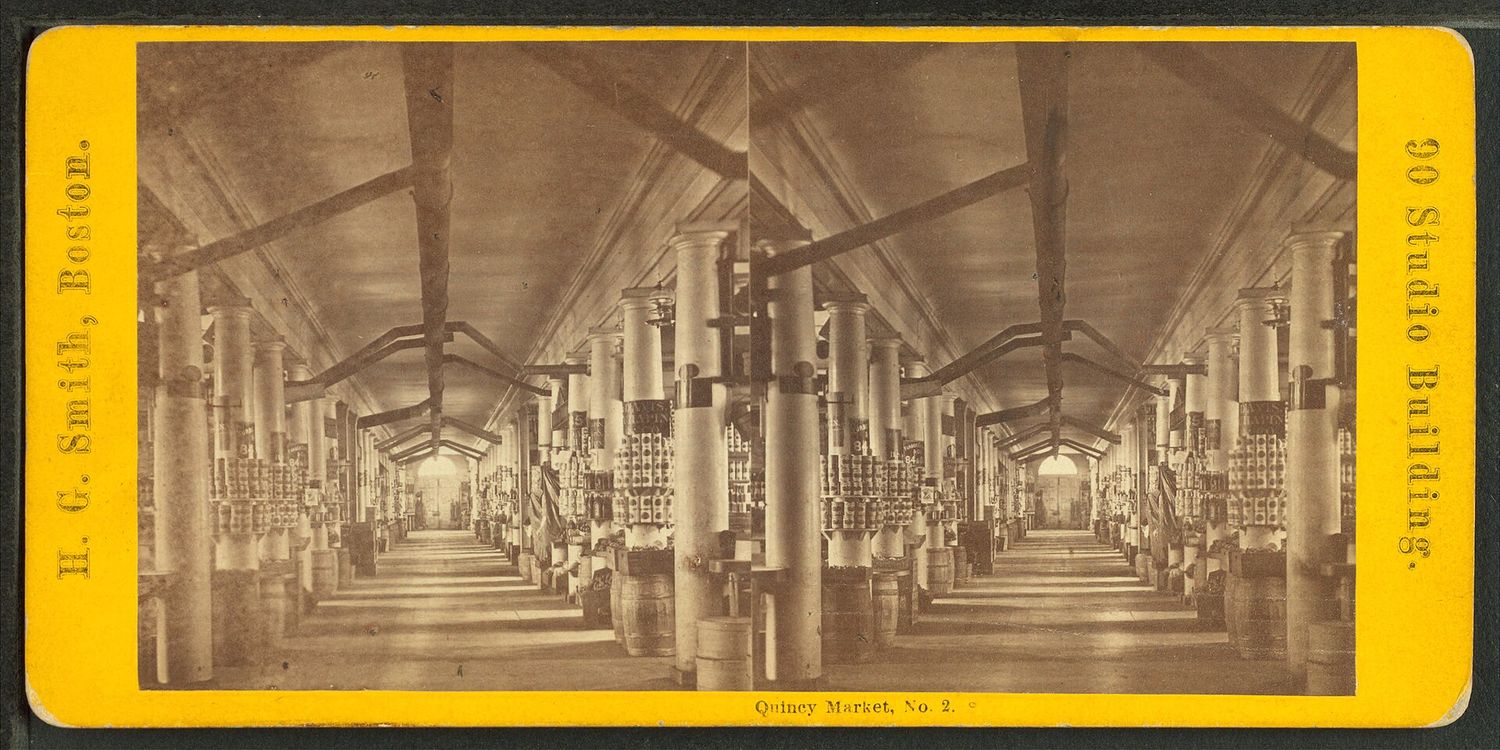
By the 1820s Faneuil Hall was too small for the city’s food trade, and Mayor Josiah Quincy pushed through a plan to build a new market behind it on land filled in from the harbor, which in those days came up almost to the back of the hall. The granite Greek Revival building designed by Alexander Parris opened in 1826, with the North and South Markets on either side, and for the next century and a half it was Boston’s wholesale food market.
By the 1960s the buildings were run down and half empty. Instead of demolishing them, the city restored them, and in 1976 the developer James Rouse and the architect Benjamin Thompson reopened the complex as a “festival marketplace” of shops, food stalls and restaurants. It was a huge success, and the model was copied across America — in Baltimore, New York and many other cities. For better and for worse, the Faneuil Hall Marketplace you see today is the prototype.
In 2026 Quincy Market marks its 200th birthday, and the marketplace has been celebrating with an “1826 Special” — offerings priced at $18.26 from selected vendors. Check the marketplace website for which counters are taking part.
Eating at Faneuil Hall Marketplace: an honest guide
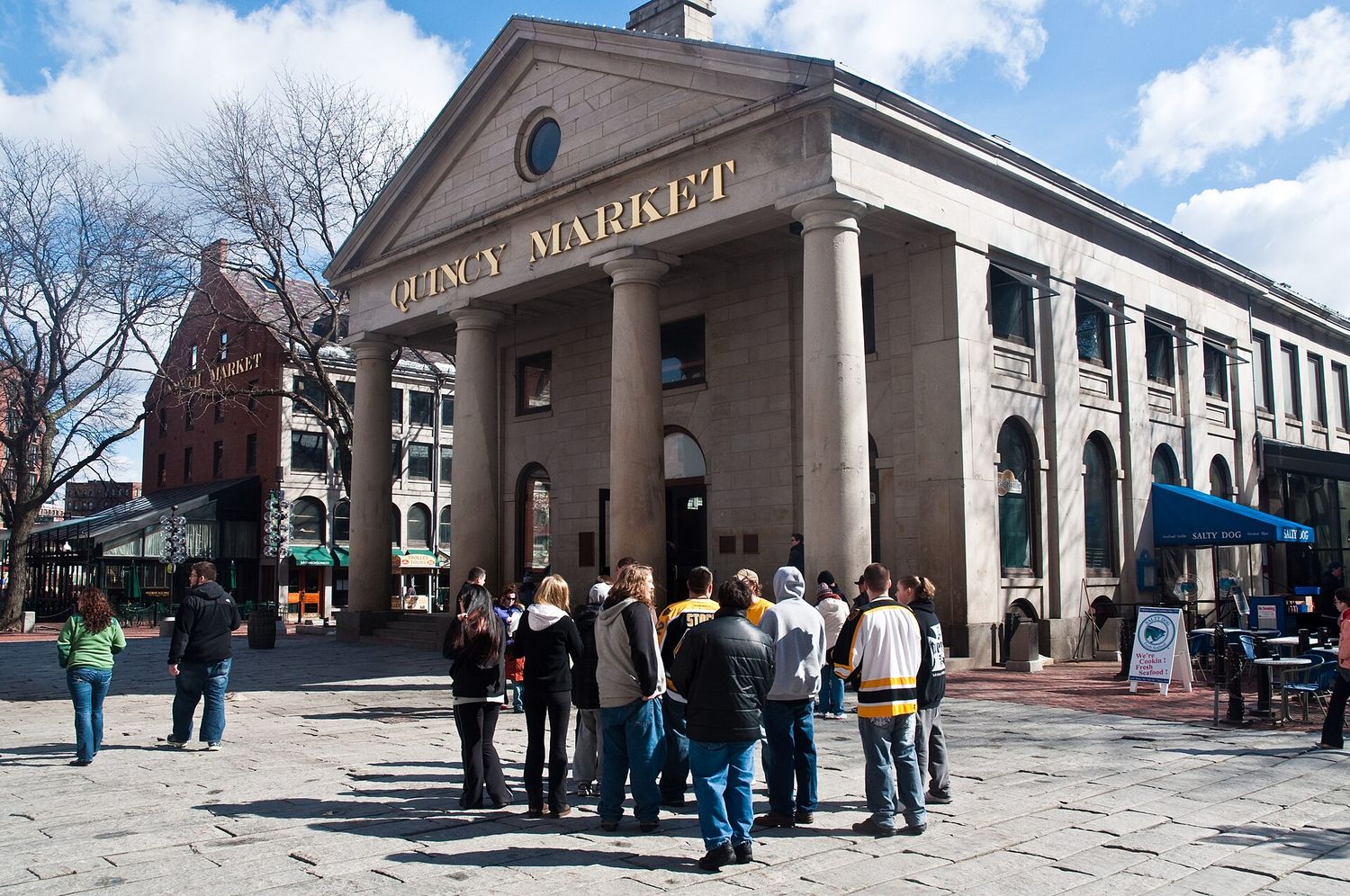
Here is the plain truth: the food hall in Quincy Market is a food court, in a very beautiful building. You can get a perfectly acceptable cup of clam chowder in a bread bowl, a lobster roll, a slice of pizza or a cannoli, and you will pay tourist prices and eat standing up or at crowded tables. If you are hungry and on the Freedom Trail with children, it does the job. If you want a good Boston meal, you can do much better within ten minutes’ walk.
A few things are genuinely worth knowing about:
- Tree House Brewing Company, one of the most admired breweries in New England, has recently opened at Quincy Market with food and outdoor seating. For beer lovers, it is the best reason to linger.
- Chowder is the thing to eat here if you eat anything. Compare a couple of counters before you commit.
- Durgin-Park, the famous old restaurant in the North Market with its long communal tables and rude waitresses, closed in 2019. Older guidebooks still mention it; it is gone.
Where to eat instead, within ten minutes
| Where | Walk | Why |
|---|---|---|
| Union Oyster House, Blackstone Block | 2 minutes | America’s oldest continuously operating restaurant; come for the history and the raw bar |
| Haymarket | 3 minutes | Open-air produce market on Fridays and Saturdays, the cheapest fruit in the city |
| Boston Public Market | 4 minutes | An indoor market of local New England food producers, by Haymarket station |
| North End | 5–10 minutes | Italian restaurants, Modern Pastry’s filled-to-order cannoli and Neptune Oyster, if you can bear the line |
Our guide to Boston food and restaurants covers the city in full.
Shopping
The marketplace has more than 40 shops and pushcart vendors, a mix of chains, souvenir shops and local sellers of apparel, gifts and accessories. It is convenient for a Red Sox cap or a Boston T-shirt, but little here is unique. For better shopping, walk to Newbury Street in Back Bay or Charles Street on Beacon Hill.
One thing worth knowing wherever you shop in Boston: in Massachusetts, clothing and footwear are exempt from the 6.25% sales tax up to $175 per item, which makes the city unusually good value for clothes. Our guide to shopping in Boston explains the rule and the best streets.
The street performers
The performers are part of the Faneuil Hall experience, and some are genuinely good. Acrobats, jugglers, magicians, break-dancers and musicians perform daily between about 11am and 9pm on the plazas around Quincy Market, drawing crowds in a circle on the cobbles. A show usually runs twenty to thirty minutes and ends with a hat passed around; if you watched the whole thing, tip. Children love them, and on a summer evening they are a free show in a handsome setting.
Faneuil Hall Marketplace with kids
For families, the marketplace is one of the easier stops on the Freedom Trail, because it has everything children run out of patience without: food, restrooms and entertainment.
- The performers are the main event for children. Find a circle forming on the cobbles and sit on the front edge.
- Restrooms are in the National Park Service visitor center on Faneuil Hall’s first floor, which is usually much less busy than the ones in Quincy Market.
- The grasshopper test. Before you arrive, ask the children what they think is on top of Faneuil Hall, then tell them about the spy legend. It works as a treasure hunt.
- The Great Hall is large, open and has seats, and a fifteen-minute ranger talk is about the right length for children over eight.
- Snacks in the food hall are convenient, if not cheap. A cannoli or a cup of chowder buys you a rest.
- Next stop: the New England Aquarium is about five minutes away on the waterfront, and the North End’s pastry shops ten.
Our guide to Boston with kids plans the rest of a family day.
Five minutes in any direction
Faneuil Hall sits at a crossroads of old and new Boston, and a few minutes’ walk takes you somewhere very different.
- City Hall and City Hall Plaza, just to the west, are the Brutalist heart of 1960s Boston. The concrete City Hall still divides opinion; the plaza in front has been rebuilt with more trees, seating and play space.
- The New England Holocaust Memorial, on Union Street just north of the marketplace, is six tall glass towers etched with millions of numbers, recalling the numbers tattooed on prisoners in the camps. Steam rises from the grates beneath each tower. It is one of the most affecting public memorials in the country, and it takes five minutes to walk through.
- The Blackstone Block, between the memorial and Haymarket, preserves a street pattern from the seventeenth century, with the Union Oyster House at its heart.
- The Rose Kennedy Greenway, to the east, is a mile-and-a-half ribbon of parks, fountains and gardens built on the land freed when the old elevated Central Artery was buried underground in the Big Dig. In summer its fountains are full of children.
- The waterfront, beyond the Greenway, with Christopher Columbus Park, Long Wharf and the Aquarium.
When to go
- For the history: Wednesday to Sunday, between 10:30am and 3:30pm, when the ranger talks are running. Come in the morning, before the crowds build in the plaza.
- For the atmosphere: a summer evening, when the performers are out, the lights are on in the trees, and the plazas are full.
- For the museum upstairs: Wednesday to Friday, 9am to 3pm.
- In December: the marketplace usually puts up a large Christmas tree and decorations, and it is one of the most festive places in the city.
- To avoid: Saturday afternoons in summer and around the holidays, when the plazas are packed, and big game days, when the bars fill up.
How long to spend
| Time | What to do |
|---|---|
| 30 minutes | See the outside of Faneuil Hall, the grasshopper and the Samuel Adams statue, walk through the Quincy Market food hall, and catch a few minutes of a street performer |
| 1 hour | All of the above, plus a ranger talk in the Great Hall and a look at the visitor center |
| 2 hours | All of the above, plus the Ancient and Honorable Artillery Company museum (Wednesday to Friday), the Holocaust Memorial and the Blackstone Block, and lunch in the North End |
Most visitors spend too long in the shops and food hall and too little upstairs. If your time is limited, reverse that.
How it fits into a day
Faneuil Hall is stop 11 on the Freedom Trail, which makes it a natural break halfway along. A good way to use it:
- Walk the first half of the Freedom Trail from Boston Common to the Old State House and the Boston Massacre site.
- Arrive at Faneuil Hall for a ranger talk in the Great Hall, then look at the Samuel Adams statue and the grasshopper.
- Walk through Quincy Market for a look, but have lunch in the North End or at the Union Oyster House.
- On the way, stop at the New England Holocaust Memorial, six glass towers on Union Street, and walk the narrow lanes of the Blackstone Block.
- Continue on the Freedom Trail into the North End for the Paul Revere House and Old North Church.
Our Boston itinerary builds this into a full first day, and our guide to hidden gems in Boston covers the Blackstone Block and other nearby corners most visitors miss.
Getting there
| Station | Lines | Walk |
|---|---|---|
| Government Center | Green, Blue | About 3 minutes, across City Hall Plaza |
| Haymarket | Orange, Green | About 3 minutes |
| State | Orange, Blue | About 5 minutes |
| Aquarium | Blue | About 5 minutes |
A subway ride is $2.40 with a CharlieCard, contactless card or cash; see mbta.com for service changes. Parking downtown is expensive, and the T is much easier. Most hop-on hop-off trolleys stop nearby; our guide to Boston sightseeing tours says which, if any, are worth it.
What’s worth it, and what isn’t
Worth it: the Great Hall and a free ranger talk; the Ancient and Honorable Artillery Company museum if you are there midweek; the grasshopper and the Samuel Adams statue; the street performers on a summer evening; and Quincy Market’s architecture, which is still magnificent at 200.
Not worth it: a sit-down meal in the food hall when the North End is five minutes away; the souvenir shops, unless you need a cap; and coming on a summer Saturday afternoon if you dislike crowds.
Faneuil Hall Marketplace is free, central and part of the Freedom Trail, so you will almost certainly pass through. Just go upstairs.
Faneuil Hall Marketplace: frequently asked questions
What are the Faneuil Hall Marketplace hours?
Monday to Saturday 10am to 9pm, and Sunday 11am to 7pm, as of September 2026. Restaurant and holiday hours vary.
Is Faneuil Hall free?
Yes. The marketplace, Faneuil Hall’s Great Hall, the National Park Service ranger talks and the Ancient and Honorable Artillery Company museum are all free.
When are the ranger talks at Faneuil Hall?
Wednesday to Sunday at 10:30am, 11:30am, 12:30pm, 1:30pm, 2:30pm and 3:30pm. Each lasts about fifteen minutes, and no registration is needed.
What is the difference between Faneuil Hall and Quincy Market?
Faneuil Hall is the historic red-brick meeting hall from 1742, with the Great Hall upstairs. Quincy Market is the long granite market building behind it, opened in 1826, which now holds the food hall. Together with the North and South Markets, they make up Faneuil Hall Marketplace.
Is the food at Quincy Market good?
It is a food court: convenient and fine for a quick cup of chowder, but priced for tourists. For a better meal, walk five to ten minutes to the North End or the Union Oyster House.
Why is there a grasshopper on Faneuil Hall?
The gilded grasshopper weathervane was made in 1742 by Shem Drowne and has topped the building ever since. Its origins are debated; it has become one of Boston’s best-loved symbols.
Is Faneuil Hall on the Freedom Trail?
Yes. It is stop 11 of the trail’s 16 official sites, between the Boston Massacre site and the Paul Revere House.
What T stop is closest to Faneuil Hall?
Government Center (Green and Blue Lines) and Haymarket (Orange and Green) are both about three minutes’ walk away.
Are there public restrooms at Faneuil Hall?
Yes. The National Park Service visitor center on the first floor of Faneuil Hall has restrooms, and there are more in Quincy Market. The visitor center’s are usually quieter.
Is Faneuil Hall Marketplace worth visiting?
Yes, for the history: the Great Hall and the free ranger talks are among the best free experiences in Boston, and the buildings are handsome. For eating and shopping, less so — the food hall is a food court and most shops are souvenir or chain stores. Go upstairs, then eat in the North End.
Faneuil Hall is stop 11 of 16 and the natural halfway point of the walk, and the Park Service visitor center on its first floor is the best place on the route to pick up a free map. Our Freedom Trail map guide shows where the line goes from here into the North End and on to Charlestown, and how long each leg takes.
In the weeks before the Boston Tea Party, Bostonians argued over the tea at Faneuil Hall, at the Green Dragon Tavern and above all at Old South Meeting House. Our guide to the Boston Tea Party Museum tells the story of those weeks and explains what the theatrical tour on the Congress Street Bridge is like today.
A short walk from the marketplace, the Old State House is where the Declaration of Independence was read to Bostonians on July 18, 1776, from the balcony above the spot where the Boston Massacre had taken place six years earlier. Our guide to the Old State House covers tickets, what is inside and the Massacre site.