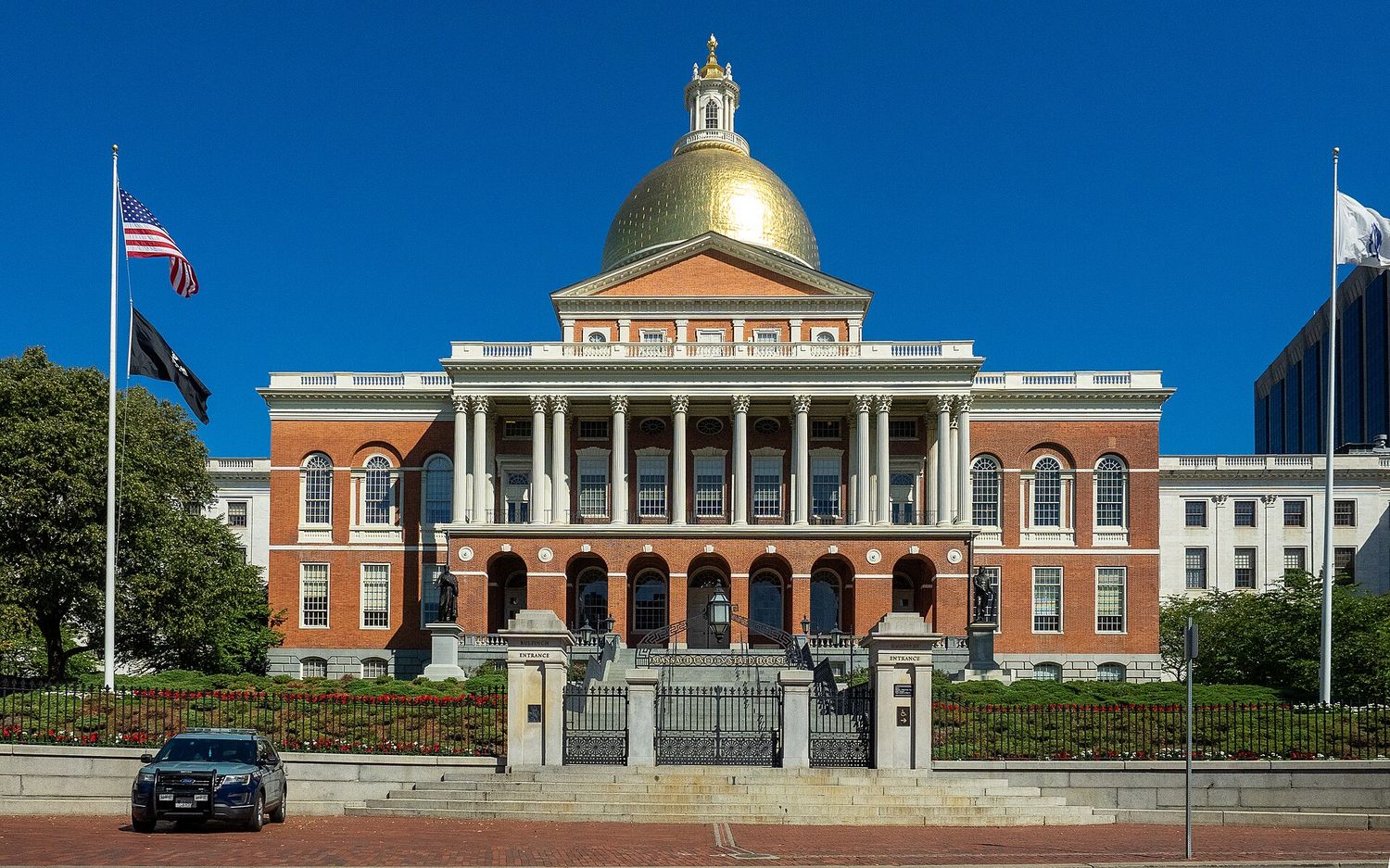
Every distance to Boston is calculated, officially, from the gold dome on Beacon Hill. The Secretary of the Commonwealth’s own tour card says so, and once you know it, the State House stops looking like a handsome building at the top of the Common and starts looking like what it is: the fixed point of Massachusetts. Going inside costs nothing. A Massachusetts State House tour takes about 40 minutes, is led by the state’s own tour staff and volunteer guides, and runs on weekdays only, which is the single most important thing to know before you plan one.
This guide covers how to book the free tour (by phone, and ahead of time), which door to use, what you will see in each hall and chamber, the story of the building and its dome, the memorials outside, and how the State House fits into a Freedom Trail day. Tour details were checked in November 2026 on the Secretary of the Commonwealth’s tour pages and the state’s own visitor information; confirm before you go.
How to book the free tour
Guided tours of the State House are free and run on weekdays, year-round, between 10am and 3:30pm. They last about 40 minutes and are organized by the State House Tours Division of the Secretary of the Commonwealth, with tours led by its staff and volunteers. You choose between two kinds: an architectural and historical tour of the building, or a tour of the legislative process, for anyone more interested in how a bill becomes law than in the mosaics.
Advance reservations are required for conducted tours, and bookings are taken by phone, on 617-727-3676. Groups can be anywhere from one to 50 people, and groups of ten or more should book at least three weeks ahead. Questions can go to the tours office by email at [email protected]. Call as soon as you know your dates.
If you can’t get a guided slot, there is a fallback. Self-guided tour materials, for groups of one to ten, are available in several languages at the Tours and Information desk in Doric Hall, on the second floor, which is also where guided tours check in. The tour card that comes with them is genuinely good.
Getting in: the door, the screening and the hours
Visitors use the General Hooker Entrance on Beacon Street, at the top of Park Street. You walk past the bronze equestrian statue of General Joseph Hooker, climb the stairs and go through security; every visitor is screened, so travel light. The accessible entrance is around the side of the building on Bowdoin Street, at the Ashburton Park entrance, where there is a ramp and where wheelchairs are available on loan. For The RIDE, the drop-off point is the Capitol Coffee House at 122 Bowdoin Street. If you have questions about photography or what you can bring in, ask the tours office when you book.
The building is open on weekdays only, closing at 5pm; the tours office gives 8:45am as the opening time and the state’s visitor page lists 9am. It is closed on weekends and on holidays. That matters if you are walking the Freedom Trail on a Saturday: the State House is the trail’s second stop, and on a weekend you will see only the outside. Inside, there is a State House Cafe on the fourth floor and a State Bookstore in Room 116.
What you will see, room by room
The tour follows roughly the order of the official tour card, starting on the second floor, which holds the building’s five ceremonial halls, and climbing to the third, where the House, the Senate and the governor’s offices are.
Doric Hall
Doric Hall takes its name from the double row of columns with Doric capitals down its center, and it is the building’s reception hall, used for social gatherings and official ceremonies. A bronze bust of John Hancock, the state’s first governor, stands on the west wall, opposite a full-length portrait of Abraham Lincoln by Albion Bicknell. On the north wall is a statue of George Washington, the first piece of art placed in the room, and in the left corner is John Andrew, governor during the Civil War. The Secretary’s children’s guide to the building adds a detail worth remembering: it was in this room that Andrew handed out guns, ammunition and flags to the volunteers going off to fight.
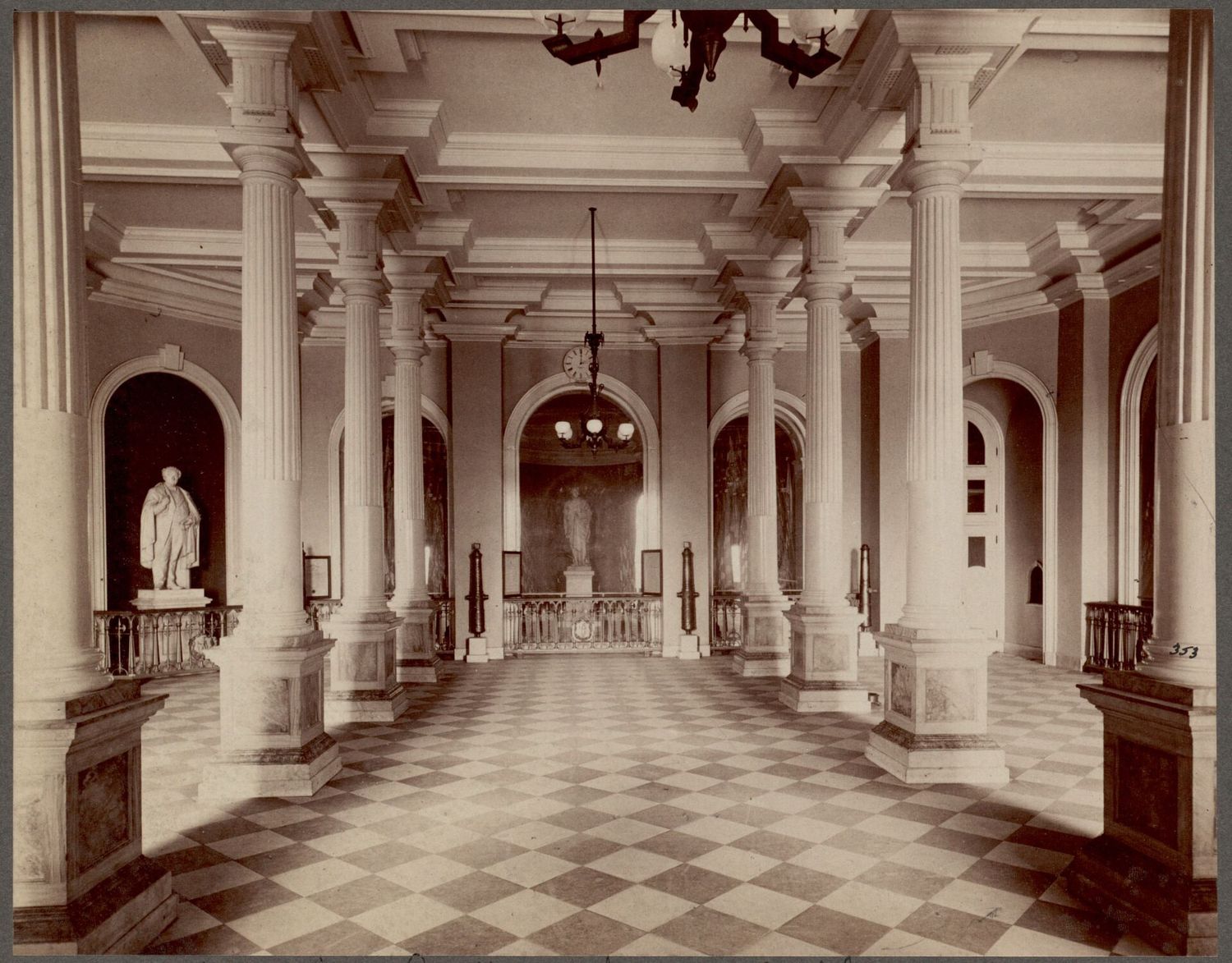
Then there are the doors. The big double doors at the front entrance of Doric Hall are opened on only three occasions: when a governor leaves the State House for the last time at the end of a term, when a Massachusetts regimental flag is returned to the permanent collection, and for an official visit by the President of the United States or a foreign head of state. The last official presidential visit, according to the tour card, was made by William Howard Taft in 1912. Everyone else comes and goes by other doors.
Nurses Hall
Five steps up from Doric Hall, you leave Charles Bulfinch’s building and enter the addition of 1895, designed by Charles Brigham, with its marble columns and mosaic floors. On the right is Bela Pratt’s 1914 statue of a Civil War nurse tending a fallen soldier, a memorial to all the nurses of that war. Above are three paintings by Robert Reid: Paul Revere’s midnight ride, James Otis arguing against the Writs of Assistance, and the Boston Tea Party. If you have been to the Boston Tea Party Museum, it is interesting to compare.
The Hall of Flags
Memorial Hall, better known as the Hall of Flags, is a circular room ringed by tall columns of Siena marble, built to honor the state’s soldiers. The flags on display are a small sample of more than 400 original flags carried into battle by Massachusetts service members, from the Civil War through Vietnam. What you see are transparencies; the originals are kept in climate-controlled vaults. Look up for the murals (the Pilgrims on the Mayflower, the return of the regimental colors at the end of the Civil War, John Eliot preaching to Native Americans and the battle at Concord Bridge) and for the stained glass window, with the seals of the 13 original states around the seal of Massachusetts.
The Great Hall
Through glass doors beyond the staircase is the newest space in the building, the marble Great Hall, completed in 1990 and used for state functions and receptions. The flags of all 351 Massachusetts cities and towns hang here, and the large clock is a working piece of art by the New York artist R.M. Fischer.
The main staircase
On the way up to the third floor, look at the iron railings: once they were cast, the molds were broken, so that no one could make another set. The stained glass window on the stairs traces the evolution of the state seal, with the motto that translates as “By the sword we seek peace, but peace only under liberty.”
The House of Representatives and the Sacred Cod
The House chamber, completed in 1895, is the larger of the two. Its 160 representatives each serve two-year terms, and the chamber, paneled in hand-carved Honduran mahogany, is capped by a circular frieze of names honoring natives of Massachusetts. The House meets year-round, with sessions held at least every 72 hours, and when it is in session, visitors are welcome in the public gallery on the fourth floor. It was not always this compact: the Secretary’s children’s guide notes that in 1812 there were 749 representatives.
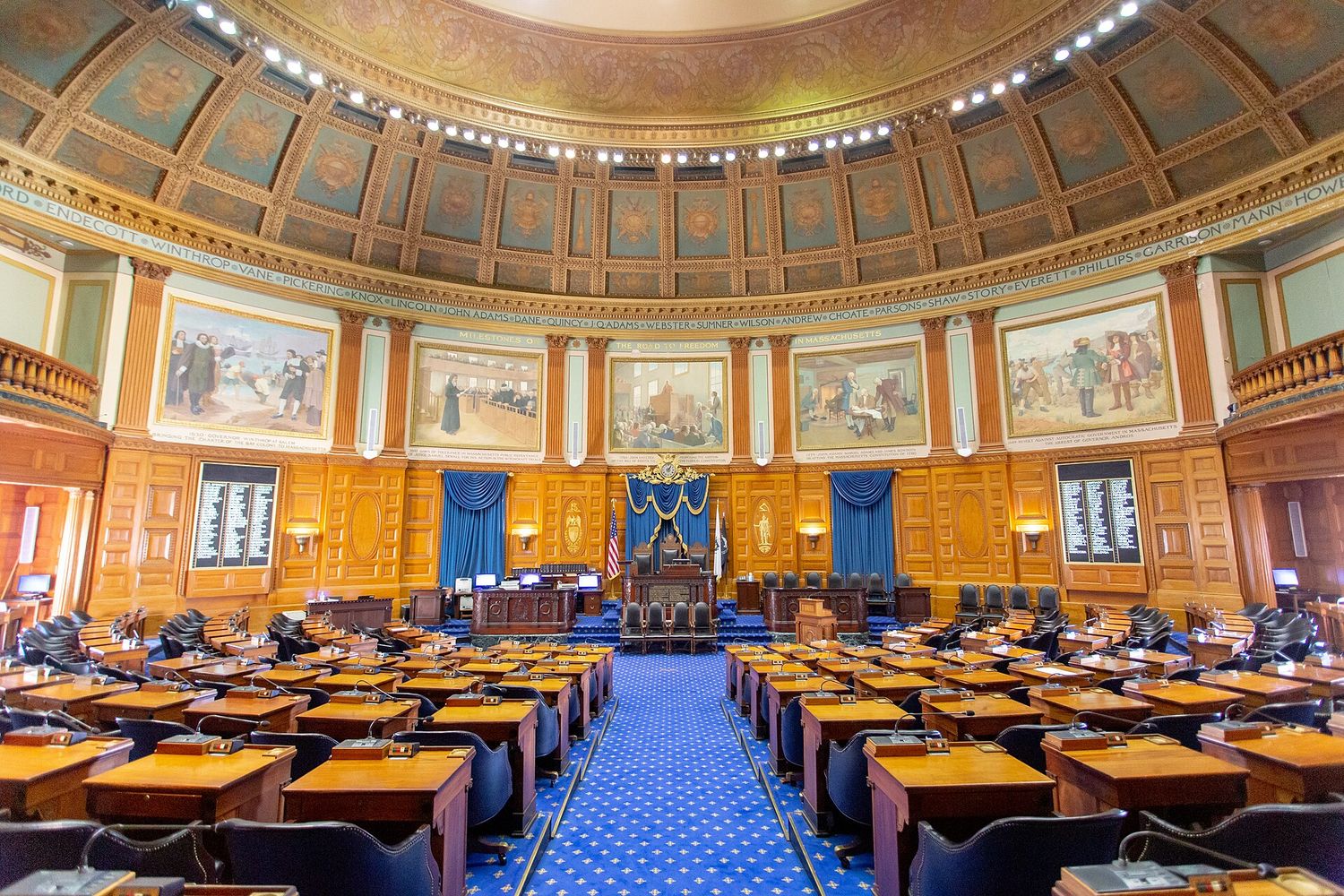
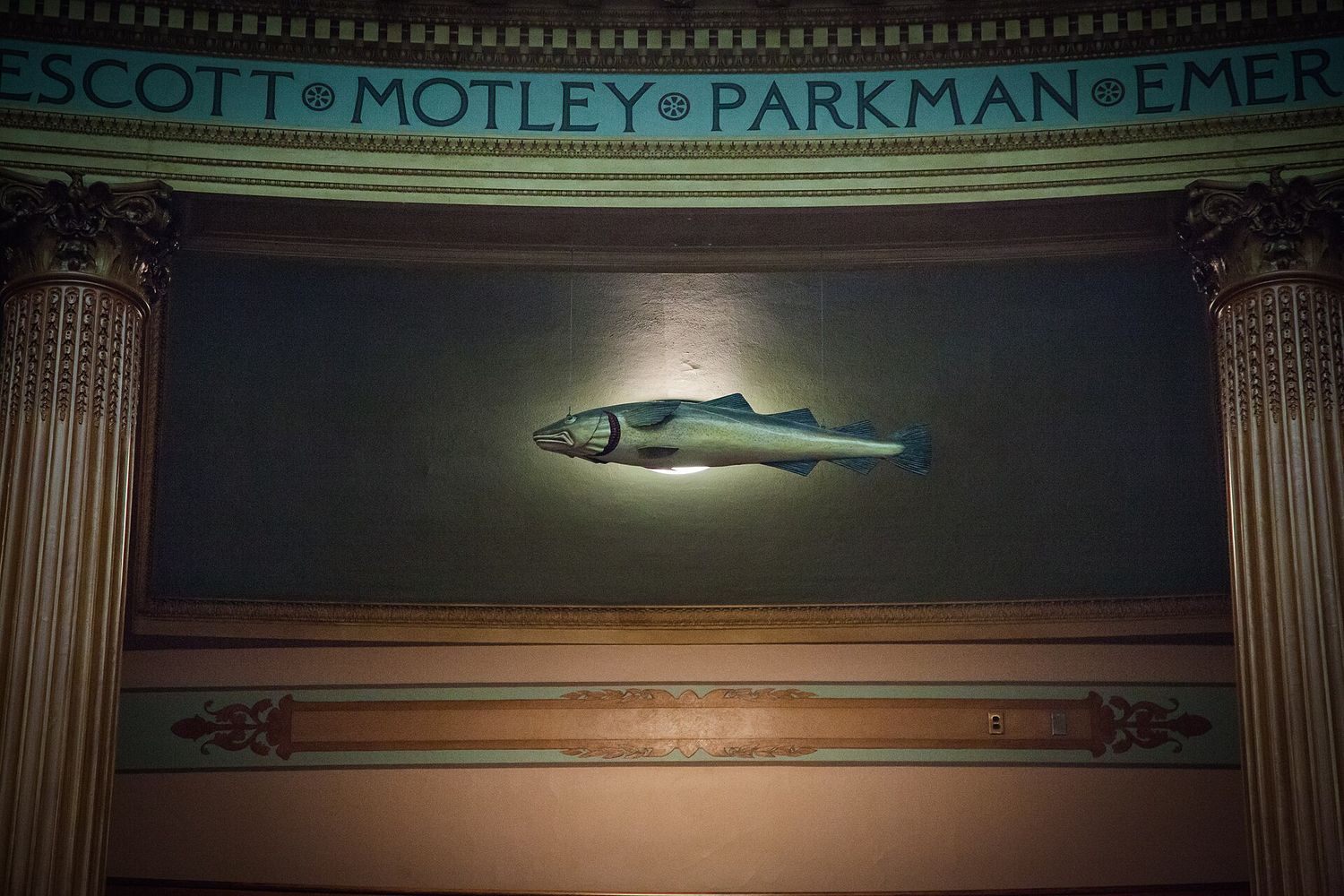
At the back of the chamber, above the public gallery, hangs the most famous fish in New England. The Sacred Cod is a five-foot wooden codfish, first given to the House in 1784 by a former representative, and it stands for good luck and for the fishing industry that built the state’s early wealth. It has had adventures: in 1933, as a prank, it was “codnapped,” in the official brochure’s word, before finding its way back to the chamber.
The Senate and the Holy Mackerel
The Senate meets in the original Bulfinch part of the building, directly under the golden dome. The tour shows you two rooms: the Senate Reception Room, which used to be the Senate chamber, and the present Senate Chamber, which used to be the House chamber. There are 40 senators, each serving a two-year term, and busts of George Washington, Abraham Lincoln and the Marquis de Lafayette line the walls. In 2019 the chamber was restored to its 1890s appearance, and a quotation from Frederick Douglass was added to the south wall: “Truth, Justice, Liberty, and Humanity will ultimately prevail.” Look up, too. Above the chandelier hangs another fish, which has been nicknamed the “Holy Mackerel.”
The Executive Chamber and the Women’s Memorial
The governor’s and lieutenant governor’s suite, with the chamber of the Governor’s Council, is a working office and isn’t open to tour groups. Back on the second floor, just outside Doric Hall in the west hallway, is “HEAR US,” a memorial created by two artists in 1999 to honor women active in public life. It shows six women who shaped Massachusetts government and public life: Dorothea Dix, Lucy Stone, Sarah Parker Remond, Josephine Ruffin, Mary Kenny O’Sullivan and Florence Luscomb, whose causes ran from the treatment of the mentally ill and racial discrimination to suffrage and working conditions.
The State Library
One more room is worth knowing about. The State Library of Massachusetts is in Room 341, at the rear of the third floor, and is open Monday to Friday from 9am to 5pm, closed on state legal holidays. It is a working research library rather than a sight, but it is open to the public, and it is a quiet place to sit for a few minutes after the tour.
The building and its dome: a short history
By the 1790s the Old State House downtown was too small for the government of an independent Massachusetts. The new building went up at the top of Beacon Hill, on land that had been John Hancock’s cow pasture, to a design by the Boston architect Charles Bulfinch. Its cornerstone was laid on July 4, 1795, by Governor Samuel Adams and Paul Revere, and it was completed in 1798. Bulfinch’s original building was only 65 feet deep; the wood for it came from the northern part of Massachusetts, which became the state of Maine in 1820. The state’s own brochure calls the State House one of the oldest state capitols in continuous use in the country, and the oldest building on Beacon Hill.
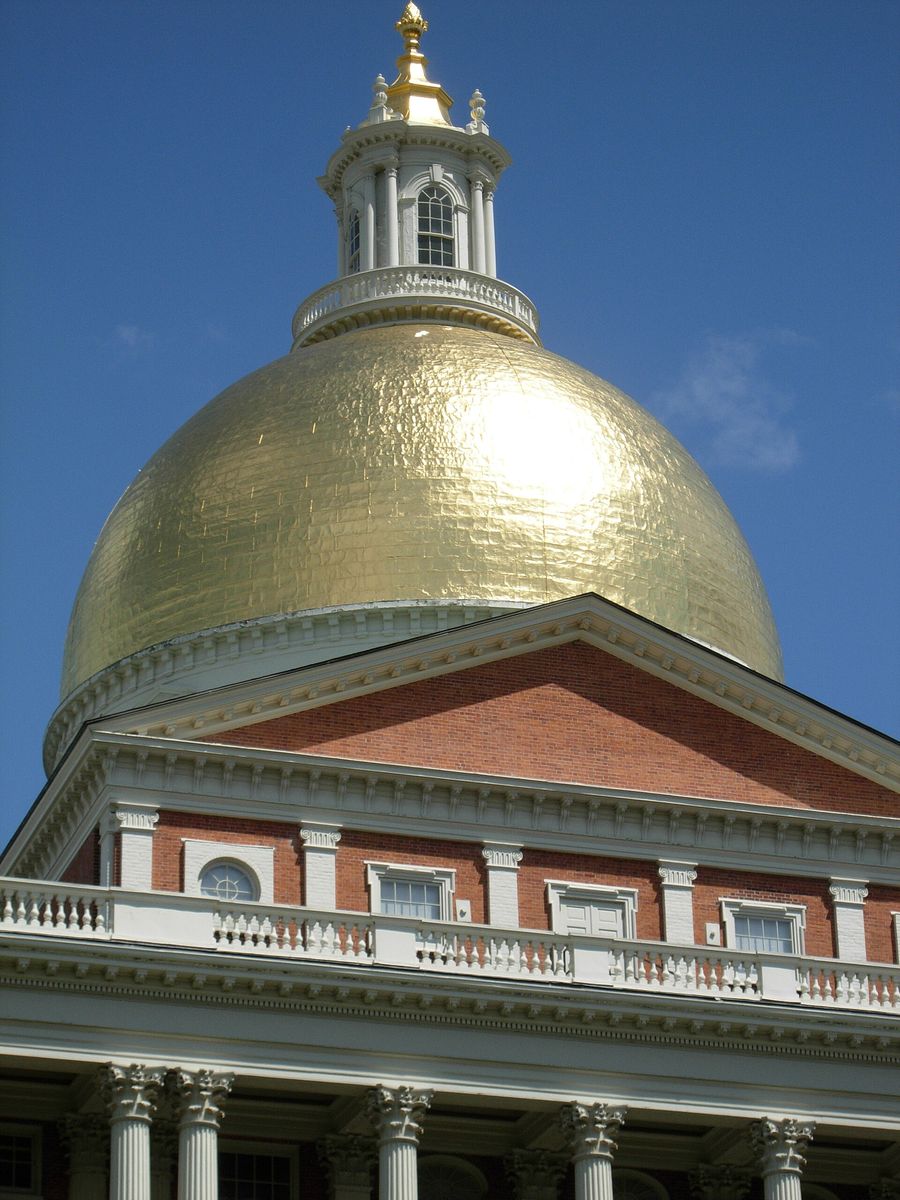
The dome was not always gold. Bulfinch’s dome was wooden and shingled, and it leaked, so in 1802 Paul Revere’s company covered it in copper. It was first gilded in 1874. During the Second World War it was painted gray, so that it would not reflect light during blackouts, and it was regilded in 1969 and again in July 1997. Today it is covered in 23-karat gold leaf, not solid gold. On top sits what many visitors take for a pineapple. It is a pine cone, put there for the timber that built early Massachusetts, and for Maine, which was still part of Massachusetts when Bulfinch’s building went up.
The building grew in stages. Charles Brigham’s addition, with Nurses Hall and the present House chamber, was finished in 1895; Memorial Hall followed in 1900; and the east and west wings, which give the State House the long white flanks you see from the Common, were added in 1917. The Great Hall, the last major space, was completed in 1990.
A working building: the General Court and the right to petition
It is easy to forget, walking through the marble halls, that this is not a museum. Together, the House and the Senate are known as the General Court, and they work here year-round; the House holds sessions at least every 72 hours. The governor and lieutenant governor have their offices on the third floor, alongside the chamber of the Governor’s Council, whose eight councillors are elected every two years. On a weekday the building is busy with legislators, staff and visitors, and the state’s welcome brochure lists public hearings, rallies, protests, award presentations and traveling exhibits among the things that regularly happen here. You may well come across one on your way to Doric Hall.
If you choose the legislative process tour, listen for the right of free petition, which the Secretary’s children’s guide singles out as something special about Massachusetts. Anyone who thinks the state needs a new law can take the idea to their state senator or representative and ask them to present it to the legislature as a petition, or bill. After discussions, meetings and votes, the bill can become law. It is a nice thing to learn in a building that began as a monument to self-government, and a reminder that the chambers you are touring are still where that work gets done.
Outside: statues and the Shaw Memorial
The lawns around the State House are an outdoor gallery of their own. General Hooker rides out from his entrance; John F. Kennedy, who never served in the state legislature but is honored as a favorite son, strides across the west lawn. Daniel Webster and the education reformer Horace Mann stand near the front, and on the lawns below the wings are statues of two women who defied the Puritan authorities of early Boston: Anne Hutchinson, the religious dissident, below the west wing, and Mary Dyer, the Quaker who was hanged in Boston, below the east.
Directly across Beacon Street, on the edge of the Common, is one of Boston’s best-known public sculptures. The Memorial to Robert Gould Shaw and the 54th Regiment, built in 1897, is a bronze relief by Augustus Saint-Gaudens showing Colonel Shaw leading the 54th Massachusetts, a regiment of Black soldiers, down Beacon Street on its way south in the Civil War. The names of the Black soldiers killed in action were added only in the early 1980s; originally the memorial listed only the white officers who died. Water damage was discovered in 2014, and a nearly $3 million restoration, funded by the National Park Service, the Friends of the Public Garden and the City of Boston, replaced the crumbling brick foundation with concrete and pinned the bronze frieze in place. The restored memorial was unveiled on May 28, 2021.
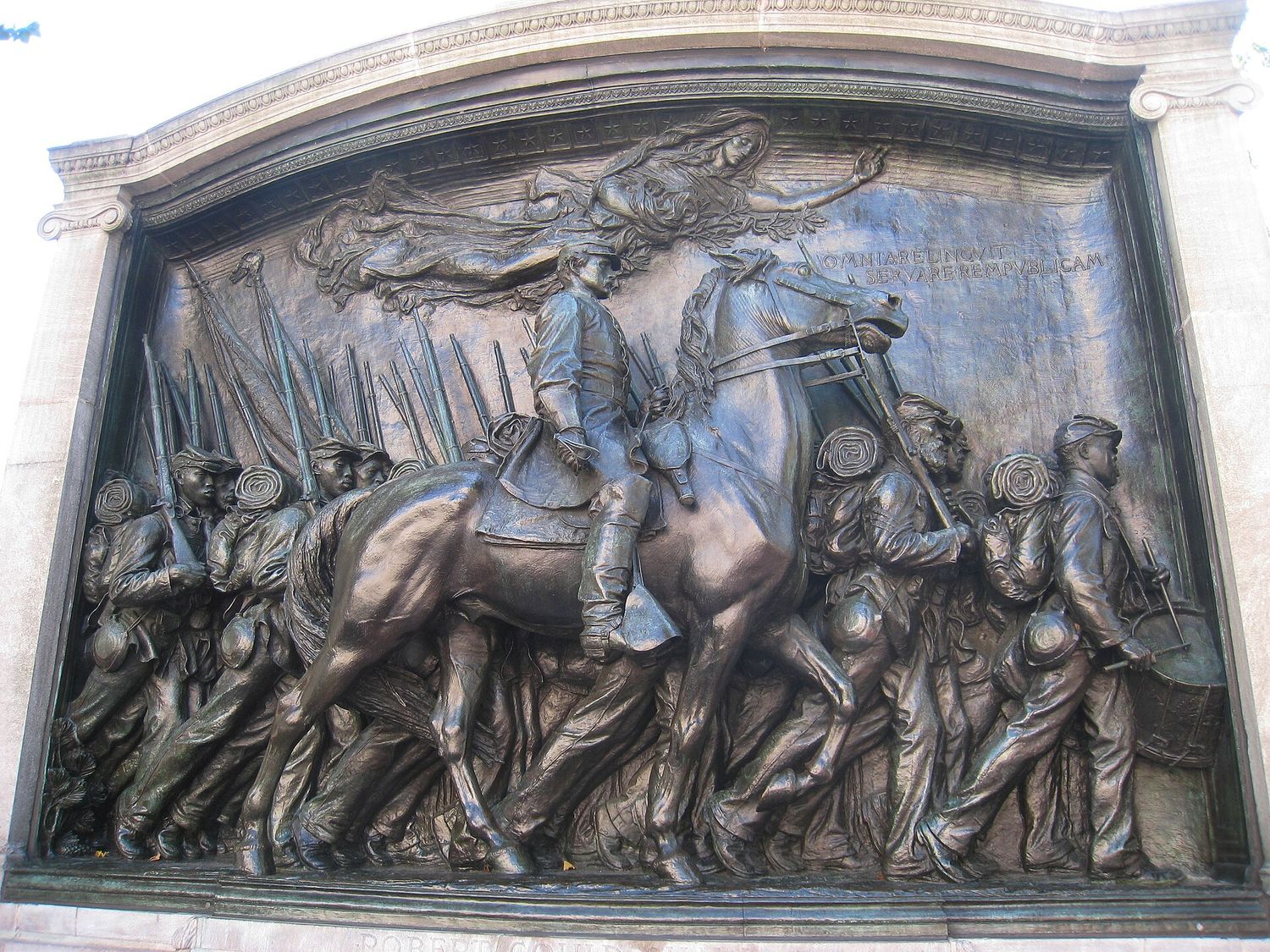
Give it five minutes, even if you skip the tour. Read the inscription on the back, which tells how the regiment’s Black soldiers risked capture and enslavement and went unpaid for the first 18 months of their service, and then look again at the faces Saint-Gaudens gave the marching men.
Getting there
The State House stands at the corner of Beacon and Park Streets, at 24 Beacon Street, looking down over Boston Common. The nearest subway stop is Park Street, on the Red and Green Lines, at the bottom of Park Street; walk up the hill and the Hooker entrance is in front of you. Bowdoin, on the Blue Line, is close to the Bowdoin Street side of the building, but the station has no elevator and the MBTA lists it as not accessible, so check the MBTA’s station page before you travel and consider Park Street or Government Center instead. Our guide to getting around Boston covers fares.
Fitting it into a Freedom Trail day
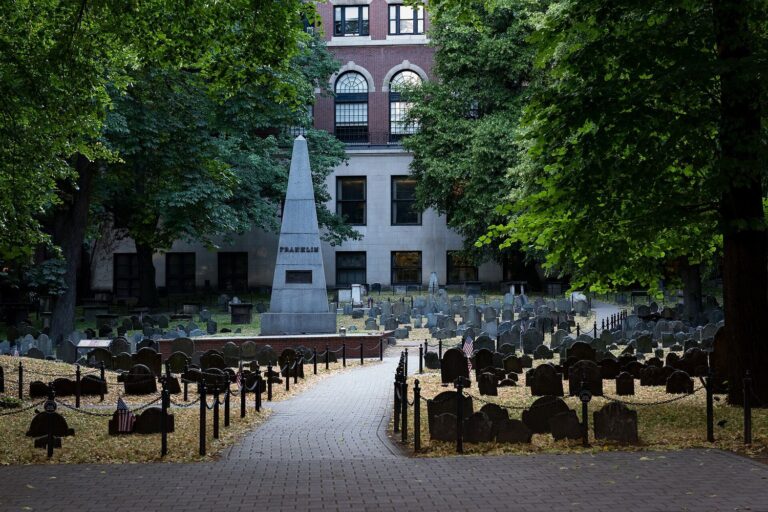
The State House is stop two of the 16 official Freedom Trail sites, right after Boston Common, and the next two stops are a few minutes’ walk down Park Street: Park Street Church, an active congregation since 1809 at 1 Park Street, and the Granary Burying Ground beside it, where Hancock, Revere and Samuel Adams, the three men most associated with this building’s early years, are buried. If you are walking the trail on a weekday, a 10am State House tour is the perfect start; book it, walk across the Common to the State House steps, and pick up the trail from Park Street Church afterward.
The Boston Athenaeum, a private library whose first floor is open to paying visitors, with docent-led tours, is a short walk along Beacon Street if the tour has given you a taste for the inside of grand Boston buildings. Our guide to all 16 Freedom Trail stops has the rest of the route, and our Freedom Trail map shows how the stops connect.
Is the State House tour worth it?
Yes, if you can do it on a weekday. It’s free, it takes about 40 minutes, and it gives you something no museum can: a working seat of government, in rooms that have been in use since the 1790s, with stories (the doors, the cod, the mackerel, the century and more since a president last came through the front doors) that make the building come alive. The guides know the building well, and the House gallery, when the House is sitting, is a bonus.
What isn’t worth it is turning up on a Saturday, when the building is closed, or arriving on a weekday without having called, when you may well find there is no guided tour for you. Don’t expect a museum, either. This is an office building full of working legislators and staff, the governor’s suite isn’t on the tour, and on busy days the halls are full of people with somewhere to be.
With children, it works better than you might expect. The Secretary’s office publishes a children’s guide to the building, “What’s Under the Golden Dome?”, the Sacred Cod is an easy win, and the tour is short enough to hold most children’s attention. Our guide to free things to do in Boston has more free indoor stops for a family day.
Frequently asked questions
Is the Massachusetts State House tour free?
Yes. Guided tours are free, and they run on weekdays between 10am and 3:30pm. Self-guided materials are free too.
Do you need to book a Massachusetts State House tour?
Yes. Advance reservations are required for guided tours, and bookings are taken by phone on 617-727-3676. Groups of ten or more should book at least three weeks ahead.
How long is the State House tour?
About 40 minutes.
Is the Massachusetts State House open on weekends?
No. The building is open on weekdays only and is closed on weekends and holidays, so on a Saturday or Sunday you can see only the outside.
Can you see the Sacred Cod?
Yes. The Sacred Cod hangs at the back of the House chamber, above the public gallery, and it is a highlight of the tour. When the House is in session, visitors can use the public gallery on the fourth floor.
Is the State House dome real gold?
It is gilded in 23-karat gold leaf over the dome, not made of solid gold. The dome was first gilded in 1874 and was painted gray during the Second World War.
Where is the visitor entrance to the State House?
Use the General Hooker Entrance on Beacon Street, at the top of Park Street, and go through security. The accessible entrance, with a ramp, is on Bowdoin Street at the Ashburton Park entrance.
Three of the men most tied to this building’s early years, John Hancock, Samuel Adams and Paul Revere, are buried a few minutes away down Park Street. Our guide to the Granary Burying Ground shows where to find their graves, and the newly restored stone of Sebastian, which WBUR reported as likely one of the oldest gravestones of a free Black person in the country.
Directly across Beacon Street from the State House, Saint-Gaudens’s memorial to Robert Gould Shaw and the 54th Massachusetts is where the Black Heritage Trail begins. Our Black Heritage Trail guide follows its ten stops across the north slope of Beacon Hill, past the homes of the free Black community that championed the abolition of slavery, to the Museum of African American History at the end of the route.