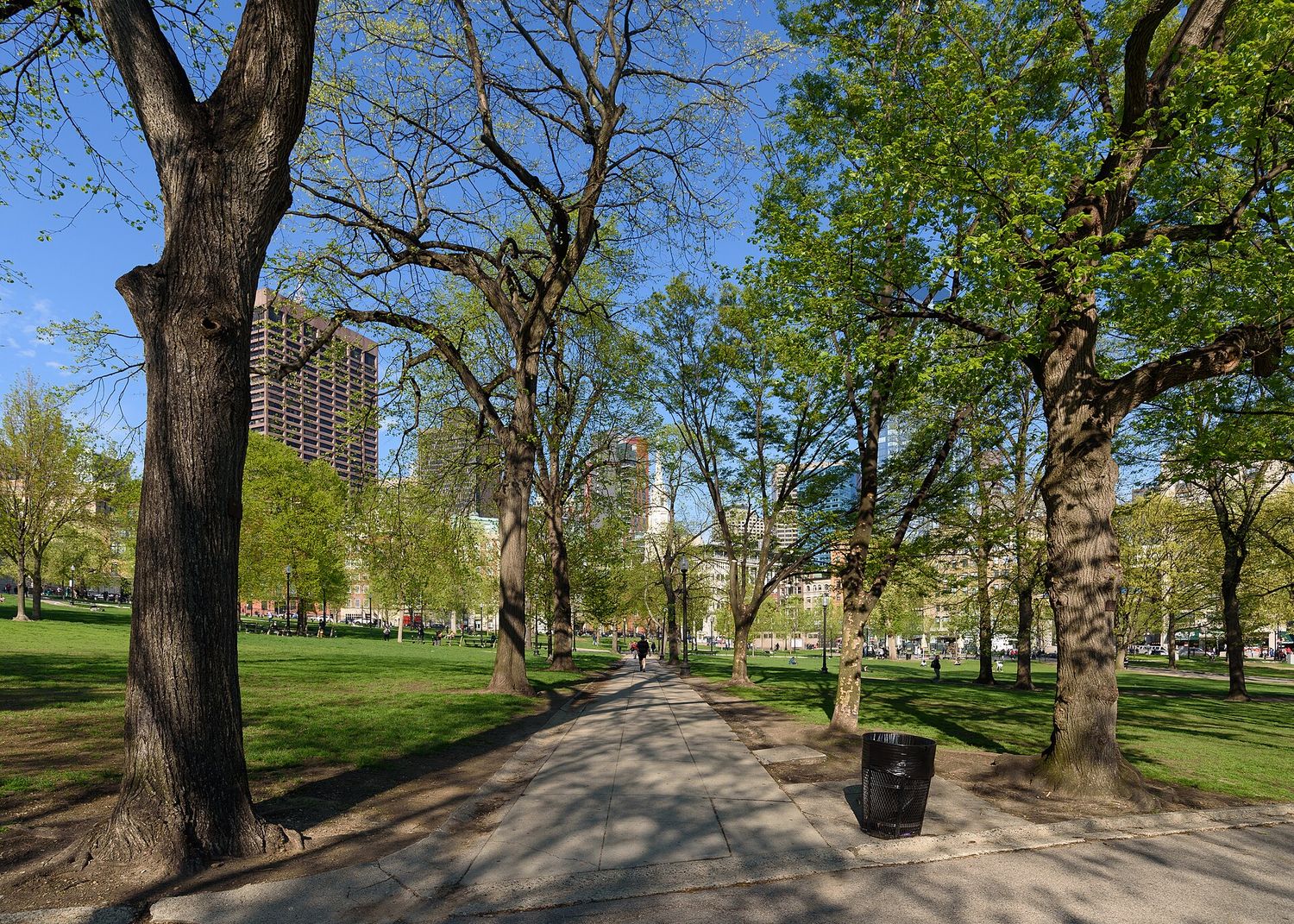
Until 1830, Bostonians grazed their cows here. That detail says most of what you need to know about the place: it was never designed as a park, it was simply the town’s shared field, and it has been used hard for nearly four centuries — for pasture, for hangings, for a British army camp, for protest marches, for a papal Mass, and now for lunch breaks, softball and the first steps of the Freedom Trail. Boston Common is the oldest public park in the United States, and it still feels like what it has always been: the city’s front yard, a little scruffy at the edges and busy from dawn until late.
This guide covers the Common’s history, what to look for as you walk it, how the Frog Pond changes through the year, the difference between the Common and the Public Garden next door, getting there on the T, and what is and is not worth your time. Prices and seasonal details were checked in September 2026; confirm before you travel, because some are set year to year and parts of the Common are due for renovation work.
Boston Common at a glance
| Fact | Detail |
|---|---|
| Established | 1634 — the oldest public park in the country |
| Size | About 50 acres |
| Cost | Free |
| Nearest T | Park Street (Red and Green Lines), Boylston (Green Line) |
| Time needed | 45 minutes for a loop; longer with the Frog Pond or a picnic |
| Best for | Starting the Freedom Trail, a walk between Beacon Hill and Downtown, summer evenings, winter skating |
| Don’t miss | The Shaw Memorial, the Central Burying Ground, the view up to the State House dome |
A short history of America’s oldest park
A cow pasture bought from a hermit
When the Puritans arrived on the Shawmut Peninsula in 1630, one European was already living there: William Blaxton, an Anglican clergyman who kept a house, an orchard and a great many books on the western slope of what is now Beacon Hill. In 1634 the town bought most of his land for about thirty pounds, raised by charging each householder six shillings, and set it aside as common ground for grazing and military training. Blaxton, who found his new Puritan neighbors no easier than the bishops he had left England to escape, moved on to Rhode Island.
For the next two centuries the Common was a working field. Cattle grazed it until 1830, when Mayor Harrison Gray Otis finally banned them. The town militia drilled here — the Ancient and Honorable Artillery Company, chartered in 1638, still holds a ceremony on the Common every June.
Hangings, redcoats and the Great Elm
The Common was also where Boston executed people. Pirates, murderers and religious dissenters were hanged here, most famously Mary Dyer, a Quaker who returned to Boston after being banished and was hanged in 1660 for refusing to give up her faith. A statue of her now stands outside the State House, a few hundred yards up the hill. Public hangings on the Common ended in the early nineteenth century.
In the years before the Revolution, British troops camped on the Common, and in April 1775 the regulars marched from its western edge — then the shoreline of the Back Bay — to take boats across the river on the way to Lexington and Concord. During the siege of Boston that followed, the Common was a British army camp. The Great Elm, a tree already ancient by then and used as a gallows and a meeting place, survived all of it until a storm brought it down in 1876. A plaque marks where it stood.
A stage for the city
Because it was common land, the Common has always been where Boston gathers. Martin Luther King Jr. led a march here and spoke from a platform on the Common in April 1965. In October 1969, a crowd estimated at a hundred thousand came for the Vietnam Moratorium. Pope John Paul II celebrated Mass here in the rain in 1979. The tradition continues: rallies, concerts, the annual lighting of the Christmas tree, the First Night fireworks on New Year’s Eve. Walking across it, you are walking across the one piece of ground in Boston that has hosted almost every chapter of the city’s story.
What to see on the Common
The Common is roughly a five-sided field bounded by Tremont, Boylston, Charles, Beacon and Park Streets. Most of what is worth seeing sits around its edges and on the rise in the middle. Here is what to look for.
The visitor information center and the start of the Freedom Trail
On the Tremont Street side, near Park Street station, the visitor information center is where the Freedom Trail begins, and where the costumed Walk Into History tours set off at 10am, 11am, noon, 1pm and 2pm daily. The red brick line starts nearby and runs up the hill toward the State House. Maps, restrooms and advice are available here.
The Robert Gould Shaw and 54th Regiment Memorial
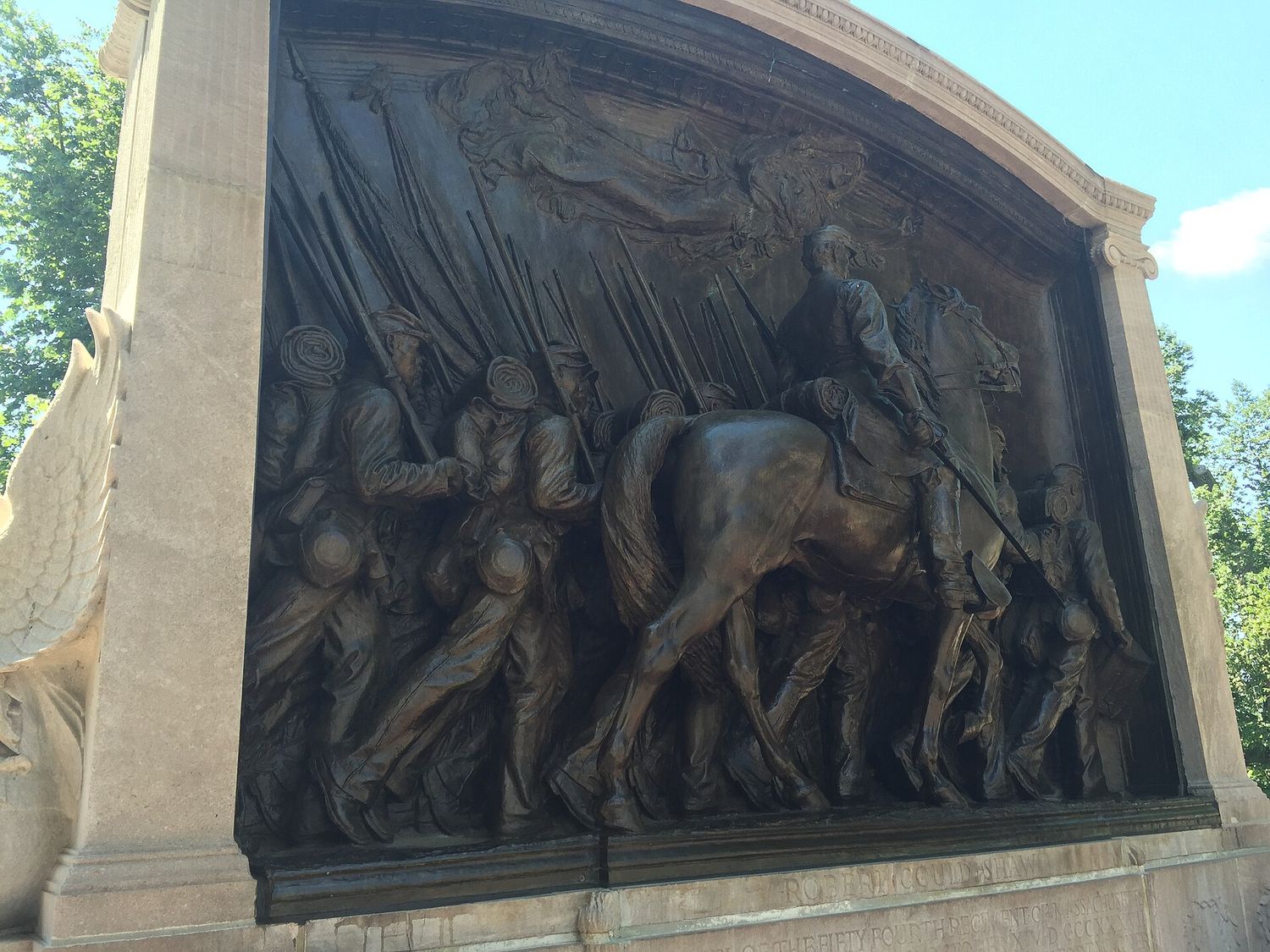
If you see only one thing on the Common, see this. Facing the State House across Beacon Street, the bronze relief by Augustus Saint-Gaudens honors the 54th Massachusetts Volunteer Infantry, one of the first regiments of Black soldiers raised in the North during the Civil War, and its white colonel, Robert Gould Shaw. Shaw and many of his men were killed in the assault on Fort Wagner in South Carolina in July 1863, the story told in the 1989 film Glory. Sergeant William Carney, who carried the flag back despite his wounds, became one of the first Black soldiers awarded the Medal of Honor.
The memorial was unveiled in 1897, and it is widely considered the finest American public sculpture of the nineteenth century. Stand close and look at the soldiers’ faces: Saint-Gaudens modeled them on individual men, and the effect is of a real column marching past you. It is also the first stop on the National Park Service’s Black Heritage Trail, which climbs from here into Beacon Hill.
The Soldiers and Sailors Monument
On Flagstaff Hill, the highest point in the middle of the Common, stands a tall granite column topped by a figure representing America. It is the Soldiers and Sailors Monument, by Martin Milmore, dedicated in 1877 to the Bostonians who died in the Civil War. The hill itself is the best spot on the Common to get your bearings: from the top you can see the State House dome, the towers of Downtown, and the length of the Common down to the Public Garden.
The Frog Pond
The last survivor of the ponds that once dotted the Common, the Frog Pond is a shallow oval that does three jobs through the year: a spray pool for children in summer, a reflecting pool in spring and fall, and a skating rink in winter. More on each season below.
The Brewer Fountain
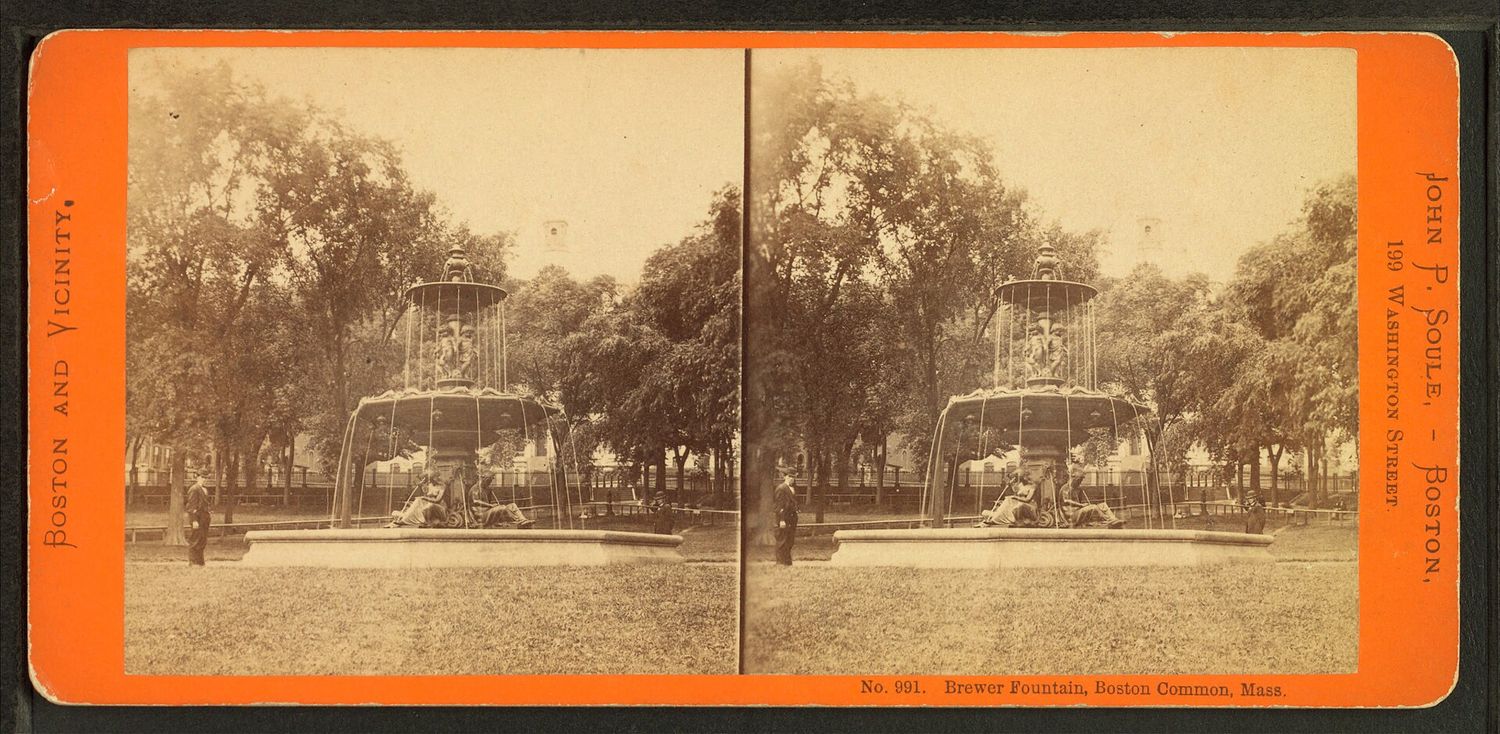
Near the Park Street corner, this bronze fountain was cast in Paris, a copy of one shown at the Paris Exposition of 1855, and given to the city by the merchant Gardner Brewer in 1868. The figures around its base are Neptune, Amphitrite, Acis and Galatea. For much of the twentieth century it sat dry and neglected; it was restored in 2010, and the plaza around it now has movable tables and chairs that make it one of the nicer places in Downtown to eat a takeout lunch.
The Parkman Bandstand and The Embrace
The white, columned Parkman Bandstand dates from 1912 and is named for George F. Parkman, whose bequest paid for the upkeep of the city’s parks. Concerts and rallies still use it. Nearby is the Common’s newest landmark, The Embrace, a twenty-foot bronze by Hank Willis Thomas unveiled in January 2023 to honor Martin Luther King Jr. and Coretta Scott King, who met as students in Boston. It shows only their arms, wrapped around each other, and it looks different from every side. Walk around it before you decide what you think; many people who dislike it from photographs change their minds in person.
The Central Burying Ground
Tucked into the Boylston Street side, the Central Burying Ground was laid out in 1756 and is the least visited of the historic graveyards in the center — which is exactly why it is worth ten minutes. The painter Gilbert Stuart, whose unfinished portrait of George Washington is the one on the dollar bill, is buried here. So are British soldiers from the occupation, and many of the Irish and other immigrants who could not afford plots elsewhere.
The Boston Massacre Memorial
On the Tremont Street side, a granite shaft with a bronze figure of Revolution breaking a chain honors the five men killed by British soldiers on King Street in March 1770 — Crispus Attucks, Samuel Gray, James Caldwell, Samuel Maverick and Patrick Carr. It was put up in 1888, over the objections of some of the city’s establishment, who thought the victims a mob rather than martyrs. Attucks, a sailor of African and Native American descent, is often described as the first person killed in the American Revolution. The massacre site itself is marked by a ring of cobbles outside the Old State House, a ten-minute walk along the Freedom Trail.
The Founders Memorial
On the Beacon Street side, near the Spruce Street entrance, a bronze relief from 1930 shows William Blaxton greeting John Winthrop and the first Puritan settlers — the moment the story of the Common begins. It is easy to walk past, and worth a look for the carved inscription and for the sense of how the city chose to remember its origins three centuries later.
A self-guided loop, about an hour
- Park Street station. Come up from the T, note Park Street Church across the road (1809; the hymn “America” was first sung there in 1831) and the Granary Burying Ground beside it.
- Brewer Fountain. A few steps into the Common from the Park Street corner.
- Shaw Memorial. Walk up along the Beacon Street side to the monument opposite the State House. Allow ten minutes.
- Frog Pond. Drop down into the Common to the pond, the pavilion and the Tadpole Playground.
- Soldiers and Sailors Monument. Climb Flagstaff Hill for the view.
- The Embrace and the Parkman Bandstand. Head toward Tremont Street.
- Central Burying Ground. Along the Boylston Street edge.
- Charles Street. Cross into the Public Garden and finish at the lagoon bridge.
At a steady pace this takes forty-five minutes to an hour. It combines naturally with the first stretch of the Freedom Trail, and our Boston itinerary uses it as the first hour of day one.
The Frog Pond through the seasons
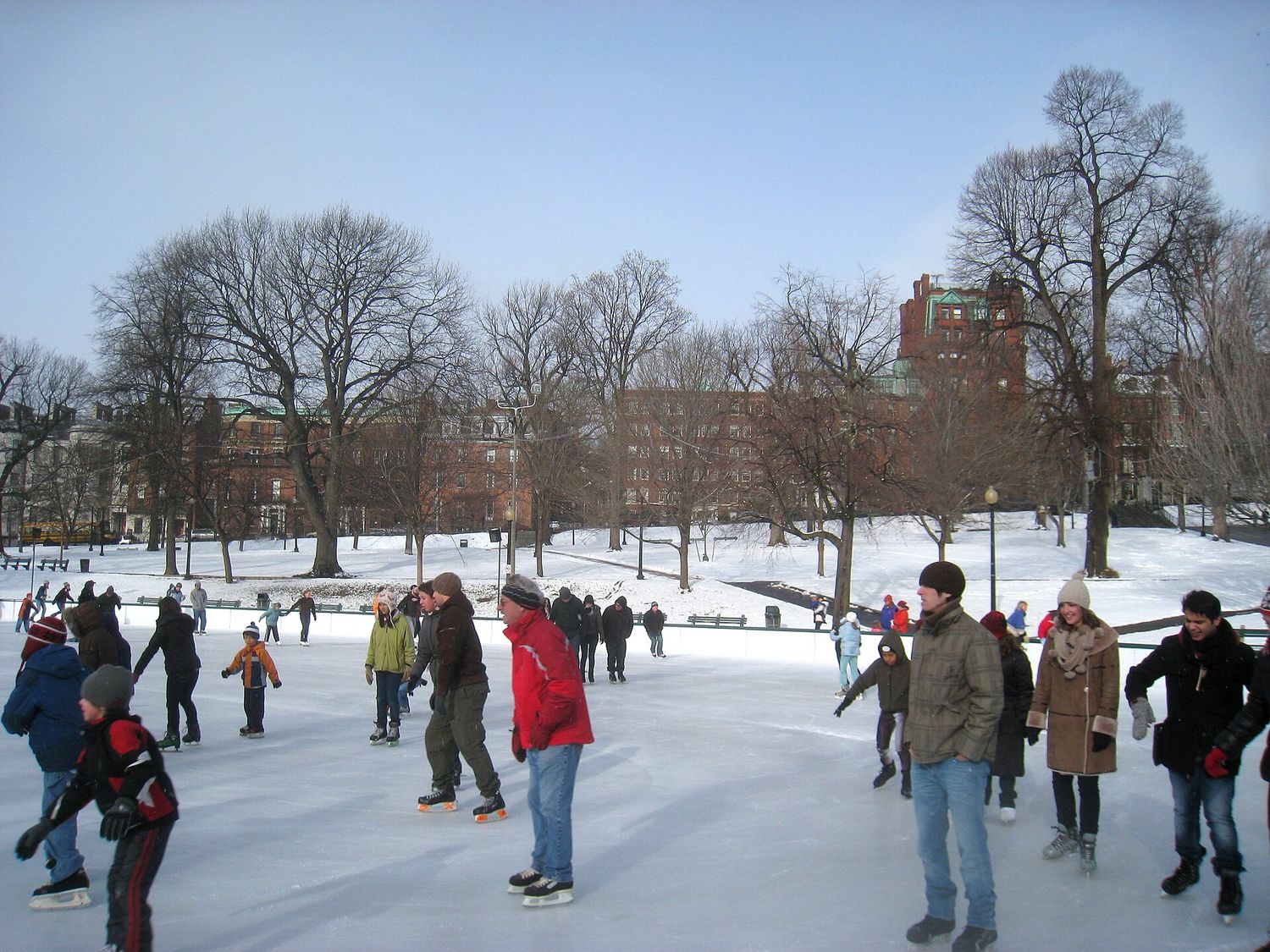
The Frog Pond is run as a partnership between the City of Boston and the Skating Club of Boston, and it changes character completely with the calendar.
| Season | What happens | Cost |
|---|---|---|
| Summer | Spray pool for children, 11am–6pm daily | Free |
| Spring to fall | Carousel beside the pond, opening daily at 10am in season | Per ride; check on site |
| Mid-November to March | Ice skating on the pond | $10 adult; free for children under 58 inches; skate rental $15 adult, $10 child |
| Skating and spray pool seasons | Café in the pavilion, opening daily at 11am | Snacks and drinks |
In summer the spray pool is a lifesaver for anyone traveling with small children — free, safe, surrounded by shade and benches, with restrooms and snacks in the pavilion. In winter the skating is the best-value cold-weather activity in the city, especially for families, since children under 58 inches skate free. Weekend afternoons get crowded; weekday mornings and evenings are calmer. Check the Frog Pond website for the season’s opening date and any public-skate schedule changes before you go.
The Frog Pond is one of the areas earmarked for change under the city’s Boston Common Master Plan, which proposes a new splash pad and a second-floor space on the pavilion. Do not expect that to arrive soon; just be aware that details may shift over the next few seasons.
Boston Common with kids
For families, the Common is the most useful piece of ground in the city: free, central, with space to run and toilets within reach. It works as a reward between museums and a pressure valve on a long walking day.
- Tadpole Playground, beside the Frog Pond, is a fenced playground for younger children, with the Frog Pond pavilion’s restrooms and snacks close by.
- The spray pool runs 11am to 6pm daily in summer and costs nothing. Bring a change of clothes; children always end up wetter than planned.
- The carousel near the Frog Pond runs from spring to fall, opening at 10am.
- Skating from mid-November is free for children under 58 inches, which makes it one of the cheapest family outings in Boston in winter. Rental skates for children are $10.
- Sledding on Flagstaff Hill after a snowfall is a Boston tradition. Bring your own sled; there is no rental.
- The ducklings. The Make Way for Ducklings bronzes are a five-minute walk into the Public Garden, and children are allowed — encouraged, really — to climb on them.
Pair a morning here with the Freedom Trail’s first stretch, which children tend to enjoy most when a costumed guide is leading it, or with the New England Aquarium on the other side of Downtown. Our guide to Boston with kids plans full days by age group, and the Boston Duck Tours guide explains the one paid tour that drives right past the Common and holds young children’s attention the whole way.
The Common through the year
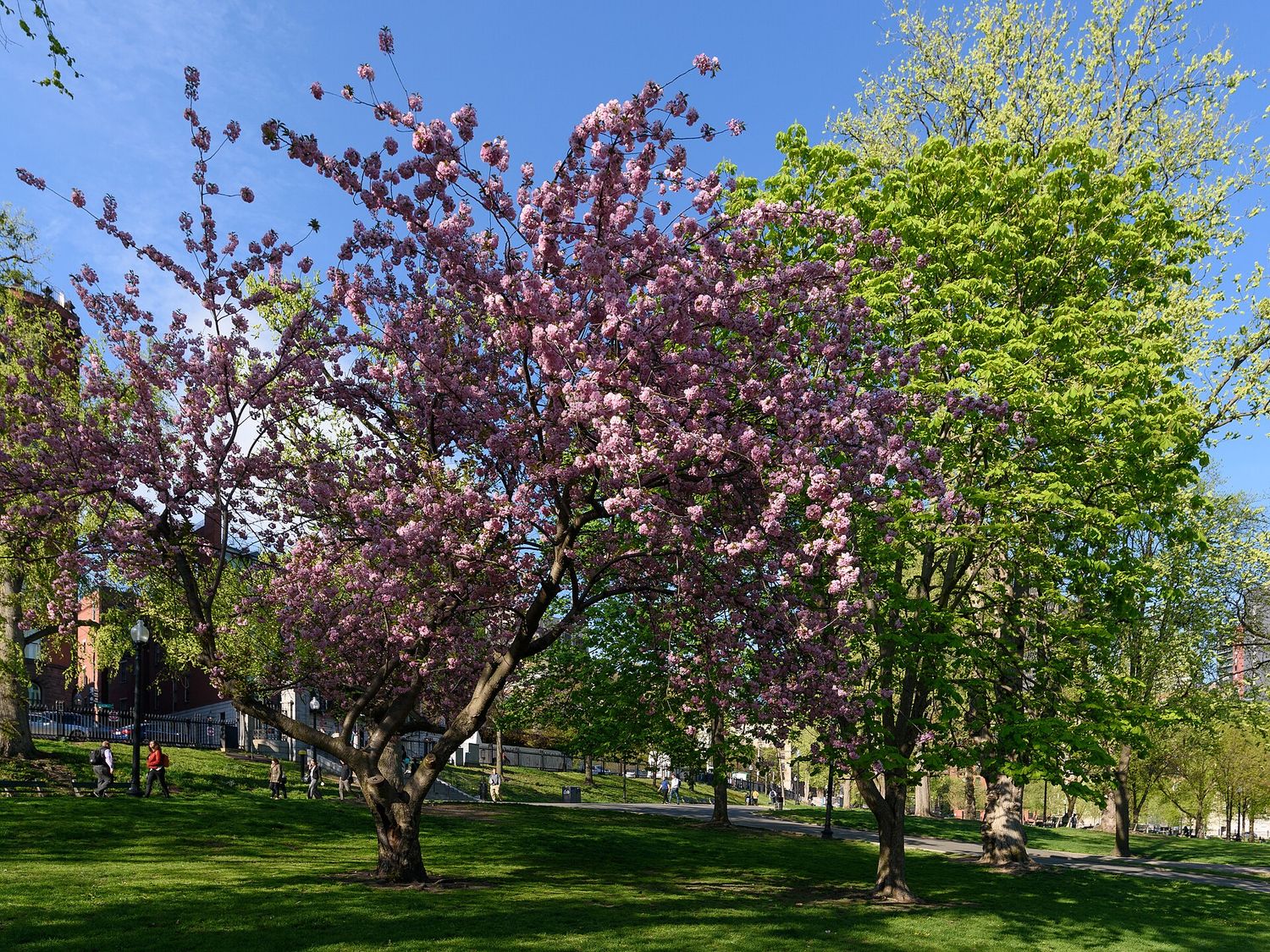
- Spring (April–May): blossom and new leaves, and the Common fills up at lunchtime on the first warm day as though someone rang a bell. The Public Garden’s tulips next door peak in late April and early May.
- Summer (June–August): softball on the ballfields, children in the Frog Pond spray pool, and free Shakespeare. The Commonwealth Shakespeare Company has staged a free production on the Common most summers since 1996; bring a blanket and arrive early for a spot near the stage.
- Fall (September–November): the trees turn from mid-to-late October, later than the mountains, and the low afternoon sun on the State House dome is worth timing a walk for. The Common is also at its quietest after the summer crowds leave.
- Winter (December–March): skating on the Frog Pond from mid-November, and in early December the lighting of the Christmas tree — an annual gift from Nova Scotia, sent to thank Boston for the help it gave after the Halifax explosion of 1917. On New Year’s Eve, First Night’s early fireworks have traditionally gone off over the Common at 7pm. Then the snow, which turns the Common into the city’s sledding hill.
For what else is on in each month, see our guides to Boston events and the best time to visit Boston.
Across Charles Street: the Public Garden
Visitors often use the names interchangeably, but the Common and the Public Garden are two different parks with two different personalities, divided by Charles Street.
| Boston Common | Public Garden | |
|---|---|---|
| Founded | 1634 | 1837 |
| What it was | Common pasture and training field | America’s first public botanical garden, built on filled marsh |
| Feel | Open fields, paths, a working park | Formal flower beds, a lagoon, specimen trees |
| Rules | Ballgames, rallies, events | No ballgames; it is a garden |
| Highlights | Shaw Memorial, Frog Pond, burying ground | Swan Boats, Make Way for Ducklings, the lagoon bridge, George Washington on horseback |
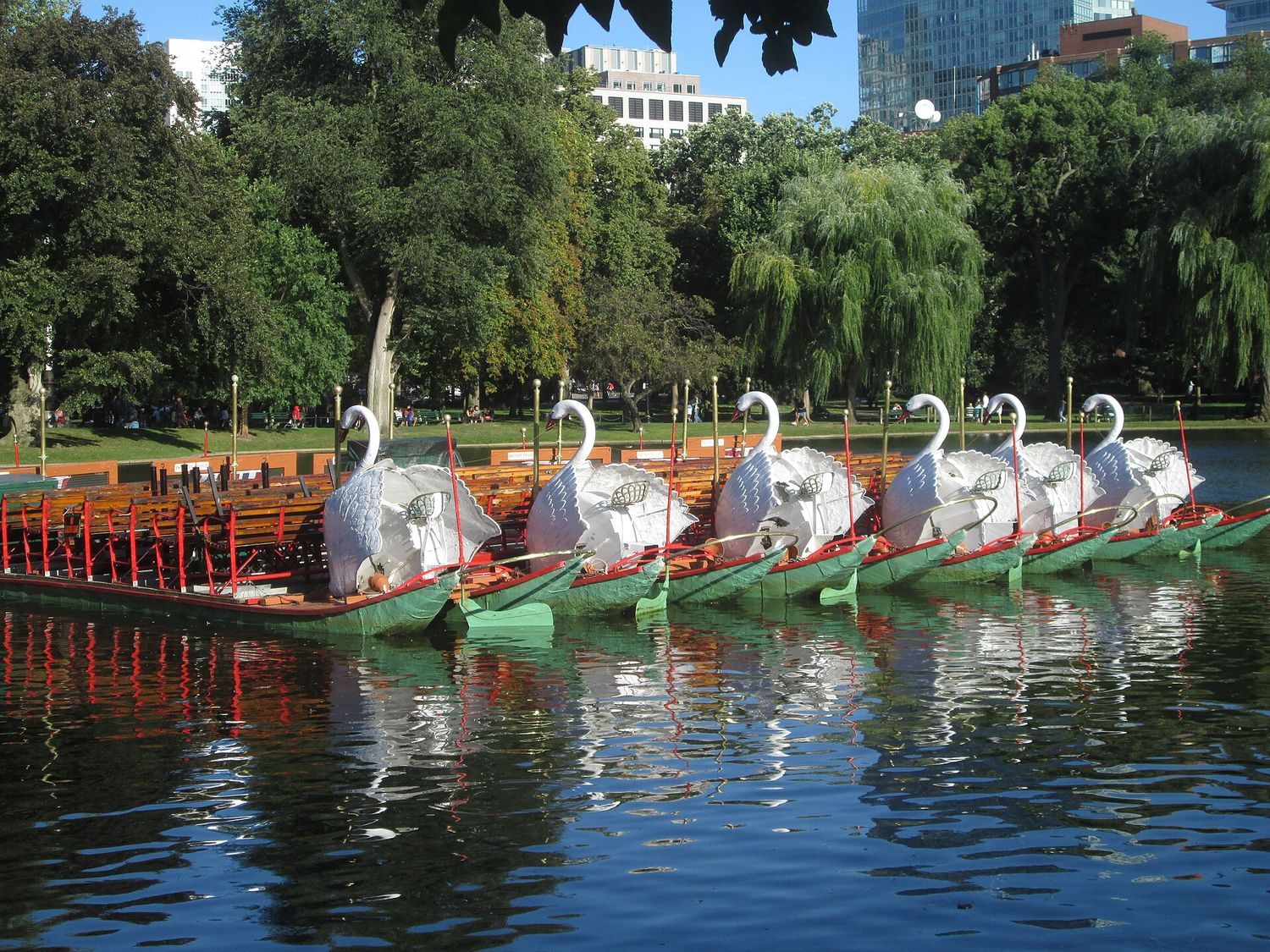
The Public Garden is the prettier of the two, and most people’s favorite. Its Swan Boats have been pedaled around the lagoon by the same family since 1877, but they are strictly seasonal: the 2026 season ran from 18 April to 7 September, so if you are visiting in the fall or winter you will see them only in photographs. They return in mid-April. The bronze ducklings from Robert McCloskey’s Make Way for Ducklings, near the Charles and Beacon Street corner, are there all year and are usually dressed up for holidays and big games. The Friends of the Public Garden, a nonprofit, cares for both parks and the Commonwealth Avenue Mall; their website has the latest on events and conservation work.
Getting there
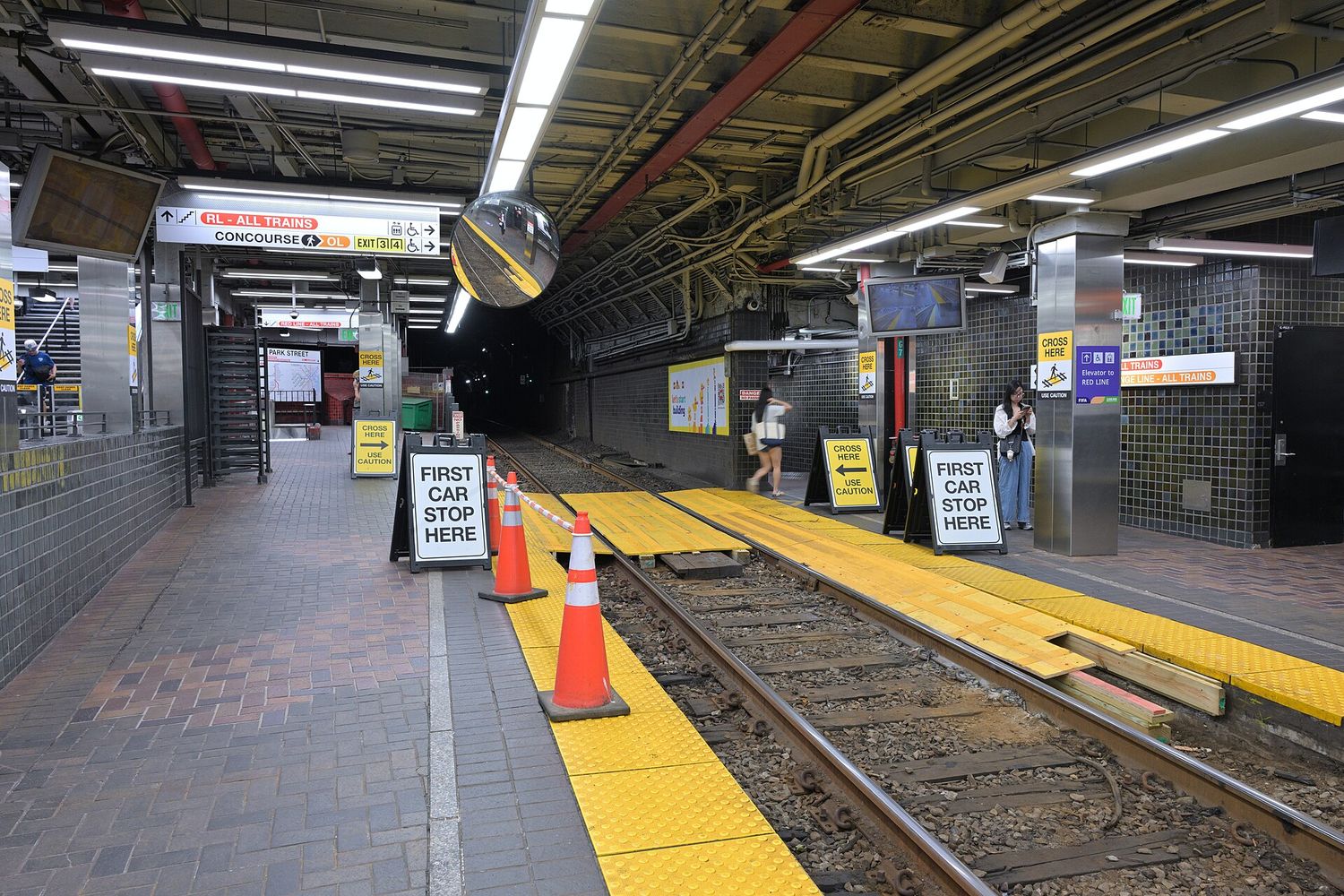
The Common is easy to reach on the T, and every one of these stations is within a few minutes’ walk. A subway ride is $2.40 with a CharlieCard, contactless card or cash.
| Station | Lines | Comes up at |
|---|---|---|
| Park Street | Red, Green | Tremont and Park Streets — the Freedom Trail end |
| Boylston | Green | Tremont and Boylston — the Central Burying Ground corner |
| Downtown Crossing | Red, Orange | Two blocks east of the Common |
| Arlington | Green | The far side of the Public Garden |
| Charles/MGH | Red | Base of Beacon Hill, a ten-minute walk down Charles Street |
Park Street and Boylston are the two original stations of the Tremont Street Subway, which opened in 1897 as the first subway in America, and both still surface on the edge of the Common where they always have. For everything else about the T, see our guide to getting around Boston.
If you drive, the Boston Common Garage sits underneath the Common with its entrance on Charles Street. It is convenient and, like all downtown parking, expensive — the T is almost always the better choice.
Practical notes
- It is free and always public. There is no admission, no gate and no ticket. Boston’s parks close overnight; check the posted hours at the entrances if you plan to be there late.
- Restrooms are at the visitor information center and at the Frog Pond pavilion in season. Public restrooms elsewhere in Downtown are scarce, so use them.
- Food: the Frog Pond café sells snacks in season, and there are food trucks along the edges in warm weather. For something better, walk ten minutes to Beacon Hill’s Charles Street or Downtown.
- At night the Common is busy along the main lit paths, particularly between Park Street and Boylston, but quieter corners can feel empty. Stick to the lit routes and walk with purpose, as you would in any big city park.
- Dogs are welcome; keep them leashed and clean up after them.
- Construction: the city’s Boston Common Master Plan, unveiled in 2022, is being carried out in phases. In early 2026 the city was seeking contractors for work on the Parkman Bandstand and Mayor’s Walk, so expect some fencing in the middle of the Common during the next year or two.
What’s worth your time, and what isn’t
Worth it, without question: the Shaw Memorial, which is one of the great works of American art and costs nothing; the Central Burying Ground, which almost nobody visits; Frog Pond skating in winter, especially with children; and simply sitting on the grass on a warm evening, which is what the place is for.
Less worth it:
- Treating the Common as a destination in itself. It is a wonderful walk and a lovely hour, not a morning’s sightseeing. Pair it with the Freedom Trail, Beacon Hill or the Public Garden.
- Cheers. The bar on Beacon Street across from the Public Garden is the one whose exterior appeared in the TV show’s opening shots. The inside looks nothing like the set, and the menu is priced for tourists. Take the photo outside and drink somewhere else.
- Driving and parking under the Common. Unless you have no alternative, take the T.
- Coming for the Swan Boats out of season. They are gone from early September to mid-April, and the lagoon without them is pretty but much less of an event.
Nearby, within ten minutes’ walk
- The Massachusetts State House at the top of the Common, with free guided tours on weekdays, roughly 10am to 3:30pm, meeting in Doric Hall. It is closed at weekends.
- Beacon Hill, directly behind the State House: gas lamps, brick sidewalks and the famous cobbles of Acorn Street, plus the purple window panes at 63 and 64 Beacon Street, the result of a bad batch of nineteenth-century glass. Our Boston neighborhoods guide covers it in full.
- The Granary Burying Ground, on Tremont Street by Park Street Church, with the graves of Paul Revere, John Hancock and Samuel Adams.
- Downtown Crossing, the pedestrian shopping streets just east of the Common.
- The Theatre District and Chinatown, just south of the Boylston Street edge.
- The Charles River Esplanade, fifteen minutes’ walk west along Beacon Street, for the river views.
Boston Common: frequently asked questions
Is Boston Common free?
Yes. Boston Common is a public park with no admission charge and no gates. The Frog Pond spray pool in summer is also free; skating in winter costs $10 for adults, with children under 58 inches free.
How old is Boston Common?
It was established in 1634, which makes it the oldest public park in the United States. The town bought the land from William Blaxton, the peninsula’s first European resident, for common grazing and militia training.
What is the difference between Boston Common and the Public Garden?
They are two separate parks on either side of Charles Street. The Common, from 1634, is an open, working park of fields and paths. The Public Garden, from 1837, was America’s first public botanical garden, with formal flower beds, the lagoon, the Swan Boats and the Make Way for Ducklings statues.
Does the Freedom Trail start at Boston Common?
Yes. The trail starts at the visitor information center on the Tremont Street side of the Common, near Park Street station, and the guided Walk Into History tours leave from there.
How long do you need at Boston Common?
About forty-five minutes to an hour for a loop that takes in the Shaw Memorial, the Frog Pond, Flagstaff Hill and the Central Burying Ground. Add an hour if you cross into the Public Garden.
When is skating on the Frog Pond?
From mid-November to March, weather permitting. Admission is $10 for adults and free for children under 58 inches; skate rental is $15 for adults and $10 for children. Check the Frog Pond website for the exact opening date.
What T stop is closest to Boston Common?
Park Street, on the Red and Green Lines, comes up at the corner of the Common where the Freedom Trail begins. Boylston, on the Green Line, is at the opposite corner.
Is Boston Common safe?
By day it is busy and safe. At night the main lit paths remain busy, but some corners are quiet; use the lit routes and the usual big-city awareness.
Across Charles Street, the Public Garden’s lagoon is home to the one ride in the city that has barely changed since the 1870s. Our guide to the Swan Boats covers the season, the $4.75 fare, the Paget family who have pedaled them since 1877, and how to avoid the long summer-afternoon line.
The Common’s darker history, the executions, the hanging elm and the Central Burying Ground on its Boylston Street edge, is the opening chapter of almost every evening tour in the city. Our guide to Boston ghost tours compares them and includes a free self-guided ghost walk that starts right here.
Related Boston Guides
For official information, see the City of Boston’s Boston Common page and the Freedom Trail Foundation.