Carved in granite above the main door on Copley Square are three words: Free to All. They were a statement of intent when the building opened in 1895, and they are still true. Behind them is one of the great interiors in America — a Renaissance palace with a reading room the length of a city block, murals by John Singer Sargent, an arcaded courtyard with a fountain — and it costs nothing to walk in. A Boston Public Library tour, whether you join the library’s free guided walk or follow a route on your own, is the best free hour in the city, and one of the best hours of any kind.
This guide covers the free guided tours and how to book them, a room-by-room self-guided route through the McKim Building, the story behind the library and its murals, practical details for visiting, and what else to see around Copley Square. Details were checked with the library in September 2026; tour schedules and opening hours change with the seasons, so confirm on bpl.org before you go.
The Boston Public Library at a glance
| Detail | What to know |
|---|---|
| Building | The McKim Building, Central Library, Copley Square, Back Bay; opened 1895; a National Historic Landmark |
| Cost | Free to enter and explore; guided tours free |
| Guided tours | Free public Art & Architecture tours run weekly; advance registration required, up to one month ahead |
| Self-guided | Any time the library is open; free 30-minute audio tour in the Bloomberg Connects app |
| Time needed | One hour for the highlights; two with the courtyard, the map center and a coffee |
| Nearest T | Copley (Green Line); Back Bay (Orange Line and commuter rail) |
| Don’t miss | Bates Hall, the Sargent Gallery, the courtyard, the grand staircase |
Guided or self-guided?
You can see the McKim Building in three ways, and all three are free.
The free Art & Architecture tour
The library runs public guided tours of the Central Library each week, led by trained guides, and they are the best way to see the building if you can fit one in. You get the history, the stories behind the murals and sculptures, and details you would walk straight past — the names carved into the facade, the symbolism in Sargent’s ceiling, the reason there are lions on the stairs. Advance registration is required, and you can book up to one month ahead through the library’s tours page. Spaces go, especially at weekends and in the fall, so book as soon as you know your dates.
The Bloomberg Connects audio tour
If you cannot make a scheduled tour, download the free Bloomberg Connects app and search for “Boston Public Library”. The library’s guide there includes a 30-minute audio tour of the McKim Building, staff favorites and behind-the-scenes material. Bring headphones, because Bates Hall is a working reading room and silence is expected.
On your own
The building is open to anyone during library hours, and you can wander at will. The route below takes about an hour and covers everything a guided tour would.
| Option | Cost | Booking | Best for |
|---|---|---|---|
| Guided Art & Architecture tour | Free | Required, up to a month ahead | First visits, anyone who likes stories |
| Bloomberg Connects audio tour | Free | None; download the app | Flexible timing, solo travelers |
| Self-guided with this route | Free | None | A quick visit, or a second one |
| Group visit (10+) | Contact the library | [email protected] or 617-859-2216 | School and tour groups |
A self-guided tour, room by room
1. The facade on Copley Square
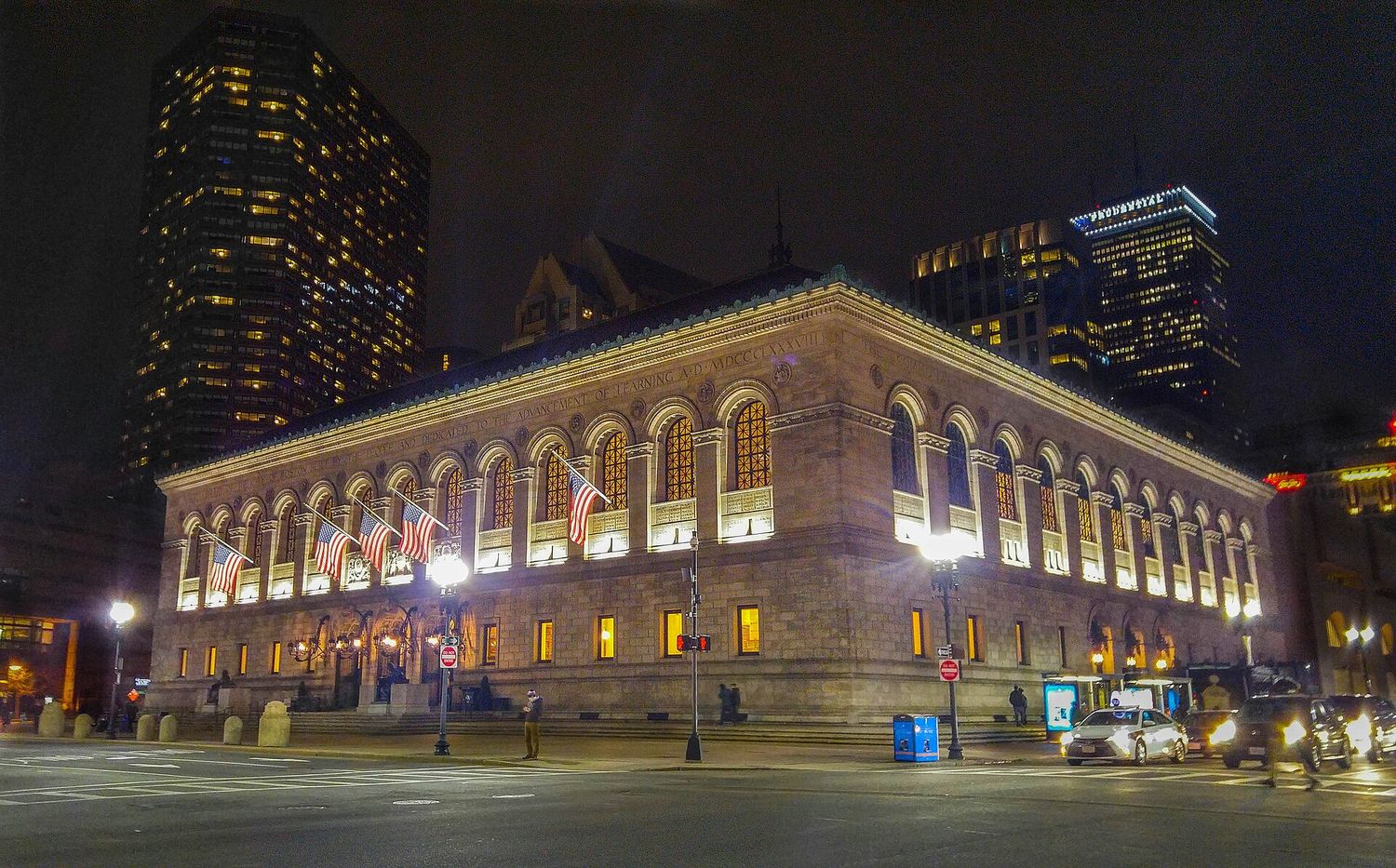
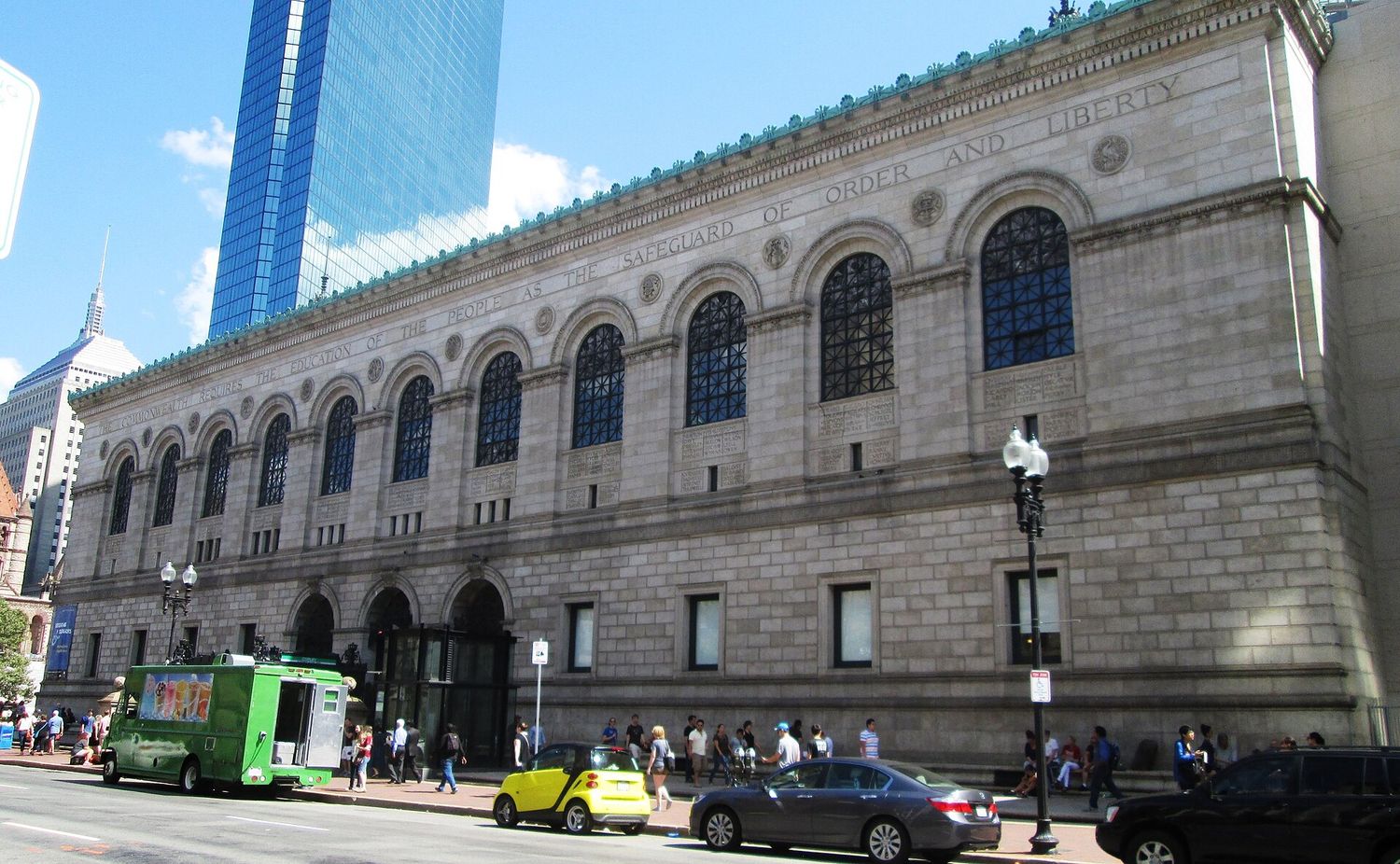
Start outside, on the steps facing Copley Square. The architect Charles Follen McKim, of McKim, Mead & White, modeled the building on the great Renaissance palaces of Italy and on the Bibliothèque Sainte-Geneviève in Paris, and he wanted it to be, in the words used at the time, a palace for the people. The long row of arched windows lights Bates Hall on the second floor. Above them runs the dedication: The Public Library of the City of Boston, built by the people and dedicated to the advancement of learning. Below the windows, carved into panels, are the names of hundreds of great writers, artists and scientists.
Look at the three arched doorways. Over the central one are the words Free to All. The bronze doors themselves, by Daniel Chester French, the sculptor of the Lincoln Memorial, show allegorical figures representing Music and Poetry, Knowledge and Wisdom, and Truth and Romance.
2. The entrance hall
Inside the doors, the vestibule and entrance hall are roofed in pale tile vaults built by Rafael Guastavino, the Spanish builder whose interlocking tile system later appeared in Grand Central Terminal and Ellis Island. The Boston Public Library was one of the first major American buildings to use it. Look up: the tiles form shallow domes with no visible support.
3. The grand staircase
The main staircase climbs in yellow Siena marble past two great marble lions by Louis Saint-Gaudens, the brother of Augustus. They are memorials to two Massachusetts infantry regiments of the Civil War, and generations of children have stroked their paws smooth. On the walls of the landing and the upper hall are murals by the French painter Pierre Puvis de Chavannes, pale and dreamlike, depicting the Muses and the branches of human knowledge. They are his only murals in the United States, and the soft colors were chosen to harmonize with the marble.
4. Bates Hall
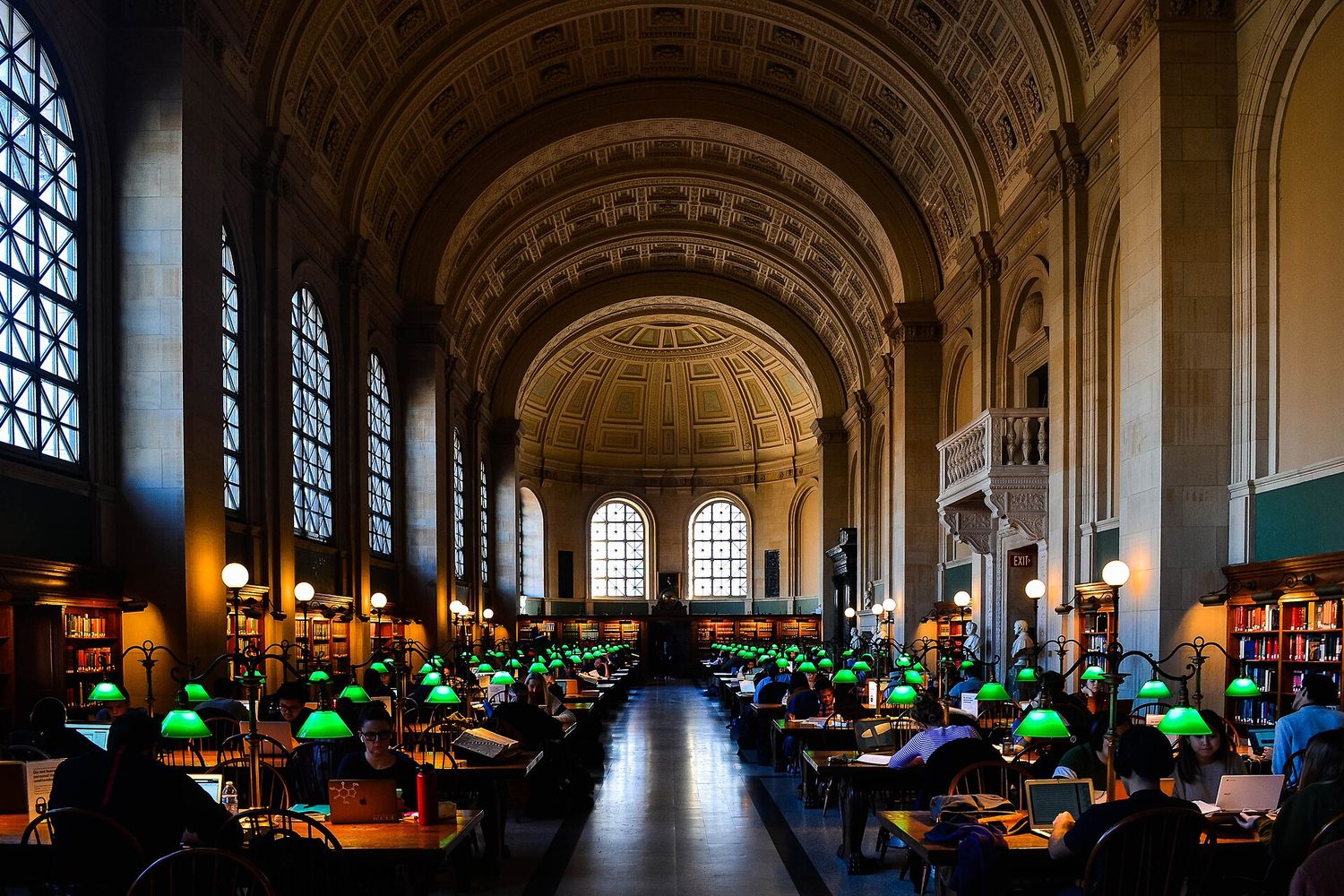
At the top of the stairs, turn into Bates Hall, and stop. The main reading room runs 218 feet along the front of the building under a coffered barrel vault, lit by the arched windows on Copley Square and by long rows of green-shaded lamps on oak tables. It is named after Joshua Bates, a Massachusetts-born London banker whose gift helped found the library. Anyone can sit and read here; it is still very much in use, so keep your voice down and your phone on silent.
Most visitors take a photo from the doorway and leave. Instead, walk quietly the full length of the room and back. The scale only becomes clear when you are in the middle of it.
5. The Abbey Room
Nearby on the same floor is the Abbey Room, once the room where books were delivered to readers, now a quiet space lined with a mural cycle by the American painter Edwin Austin Abbey telling the story of the Quest for the Holy Grail. The paneled room, with its fireplace and rich colors, is one of the most atmospheric in the building.
6. The Sargent Gallery
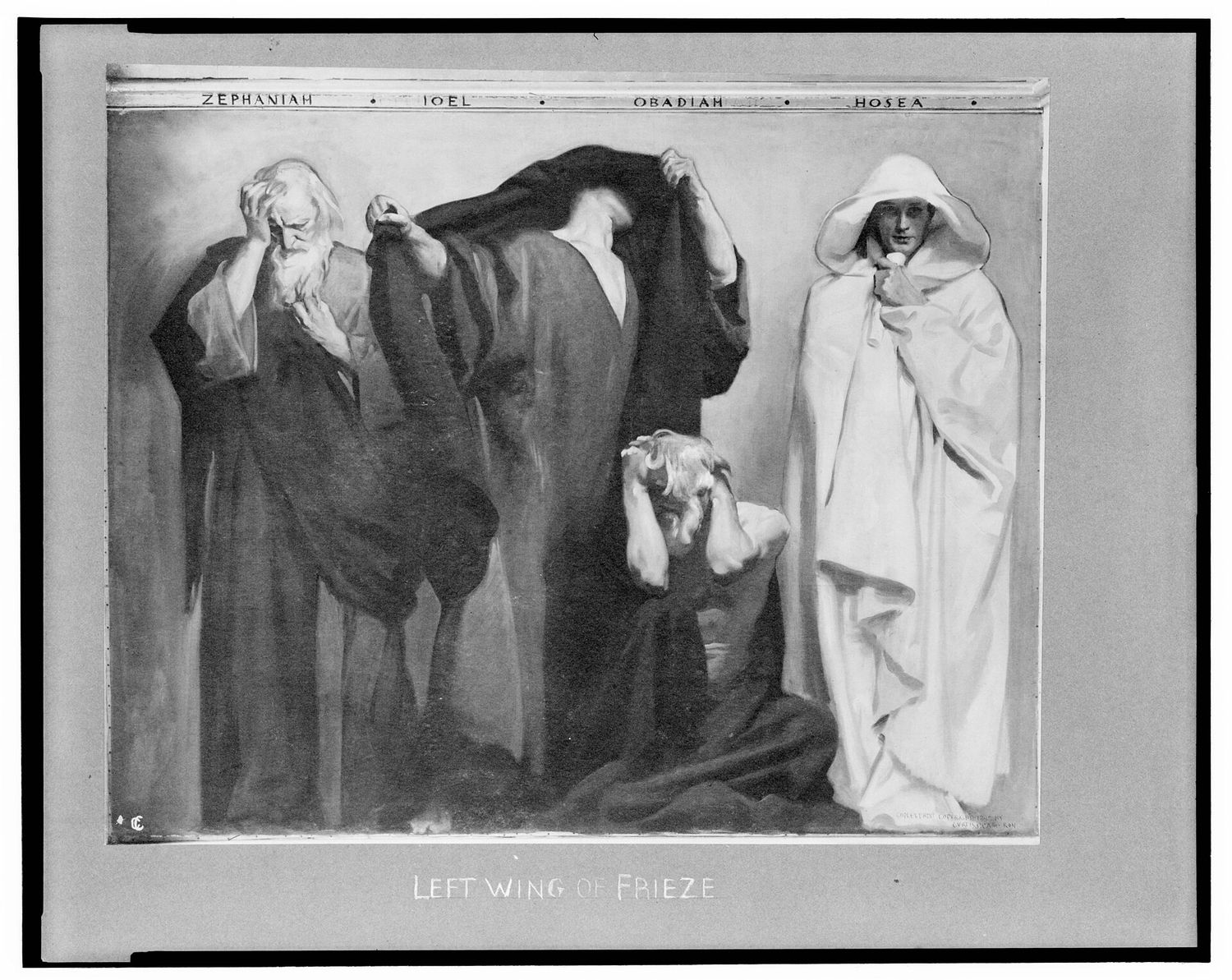
Climb to the third floor for the Sargent Gallery, a long, narrow hall covered from floor to vaulted ceiling in John Singer Sargent’s mural cycle, The Triumph of Religion. Sargent, the most fashionable portrait painter of his day, worked on it on and off for nearly thirty years, from the 1890s until 1919, and considered it his most important work. It is dense, dark, gilded and strange — part painting, part sculpture, with raised and molded elements — and nothing like his portraits. The Frieze of the Prophets along one wall is the most accessible part, a line of brooding figures in robes. There is more on the murals, and the controversy over one of them, below.
7. The courtyard
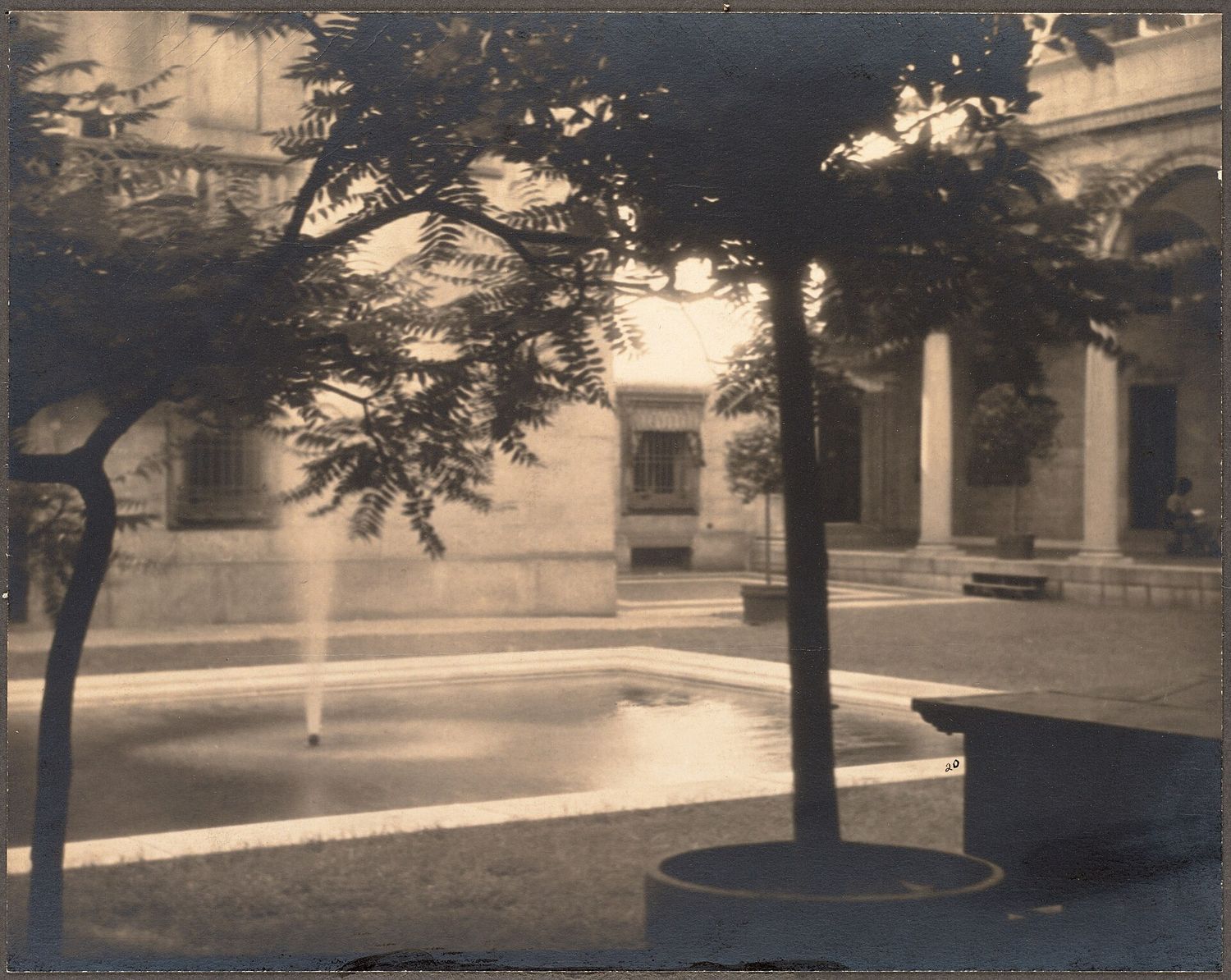
Come back down to the ground floor and find your way into the courtyard, the building’s secret heart. It is modeled on the courtyard of a Roman palace, with an arcaded walk on all four sides, a rectangular pool and fountain in the middle, and chairs for sitting. From May to October it is one of the most peaceful places in Boston, a few yards from the traffic on Boylston Street but completely insulated from it.
The bronze in the fountain has a story. In 1896 the architect McKim gave the library a statue by Frederick MacMonnies of a naked, laughing Bacchante holding a baby and a bunch of grapes. Boston’s moral guardians were scandalized, the trustees had it removed, and the original went to the Metropolitan Museum in New York. A copy was finally installed in the courtyard more than a century later. Find her, and enjoy the fact that she won in the end.
8. The Leventhal Map & Education Center
Just off the main entrance hall is the Norman B. Leventhal Map & Education Center, which holds one of the finest map collections in the country and puts on free exhibitions drawn from it. If you like maps — and even if you think you don’t — ten minutes here is time well spent. See leventhalmap.org for the current show.
9. The Johnson Building
The modern wing behind the McKim Building, facing Boylston Street, was designed by Philip Johnson and opened in 1972. It holds the circulating collections, the children’s library and the teen space, and a renovation in the 2010s opened it up to the street with big windows. It is useful rather than beautiful; if you are short of time, skip it and give the extra minutes to the courtyard.
Details most visitors miss
The McKim Building rewards slow looking. A few things to seek out once you have seen the big rooms:
- The floor of the entrance hall. Look down as you come in: the signs of the zodiac are inlaid in brass in the marble floor. Most people are looking up at the vaults and walk straight over them.
- The names on the facade. Before you go in, spend two minutes reading the panels under the windows. The list of great names runs from Moses and Homer to scientists and painters of the nineteenth century, and working out who made the cut — and who did not — is an entertaining game.
- The view from the staircase landing. Stop halfway up the grand staircase and look back down through the arches to the entrance hall. It is the best framed view in the building, and the lions are at their most imposing from here.
- The Venetian Lobby. On the second floor, a small lobby is painted with scenes of Venice, a reminder of how thoroughly McKim and his artists looked to Italy for their models.
- The windows of Bates Hall from outside. After dark, when the green lamps are lit, the arched windows glow along the length of Copley Square. Walk past in the evening if you can.
- The courtyard’s upper arcade. From the second-floor windows you can look down into the courtyard, which from above looks even more like a Roman palace than it does at ground level.
The story of the library
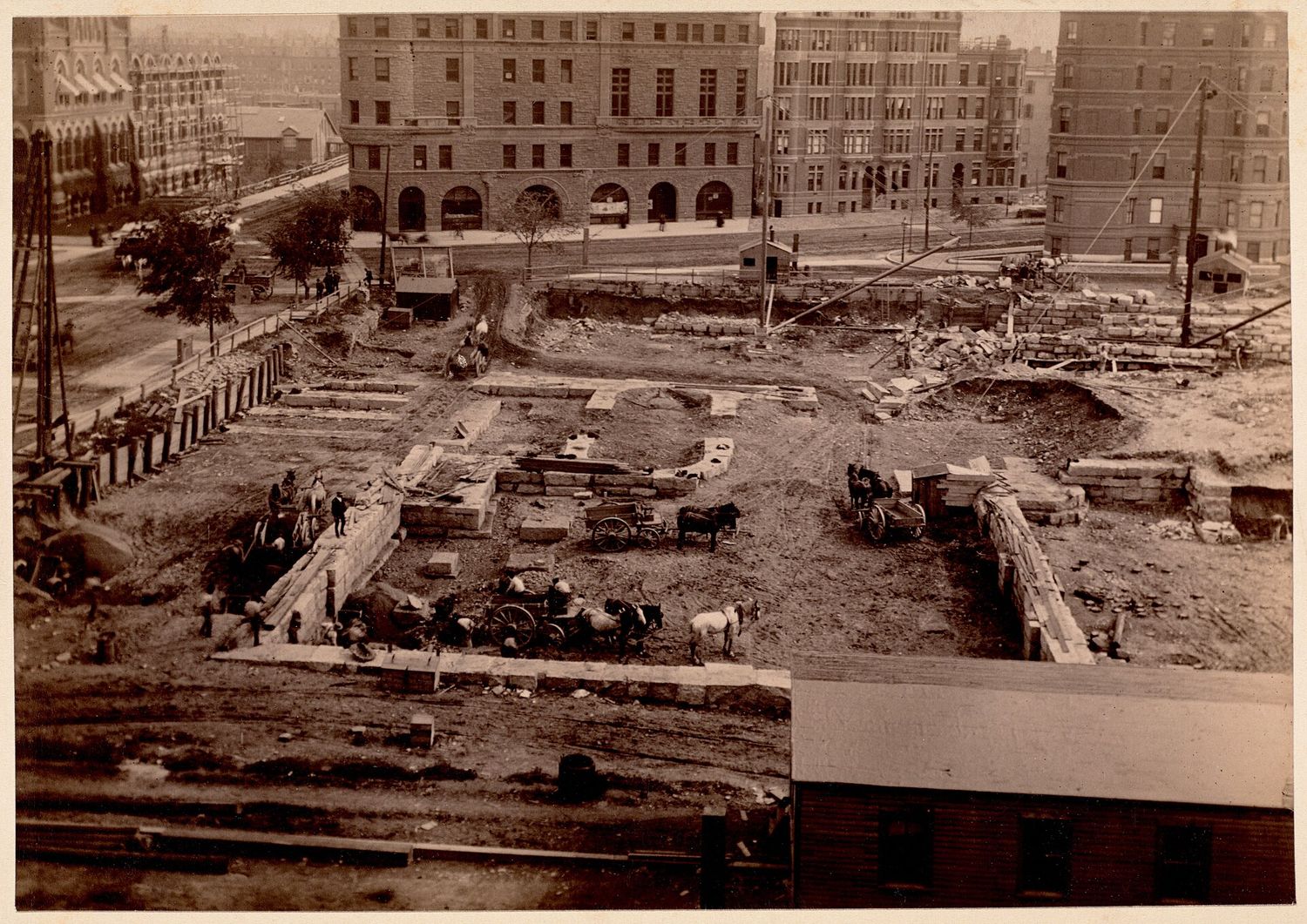
The Boston Public Library was founded in 1848, when the Massachusetts legislature authorized the city to create a library funded by taxes and open to every resident. It was the first large free municipal library in the United States, and it was a radical idea: a library that belonged not to scholars or subscribers, but to the public. It opened in 1854 in a former schoolhouse, soon moved to a building on Boylston Street facing the Common, and within a generation had outgrown it.
The new building on Copley Square was commissioned from McKim, Mead & White in the 1880s, and it took most of a decade to build. McKim treated it as a civic monument, bringing in the best artists he could find — Sargent, Abbey, Puvis de Chavannes, French, Saint-Gaudens — to decorate it. When it opened in 1895, it set the pattern for public libraries across the country, and many of the Carnegie libraries that followed borrowed its language of arches, reading rooms and carved inscriptions.
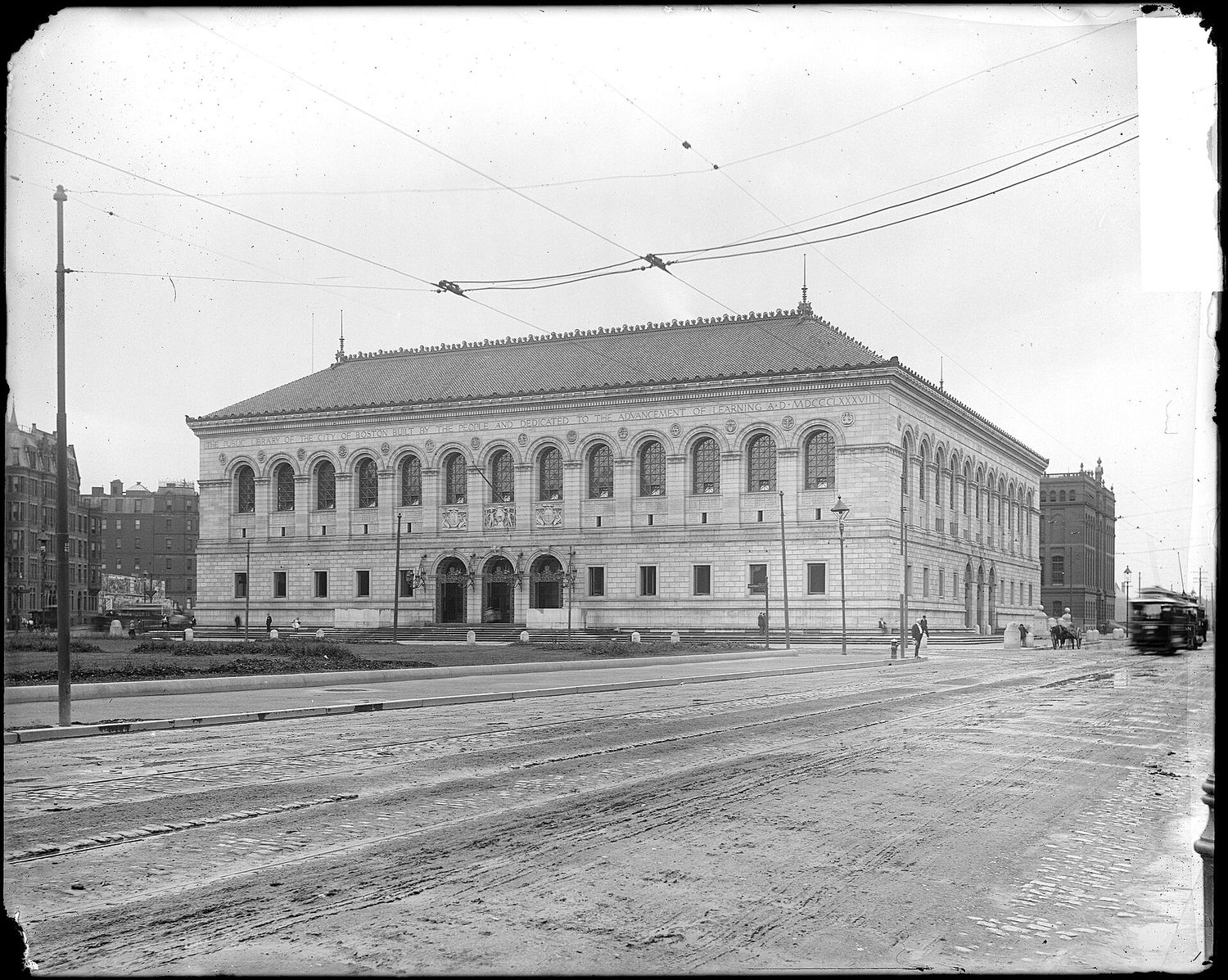
Today the Boston Public Library runs branches across the city, and the Central Library holds millions of items, including rare books, manuscripts, prints and maps. It is still free to all, and it is still used every day by students, researchers and people who simply want a beautiful place to read.
The Sargent murals, and the controversy
Sargent’s Triumph of Religion was meant to trace the development of religious thought from ancient polytheism through Judaism to Christianity. It is a work of great ambition and technical daring, and when the gallery was restored in the early 2000s, the color and gilding came back to startling life.
It is also a work with a problem. One of the panels Sargent installed in 1919, Synagogue, shows Judaism as a defeated, blindfolded woman with a broken crown, set opposite a triumphant figure representing the Church. It drew protests from Boston’s Jewish community almost as soon as it went up, and there were calls, including in the state legislature, for it to be removed. It is still there, and the library now provides interpretation that explains its history and why many people find it offensive. The gallery is worth seeing, but go in knowing that part of what you are looking at is an argument about religion painted from one side.
When to visit
The library is at its best on a weekday morning, when Bates Hall is quiet and the light through the arched windows is soft. Weekday afternoons bring more students, and weekends more visitors, but the building is so large that it rarely feels crowded.
It is also the ideal rainy-day destination in Back Bay: free, dry, warm in winter and cool in summer, with restrooms, wifi and coffee. When the weather turns on a sightseeing day, this is where to go.
The courtyard is best from late spring to early fall, when the chairs are out and the fountain is running. In winter you can still look at it through the windows of the arcade.
One day to avoid: Marathon Monday, the third Monday in April, when the race finishes on Boylston Street outside and the whole of Copley Square is closed to traffic and packed with spectators. The library’s hours may also change that day.
With children
Children often enjoy the library more than their parents expect. The marble lions on the staircase are there to be stroked, Bates Hall is impressive even to a seven-year-old, and the courtyard fountain is a good place for a snack. The Johnson Building has a children’s library with its own programs and story times, which is a useful refuge for younger children. For a full plan, see our guide to Boston with kids.
Practical details
- Hours: the Central Library is open most days, with shorter hours on some days and seasonal changes to Sunday opening. Check the Central Library page for current times before you go.
- Entrance: for the full effect, use the main Dartmouth Street entrance on Copley Square. The Boylston Street entrance into the Johnson Building avoids the front steps; ask staff about elevator access to the McKim Building’s upper floors.
- Quiet, please: Bates Hall and the other reading rooms are in use. Photographs for personal use are usually fine, but no flash, and do not photograph readers.
- Food: the library has a café and a restaurant in the McKim Building, and afternoon tea there has long been a Boston tradition. Check current hours on the library’s site.
- Restrooms: available, and among the most reliable free restrooms in Back Bay.
- Wifi: free throughout the building.
- Groups: contact the Visitor Experience team at [email protected] or 617-859-2216.
Is it worth it?
Yes, without qualification. The Boston Public Library is free, central, open most days and in any weather, and it contains Bates Hall, one of the most beautiful rooms in the country. In our ranking of the top attractions in Boston it sits sixth — ahead of several attractions charging $30 and more.
The only ways to get it wrong are to rush it or to miss the best parts. Allow an hour at the very least. Do not stop at the doorway of Bates Hall. Climb to the third floor for Sargent. And go into the courtyard, which a surprising number of visitors never find.
What is not worth it: paying for a third-party “library tour” when the library’s own is free, or visiting only the Johnson Building because it is on Boylston Street, where most people walk past.
Around Copley Square
The library faces one of the finest public squares in America, and it is easy to spend a whole afternoon here.
- Trinity Church, directly opposite, is H. H. Richardson’s Romanesque masterpiece of 1877, with interiors by John La Farge. It charges admission for visitors; check trinitychurchboston.org for tour times and prices.
- Old South Church, on the corner of Boylston and Dartmouth, is a Venetian Gothic church from 1875 with a tall campanile.
- The Boston Marathon finish line is painted across Boylston Street right beside the library. The race finishes here on Patriots’ Day, the third Monday in April; see our guide to Boston events.
- Newbury Street, one block north, for boutiques and cafés.
- View Boston, at the top of the Prudential Tower a few minutes away. Our guide to the View Boston observation deck covers tickets and the best time to go up.
- The Mapparium, a walk-through stained-glass globe at the Mary Baker Eddy Library, about ten minutes’ walk away: $6 for adults, free for under-18s.
A Back Bay day that works: the library’s guided tour in the morning, lunch nearby, Trinity Church, a walk along Newbury Street, and View Boston for sunset. Our Boston itinerary builds this into a full plan.
Getting there
Copley station on the Green Line comes up right outside the library on Boylston Street. Back Bay station, on the Orange Line and commuter rail, is about five minutes’ walk south. Several bus routes stop nearby, including the 9, 10, 39 and 55. A subway ride is $2.40 with a CharlieCard, contactless card or cash; check mbta.com for service changes, and see our guide to getting around Boston.
Boston Public Library tour: frequently asked questions
Is the Boston Public Library tour free?
Yes. The library’s public Art & Architecture tours are free, as is entry to the building. Advance registration is required for the guided tours, up to one month ahead.
How often are Boston Public Library tours offered?
Public guided tours of the Central Library are offered weekly. Check the library’s tours page for the current schedule and to register.
Can I visit the Boston Public Library without a tour?
Yes. The building is open to everyone during library hours, and you can explore on your own. The free Bloomberg Connects app has a 30-minute audio tour.
How long does it take to see the Boston Public Library?
About an hour for Bates Hall, the grand staircase, the Sargent Gallery and the courtyard. Allow two if you want to linger, see an exhibition or stop for coffee.
What is Bates Hall?
The library’s main reading room: 218 feet long, under a barrel-vaulted ceiling, with green-shaded lamps on long oak tables. It is named after the benefactor Joshua Bates and is still in daily use.
Where are the Sargent murals in the Boston Public Library?
On the third floor of the McKim Building, in the Sargent Gallery. The cycle is called The Triumph of Religion, and Sargent worked on it for nearly thirty years.
What T stop is closest to the Boston Public Library?
Copley, on the Green Line, which comes up right beside the library. Back Bay, on the Orange Line, is about five minutes’ walk away.
Bates Hall is also the best free shelter in the city when the weather turns. If a downpour has wrecked your plans, our guide to things to do in Boston when it rains pairs the library with the Athenaeum, the Fenway museums and the indoor stops of the Freedom Trail, and lists the days each one is closed.