Boston rain rarely falls straight down. It comes in sideways off the harbor, turns the brick sidewalks of Beacon Hill into slides and finds the gap between your collar and your neck within about four minutes. The good news is that the city was built by people who spent a lot of time indoors, and they filled it with museums, libraries and meeting halls that are at their best when the weather is at its worst. The list of things to do in Boston when it rains is long enough that a wet day here often turns out better than the dry one you planned.
This guide covers the art museums, the science and family attractions, the libraries, the indoor half of the Freedom Trail, where to eat without getting soaked, the covered walkways of Back Bay, a handful of odd small museums, rainy evenings, and the things you should not bother with in bad weather. It ends with four ready-made rainy-day plans and a cost table. Prices and hours were checked in September 2026; confirm before you book, because museums change their hours more often than their collections.
The short version: the best rainy-day picks
If you only read one section, read this one. These are the places that reward a wet afternoon, with the day each one is closed, because the most common rainy-day mistake in Boston is walking twenty minutes through a downpour to a locked door.
| Place | Area | Adult price | Allow | Closed |
|---|---|---|---|---|
| Museum of Fine Arts | Fenway | $30 | 3–4 hours | Tuesday |
| Isabella Stewart Gardner Museum | Fenway | $25 | 2 hours | Tuesday |
| Boston Public Library, McKim Building | Copley Square | Free | 1 hour | Check bpl.org |
| Boston Athenaeum (first floor) | Beacon Hill | $11 | 1 hour | Sunday |
| Museum of Science | Science Park | About $33 | Half a day | Open daily |
| New England Aquarium | Waterfront | $39.95 | 2–3 hours | Open daily |
| Harvard Art Museums | Cambridge | Free | 2 hours | Monday |
| Institute of Contemporary Art | Seaport | $20 | 1.5 hours | Monday |
| Old State House and Old South Meeting House | Downtown | $18 for both | 1.5 hours | Open daily |
| Boston Public Market | Haymarket | Free to enter | 1 hour | Open daily |
Notice the pattern: Tuesday takes out the two big Fenway museums and the Children’s Museum, and Monday takes out the ICA and the Harvard Art Museums. If rain is forecast for early in the week, plan around those gaps first and fill in the rest after.
Art museums built for a wet afternoon
Museum of Fine Arts
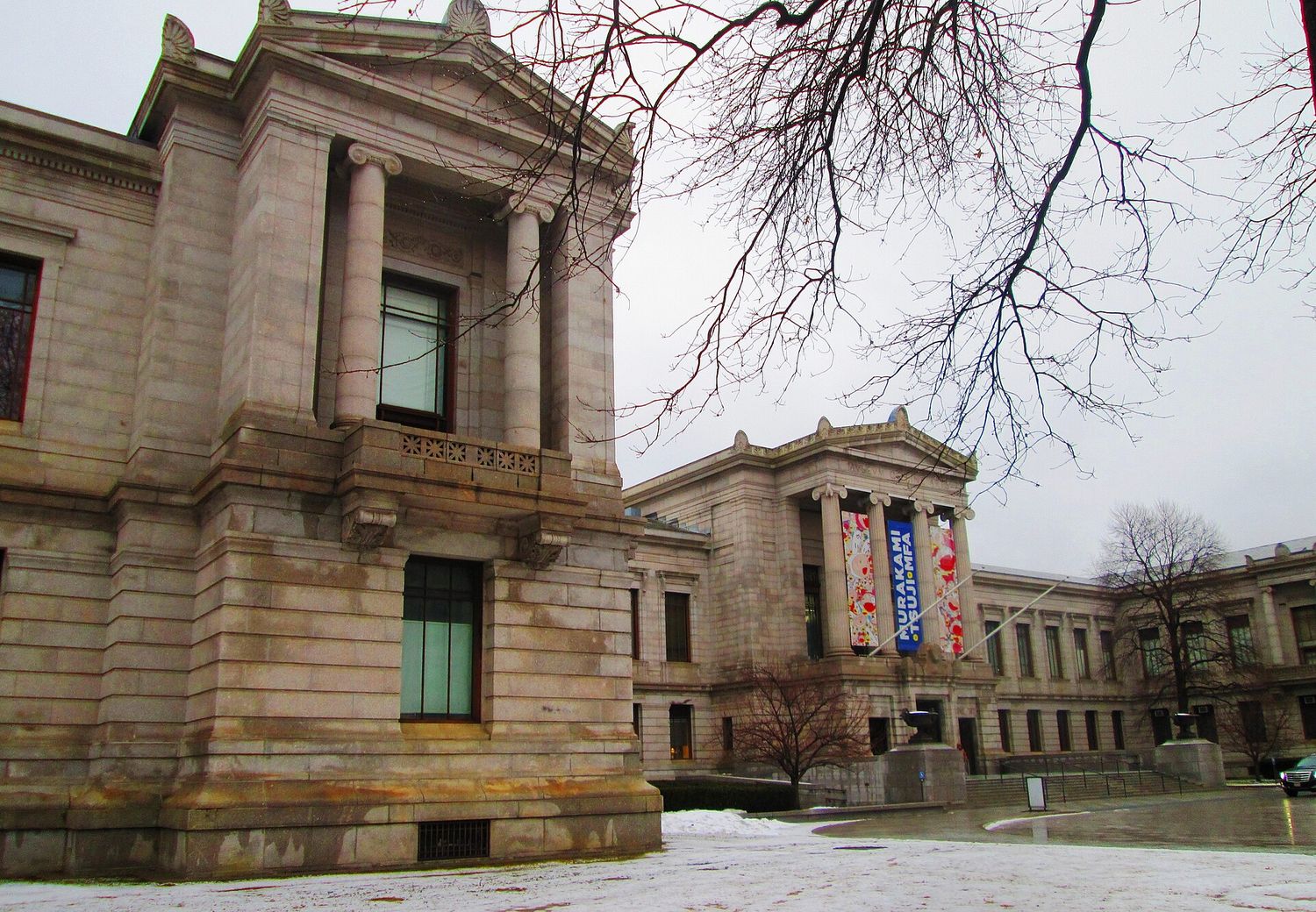
The Museum of Fine Arts is the obvious answer to a wet day, and for once the obvious answer is correct. It is enormous, with a collection running from Egyptian tombs to John Singer Sargent to a whole wing of American art, and you could lose a week in it. Admission is $30 for adults and $14 for ages 7 to 17; under-7s are free. It is closed on Tuesdays and stays open until 10pm on Thursdays and Fridays, which makes it the best place in the city to spend a rainy evening that does not involve a bar.
The trap is ambition. Visitors on a rainy day tend to arrive thinking they have finally got time to do the MFA properly, and at hour three they are glazed and wandering the corridors looking for a bench. Pick two or three areas before you go in. The Art of the Americas wing, with Paul Revere’s Sons of Liberty Bowl and Copley’s portraits of the people who started the Revolution, is the one that connects best to everything else you will see in Boston. Take the Green Line E branch to the Museum of Fine Arts stop, or the Orange Line to Ruggles and walk ten minutes.
Isabella Stewart Gardner Museum
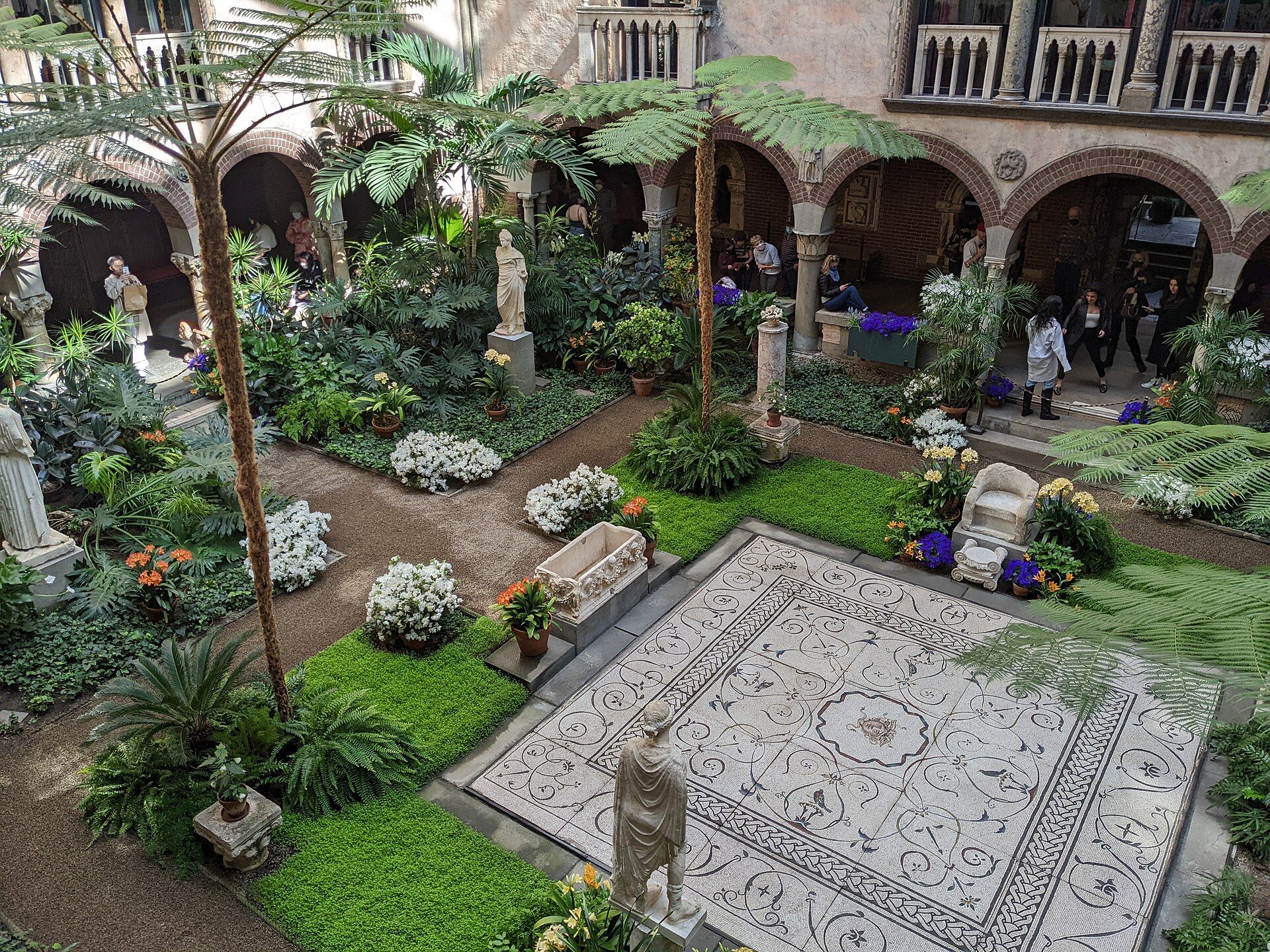
Five minutes’ walk from the MFA, the Gardner is the rainy-day museum people remember longest. Isabella Stewart Gardner built a Venetian palace around a flowering courtyard, filled it with Titian, Rembrandt and Sargent, and left instructions that nothing be moved. When thieves took thirteen works in March 1990, including a Vermeer and three Rembrandts, the museum could not rearrange the rooms, so the empty frames still hang where the paintings were. The case remains unsolved.
Admission is $25 for adults, $22 for seniors and $15 for students, and everyone under 18 gets in free, as does anyone named Isabella, for life. It is closed on Tuesdays. The Gardner is small enough to see in two hours, which makes it the better choice if you have only one museum slot. On a very wet Saturday it gets busy, because every local with the same idea has also remembered the courtyard, so aim to arrive at opening.
Institute of Contemporary Art
The ICA cantilevers out over the harbor in the Seaport, and its glass-walled Founders Gallery is one of the few places in Boston where watching a storm roll in counts as the main attraction. Adults pay $20, seniors $17 and students $15; under-18s are free, and the museum is free for everyone on Thursday evenings from 5 to 9pm. It is closed on Mondays. The collection is contemporary and the building is the draw as much as the art. Take the Silver Line to Courthouse, or walk from South Station in about fifteen minutes if the rain is light.
Harvard Art Museums
Across the river in Cambridge, the Harvard Art Museums have been free to everyone since 2023, which makes them the best-value rainy day in the region. Three collections live under one glass roof: the Fogg, the Busch-Reisinger and the Arthur M. Sackler. They are open Tuesday to Sunday, 10am to 5pm. The Red Line to Harvard drops you a few minutes’ walk away, and you can combine them with the natural history museum below for a full Cambridge day that costs less than a single MFA ticket. Our Cambridge and Harvard guide covers the rest of the square.
Science, sea creatures and things kids will like
Museum of Science
The Museum of Science sits on a dam across the Charles River and is the single most popular rainy-day destination for families in Boston, which is both its strength and its problem. General admission is about $33 for adults, $28 for ages 3 to 11 and $29 for seniors, with the planetarium and the Omni theater costing about $6 each on top. It is open daily from 9am to 5pm. There is enough here for a whole day, from the lightning show to the dinosaur hall, and older children will not want to leave.
The honest caveat: on a wet Saturday in school vacation week, this building is packed from the moment the doors open. If you have a choice of days, go on the weekday. If you do not, arrive at 9am, head to the far end of the building first, and book any planetarium or Omni show as soon as you arrive, because they sell out. The Green Line stop is Science Park/West End.
New England Aquarium
The New England Aquarium on Central Wharf is built around its four-story Giant Ocean Tank, with a ramp spiraling up the outside so you circle the sea turtles and sharks as you climb. The penguin colony at the bottom is the part small children talk about afterwards. Tickets are $39.95 for adults, $30.95 for ages 3 to 11 and $37.95 for seniors 60 and over; it is open 9 to 5 on weekdays and 9 to 6 on weekends. Take the Blue Line to Aquarium.
Is it worth $39.95 on a rainy day? For families with children under about twelve, yes. For two adults with no particular interest in fish, the MFA or the Gardner is a better use of the money and the time. The aquarium is also one of the choices on Boston CityPASS, and on a rainy trip it is one of the combinations where the pass pays back, because you are likely to visit the Museum of Science too.
Boston Children’s Museum
On Fort Point Channel, behind the 40-foot Hood Milk Bottle, the Children’s Museum charges $24 for everyone aged one and over, adults included, and is free for babies under twelve months. It is open Wednesday to Monday, 9am to 4pm, and closed on Tuesdays. It is best for children from toddlers to about eight or nine. Parents of older children should go to the Museum of Science instead. South Station on the Red Line is a ten-minute walk.
MIT Museum and the Glass Flowers
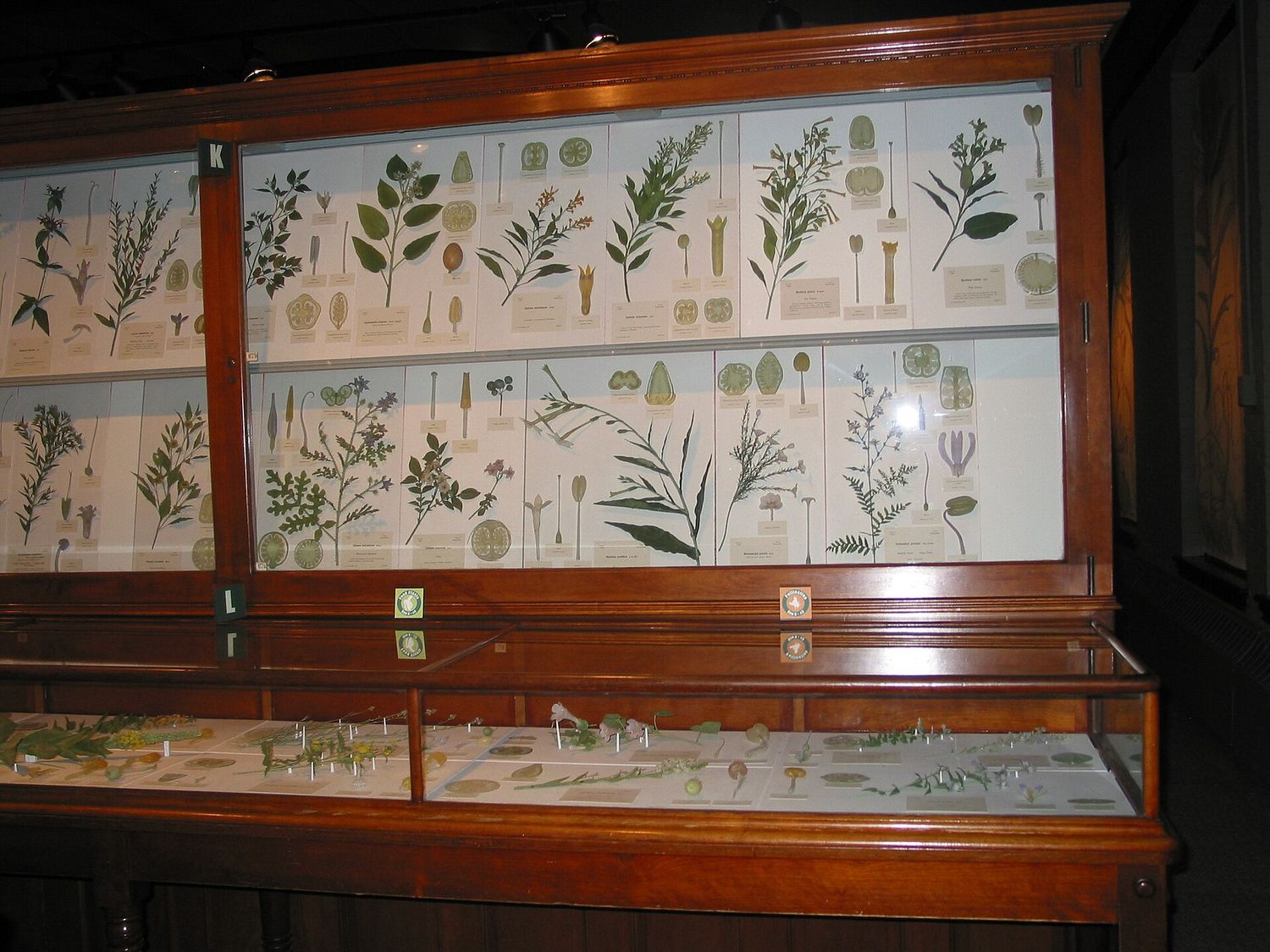
Two Cambridge museums make a strong rainy afternoon for curious adults and older children. The Harvard Museum of Natural History holds the Glass Flowers, more than 4,300 models of over 780 plant species made by a father and son in Dresden between the 1880s and the 1930s. They look so real that most visitors assume, for the first minute or two, that they are pressed specimens. Admission rose on 1 July 2026 to $20 for adults, $18 for seniors and $15 for ages 3 to 18. Massachusetts residents get in free on Sunday mornings from 9 to noon and on Wednesday afternoons from 3 to 5.
A mile east in Kendall Square, the MIT Museum at 314 Main Street is open daily from 10am to 5pm, with adult tickets at $20, students and ages 6 to 18 at $10, and a $55 family ticket for two adults and two young people. Its robots and holograms are a good match for teenagers who have had enough of paintings. It sits beside the Kendall/MIT stop on the Red Line, so you can link the two by train without a long walk in the rain.
Libraries: the best free shelter in the city
Boston Public Library
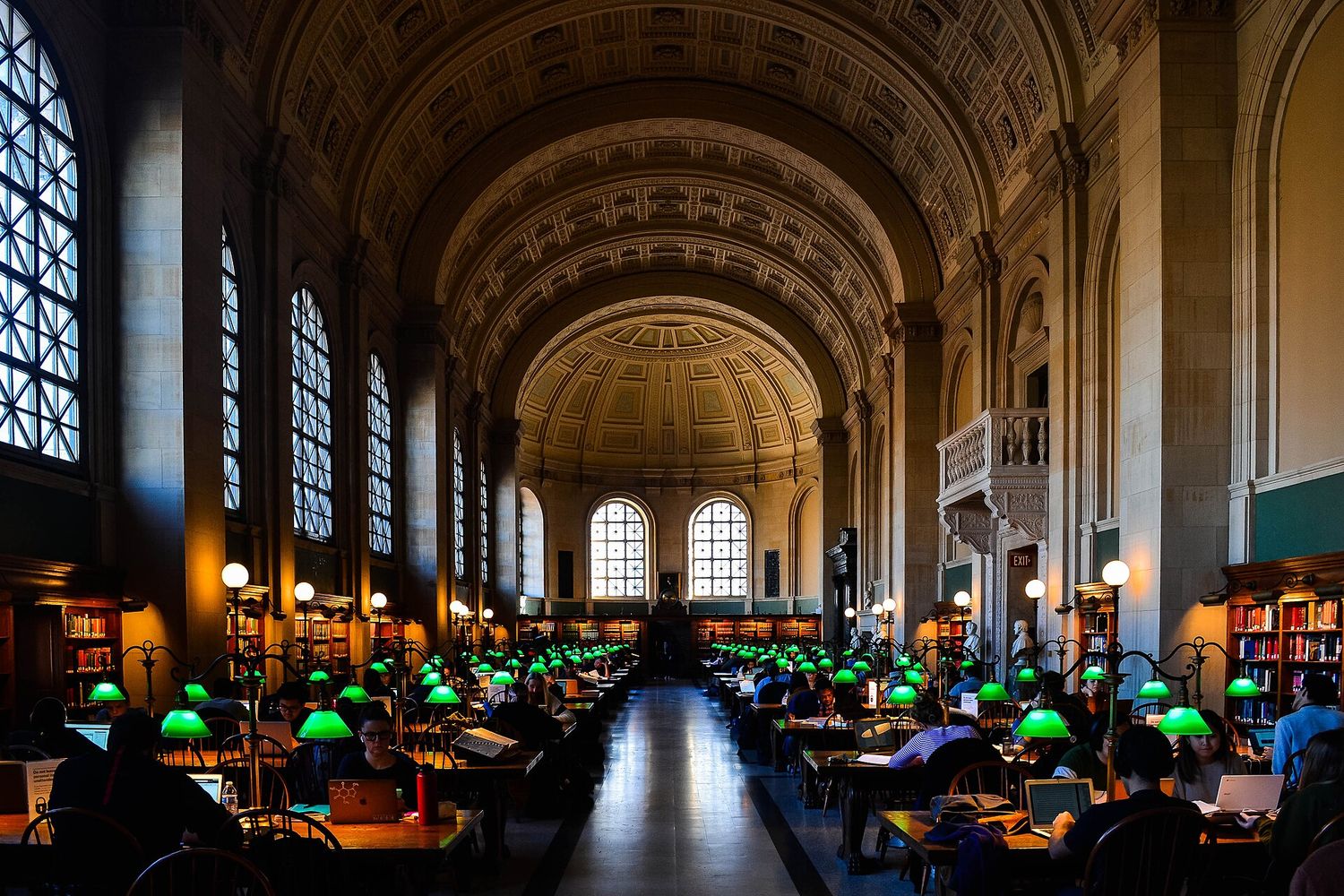
The McKim Building on Copley Square opened in 1895 as the first large free municipal library in America, and it still behaves like one: walk in, climb the marble staircase past the Chavannes murals, and you are in Bates Hall, a 218-foot barrel-vaulted reading room under green lamps. Nobody will ask why you are there. On the third floor are the Sargent murals, and in the middle of the building is an arcaded courtyard that is lovely to look at from under cover when rain is hammering the fountain.
The library runs free Art and Architecture tours each week, which need advance registration on bpl.org, and there is a free 30-minute audio tour in the Bloomberg Connects app. Check current opening hours on the library’s website before you go. We have a full Boston Public Library tour guide that walks the building room by room. Take the Green Line to Copley.
Boston Athenaeum
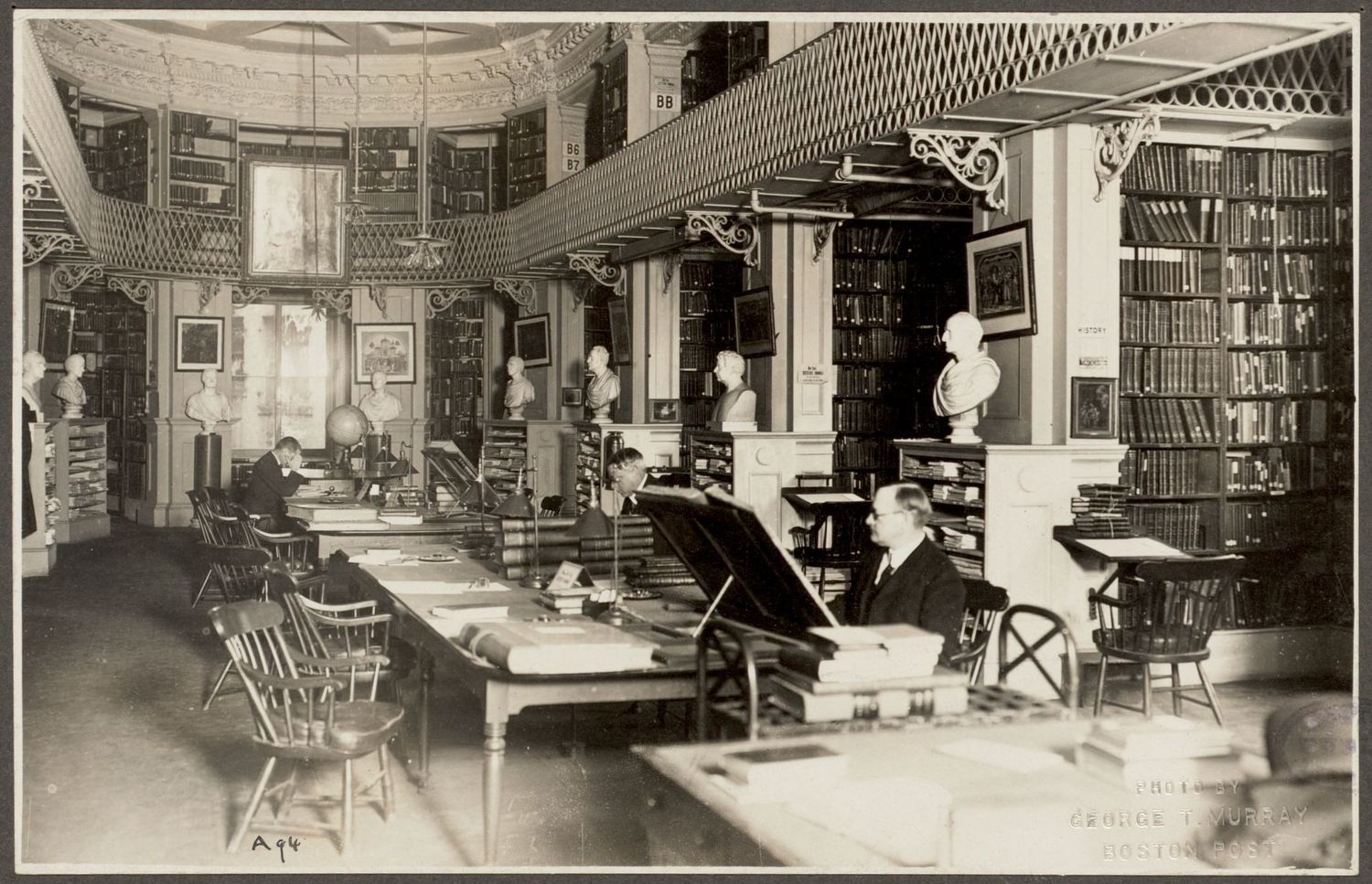
If the BPL is the people’s library, the Boston Athenaeum at 10½ Beacon Street is the private club next door to the State House, founded in 1807 and still run by subscription. Most visitors never realize they can go in. Non-members pay $11 for adults, $8 for students, educators and military, and $5 for children 13 and under, which buys the first floor: the Norma Jean Calderwood Gallery, rotating art and special collections displays, and the architecture of a building from 1849. The upper floors are for members, but a $40 day membership opens them, and the docent-led one-hour Art and Architecture tours include first-floor admission.
It is open Monday to Thursday from 9am to 8pm and Friday and Saturday from 9am to 5pm, and closed on Sunday. Check tour dates on the Athenaeum’s visit page. Park Street station is two minutes away. For book lovers this is one of the best hours you can spend in Boston in any weather.
The Mapparium
At the Mary Baker Eddy Library on Christian Science Plaza, the Mapparium is a three-story stained-glass globe from 1935 that you walk through on a glass bridge. The political borders are frozen in the year it was made, and the acoustics are so strange that a whisper at one end arrives clearly at the other. Tickets are $6 for adults and free for under-18s, sold as timed entries, so book ahead on a rainy day. Hours were not published when we checked; see marybakereddylibrary.org. It is the shortest visit on this list and one of the most memorable.
Doing the Freedom Trail when it’s raining
The Freedom Trail is 2.5 miles of red-brick line on the sidewalk and it does not stop for weather. Walking all of it in a nor’easter is miserable, and three of the sixteen stops are burying grounds with nothing to shelter under. But roughly half the trail is indoors, and a rainy day is a good excuse to do that half properly instead of rushing past it.
- Old State House and Old South Meeting House — one Revolutionary Spaces ticket covers both: $18 for adults, $16 for seniors and $10 for ages 6 to 17. Both are open daily from 10am to 5pm. The Old State House balcony is where the Declaration of Independence was first read in Boston; Old South is where the meeting that became the Boston Tea Party broke up.
- Faneuil Hall — free. National Park Service rangers give 15-minute talks in the Great Hall Wednesday to Sunday, on the half hour from 10:30am to 3:30pm. See our Faneuil Hall Marketplace guide for what else is in the building.
- Paul Revere House in the North End — $6 for adults, $5.50 for students and $1 for ages 5 to 17. Built around 1680, it is the oldest surviving house in downtown Boston, and about 40 minutes is right.
- Old North Church — $10 for adults and $5 for young people, with the crypt included, or $15 with a guided tour of the bell chamber. The crypt is the part to linger in on a wet day.
- Massachusetts State House — free guided tours on weekdays only, roughly 10am to 3:30pm, starting in Doric Hall. The building is closed on weekends, so a Saturday rain plan cannot include it.
The $35.10 Boston 250 Pass, worth buying only if you will visit all five, covers adult entry to five of the paid sites: the Paul Revere House, the Old State House, Old North Church, Old South Meeting House and King’s Chapel. The outdoor stops, the Granary and Copp’s Hill burying grounds and the Bunker Hill Monument with its 294 steps and no elevator, can wait for a dry morning.
Eating your way through a rainy day

Rain makes lunch the main event, and two indoor markets sit five minutes apart. The one worth your money is the Boston Public Market at 100 Hanover Street, directly above Haymarket station on the Orange and Green Lines. It is open daily from 8am to 8pm with more than 30 New England farmers, bakers, cheesemakers and cooks under one roof, and everything is grown or made in the region. It is a real market used by people who live here, and you can eat well in it for $15 to $20.
Quincy Market, across the street, is the one everybody goes to, and on a rainy day it is where everybody goes at once. The 1826 granite hall is worth walking through, but the food inside is essentially a food court, the seating in the central rotunda fills fast, and you will eat standing up among wet backpacks. Walk through it for the building; eat at the Public Market.
If the rain eases, the North End is a five-minute walk over the Greenway, and its cafes are made for sitting out a shower with an espresso. Our Boston food guide covers where to go.
Staying dry between stops: Back Bay’s covered walkways
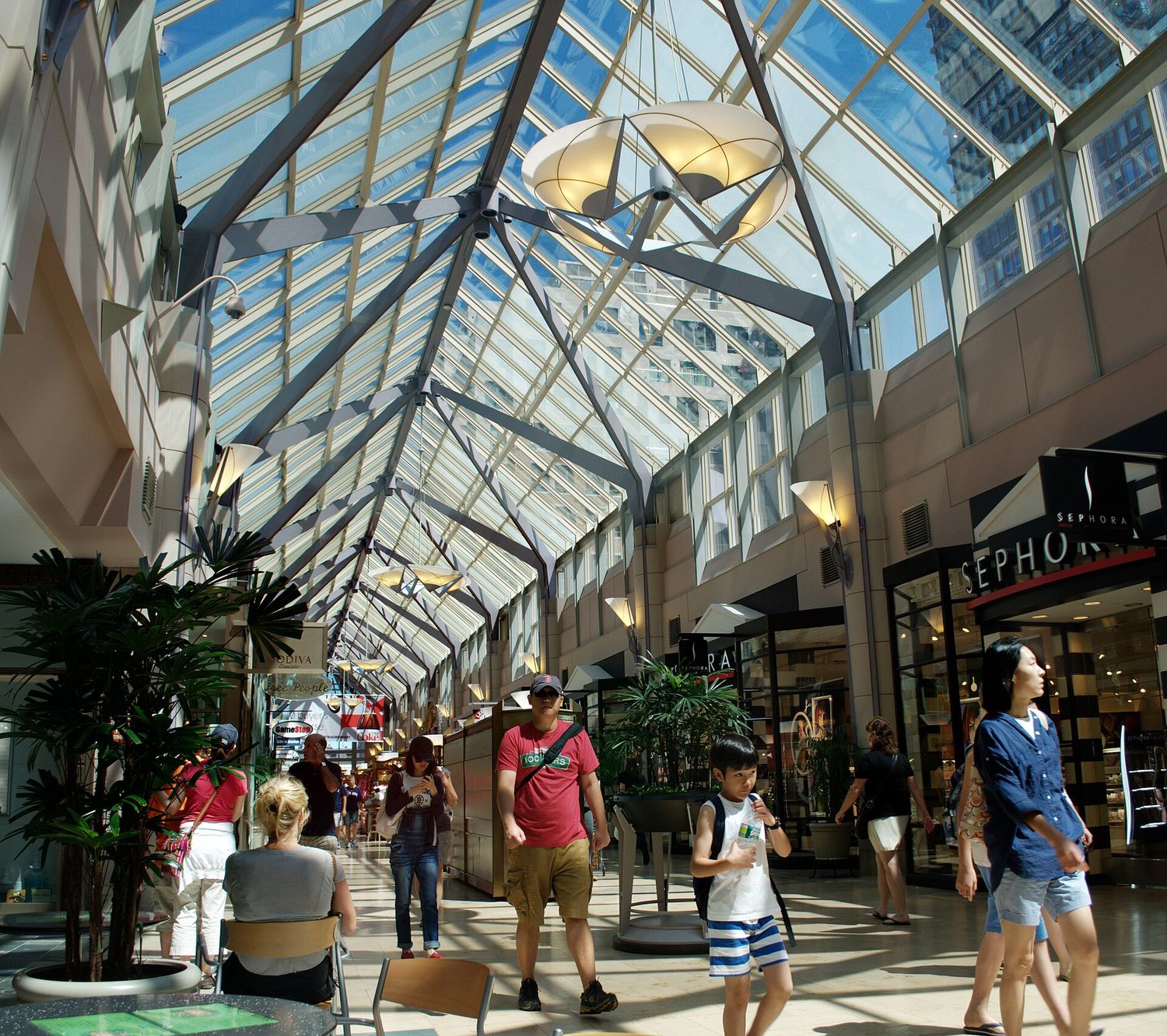
Back Bay has the city’s best trick for a wet day: you can walk a surprising distance without going outside. The Shops at Prudential Center connect by an enclosed glass bridge over Huntington Avenue to Copley Place, and between them you reach the Westin, the Marriott Copley Place, the Sheraton and the Hynes Convention Center under cover. Prudential station on the Green Line E branch is right by the entrance, and Copley station is a short dash away.
Shopping is a respectable rainy-day activity in Boston for one reason visitors rarely know: Massachusetts does not charge sales tax on clothing or shoes up to $175 per item, and above that only the amount over $175 is taxed. The general sales tax is 6.25%. Our Boston shopping guide covers the streets and markets beyond the malls.
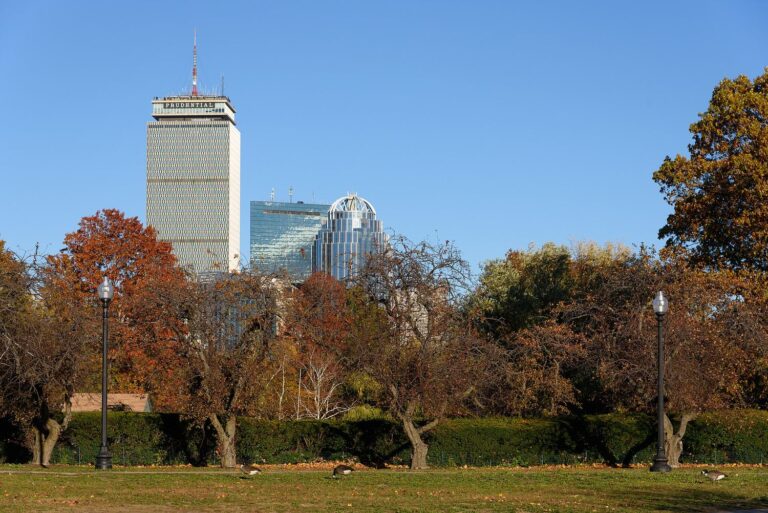
The View Boston observation deck is in the same complex, on the 52nd floor of the Prudential Tower, and this is where a rainy-day plan can go wrong. More on that below.
Small, odd and mostly free: rainy-day hidden gems
Some of the best wet-weather hours in Boston are spent in rooms most visitors never hear about. None of these will take more than an hour, and most cost nothing.
- The Ether Dome at Massachusetts General Hospital, where surgical anesthesia was first demonstrated in public in 1846. Free, weekdays 9am to 5pm, closed when the room is in use for meetings, so call the Russell Museum first on 617-724-8009. Charles/MGH on the Red Line.
- The Warren Anatomical Museum on the fifth floor of the Countway Library in Longwood. Free, Monday to Friday 9am to 5pm, closed weekends; bring photo ID for security. It holds the skull of Phineas Gage and the iron bar that went through it.
- The Gibson House Museum, 137 Beacon Street, a Victorian Back Bay townhouse left almost untouched. Guided tours only, Friday to Sunday at 1, 2 and 3pm; $10 for adults, $8 for students and seniors, $3 under 12.
- The Nichols House Museum, 55 Mount Vernon Street on Beacon Hill, open Tuesday to Sunday by tour.
Our hidden gems guide has twenty more places like these, and the Boston museums guide covers the full list of larger collections.
Rainy evenings: sports, beer and a movie
When the museums close, the rain usually has not. The MFA stays open until 10pm on Thursdays and Fridays, and the ICA is free on Thursday nights until 9. Beyond that, Boston has three good indoor answers.
The first is a game. The Celtics and the Bruins both play at TD Garden, above North Station, and their seasons run from October into spring. Even without tickets, the Sports Museum inside the Garden is open daily from 10:30am to 5pm, with adult tickets at $30, seniors at $25 and children 2 to 12 at $20; tours run every 30 minutes, but schedules bend around arena events, so book ahead. Our Boston sports guide covers tickets.
The second is beer. The Samuel Adams Boston Brewery at 30 Germania Street in Jamaica Plain is open daily from 11am to 9pm, a short walk from Stony Brook on the Orange Line, and Harpoon’s big beer hall in the Seaport is another good place to wait out a storm. The third is a film: the Brattle Theatre in Harvard Square and the Coolidge Corner Theatre in Brookline are both independent, much-loved cinemas showing a mix of new releases, revivals and oddities, with programs worth checking on the day. Our Boston nightlife guide covers the bars, and one fact matters on a wet night in particular: the T stops running around 12:30 to 1am, an hour before last call.
What to skip when it rains
Some of Boston’s best-known attractions are much worse in the rain, and a few are not worth doing at all. Be honest with yourself about these.
- View Boston in low cloud. The 52nd floor is above the ceiling on a lot of rainy days, and from $32 plus a $3 fee to look at the inside of a cloud is a poor trade. Look up at the Prudential Tower before you buy: if the top is in cloud, come back another day.
- Boston Duck Tours. They run rain or shine and they have covers, but $57 for an adult to see a steamed-up city through plastic is hard to justify. Only the river section is cancelled in severe weather, for a half refund.
- Harbor cruises and whale watches. A gray, choppy harbor is not much of a view, and seasickness is worse in rough weather. Rebook if you can.
- Hop-on hop-off trolleys. They make little sense in a city this compact even in good weather. In the rain you spend the day climbing on and off a damp vehicle.
- The Swan Boats and the Harbor Islands. In the fall, these are mostly off the table regardless of the weather. The Swan Boats finished their season on 7 September and return in April, and the Harbor Islands ferries stop after the Indigenous Peoples’ Day weekend in October.
- Quincy Market as a lunch plan. As above: go for the building, eat somewhere else.
Four rainy-day plans
The art day (not Tuesday)
Arrive at the Gardner at opening, when the courtyard is quiet, and give it two hours. Walk five minutes to the MFA, eat lunch in the museum, and pick two wings for the afternoon. On a Thursday or Friday you can stay until 10pm and have dinner nearby. Cost for one adult: $55 in admission.
The family day
Choose one big attraction, not two. The Museum of Science suits children from about six upward and can fill a full day on its own; the Aquarium works for all ages and fills a morning. Pair the Aquarium with lunch at the Public Market and an afternoon at the Children’s Museum if your children are young, or with the Museum of Science if they are older and you have a CityPASS. Our Boston with kids guide has much more. For two adults and two children aged 5 and 9, the Aquarium alone is $141.80.
The history day
Start at the Old State House at 10am and cross to Old South Meeting House on the same ticket. Walk to Faneuil Hall for a ranger talk, then eat at the Public Market. Continue into the North End for the Paul Revere House and Old North Church, with a pastry stop in between. On a weekday, begin instead at the State House for its free tour. The paid sites on this plan come to $34 at the door, a little less than the $35.10 Boston 250 Pass, unless you add King’s Chapel.
The Cambridge day
Take the Red Line to Harvard and spend the morning at the free Harvard Art Museums. After lunch in the square, walk to the Harvard Museum of Natural History for the Glass Flowers, then either ride two stops to Kendall/MIT for the MIT Museum or end the day at a film at the Brattle. Cost for one adult: $20 to $40 plus the T.
Rainy-day costs compared
| Plan | What you pay (one adult) | Verdict |
|---|---|---|
| Libraries and hidden gems | $0–11 | The best free rainy day in any American city |
| Cambridge day | About $20–40 | Excellent value; Harvard Art Museums are free |
| History day with the Boston 250 Pass | $35.10 | Good value only if you visit all five sites |
| Art day, Gardner and MFA | $55 | Worth every dollar; the best rainy day in Boston |
| Museum of Science with planetarium and Omni | About $45 | Great for families; crowded on weekends |
| Aquarium | $39.95 | Worth it with children; less so for adults alone |
| View Boston in cloud | From $35 | Not worth it; wait for a clear day |
Add $2.40 for each subway ride or $11 for an all-day pass. From 1 September 2026, the MBTA is also piloting unlimited transfers within two hours on the same payment method, which helps on a museum-hopping day.
Getting around Boston in the rain
Boston’s rain does not suit umbrellas. The wind off the harbor turns them inside out on any street that lines up with the water, and the narrow sidewalks of the North End and Beacon Hill leave no room to hold one. A waterproof jacket with a hood beats an umbrella every time, and shoes with some grip beat anything leather on wet brick.
The T is your best friend on a wet day. Every museum on this list is within a short walk of a subway stop. A single ride is $2.40, and you can tap a contactless card, phone or watch at the gate instead of buying a CharlieCard, so there is no need to stand in line at a machine with wet hands. An $11 one-day pass pays back after five rides. Our guide to getting around Boston explains the lines, and the MBTA site has live service alerts.
Plan for the calendar as much as the weather. Remember the closed days: Tuesday for the MFA, the Gardner and the Children’s Museum; Monday for the ICA and the Harvard Art Museums; Sunday for the Athenaeum; weekends for the State House, the Ether Dome and the Warren Anatomical Museum. And remember that rain here is not seasonal. Boston gets about 49 inches of precipitation a year, spread fairly evenly across the months, so there is no dry season to aim for. Our best time to visit Boston guide sets out what each month is like.
Frequently asked questions
What can I do for free in Boston on a rainy day?
The Boston Public Library’s McKim Building, the Harvard Art Museums, Faneuil Hall and its ranger talks, the State House tours on weekdays, the Ether Dome and the Warren Anatomical Museum are all free and indoors. The ICA is free on Thursday evenings, and everyone under 18 gets into the Gardner and the ICA free. Our free things to do in Boston guide has the rest.
Which Boston museums are closed on Tuesdays?
The Museum of Fine Arts, the Isabella Stewart Gardner Museum and the Boston Children’s Museum are all closed on Tuesdays. The ICA and the Harvard Art Museums close on Mondays instead. The Museum of Science and the New England Aquarium are open every day.
Is the Freedom Trail worth walking in the rain?
The whole 2.5 miles in heavy rain is not much fun, and the burying grounds offer no shelter. But the indoor sites, the Old State House, Old South Meeting House, Faneuil Hall, the Paul Revere House and Old North Church, are all worth visiting on a wet day and are close together. Save the outdoor stops and the Bunker Hill Monument for a dry morning.
What is the best thing to do in Boston with kids when it rains?
The Museum of Science for children about six and older, the New England Aquarium for any age, and the Children’s Museum for toddlers to about eight. Pick one and arrive at opening, because on rainy weekends every family in the city makes the same choice.
Is Boston a rainy city?
Boston gets about 49 inches of precipitation a year, more than Seattle in total, but it comes in bursts rather than steady drizzle and is spread fairly evenly across the year. Most wet days include some dry hours, so it is worth keeping one outdoor option in reserve.
What can I do in Boston on a rainy evening?
The MFA is open until 10pm on Thursdays and Fridays and the ICA is free until 9pm on Thursdays. After that, catch a Celtics or Bruins game at TD Garden in season, visit a brewery taproom, or see a film at the Brattle Theatre or the Coolidge Corner Theatre. Allow for the last train, which leaves downtown around 12:30 to 1am.