There is no engine, no commentary and no view of anything much beyond willows, a small island and a footbridge. The whole trip lasts about fifteen minutes and costs less than a sandwich. And yet the Swan Boats Boston has loved since 1877 remain one of the most cherished things in the city — a slow, quiet, slightly absurd pleasure that has hardly changed in a century and a half, run by the same family the whole time.
This guide covers when the boats run and what they cost, the story behind them, what the ride is actually like, the tips that save you a long wait, and the rest of the Public Garden around the lagoon. One thing first, because it matters for anyone reading this in the fall or winter: the Swan Boats are seasonal. The 2026 season ran from 18 April to 7 September, and the operator says the boats return in April 2027. Prices and hours below were checked in September 2026; confirm the new season’s details before you plan around them.
Swan Boats at a glance
| Detail | 2026 season |
|---|---|
| Where | The lagoon in the Boston Public Garden |
| Season | 18 April – 7 September 2026; returns April 2027 |
| Hours | 10am–4pm until 20 June, then 10am–5pm |
| Adult | $4.75 |
| Child (2–15) | $3.25 |
| Senior | $4.25 |
| Ride length | About 15 minutes |
| Nearest T | Arlington (Green Line) |
| Run by | The Paget family, since 1877 |
Are the Swan Boats running right now?
Probably not, if you are reading this between September and mid-April. The boats come out of the water at the end of the summer and go back in each spring, so your chances depend entirely on the month.
| When | Status |
|---|---|
| January – mid-April | Closed |
| Mid-April – about 20 June | Open daily, 10am–4pm |
| Late June – early September | Open daily, 10am–5pm |
| Early September – December | Closed |
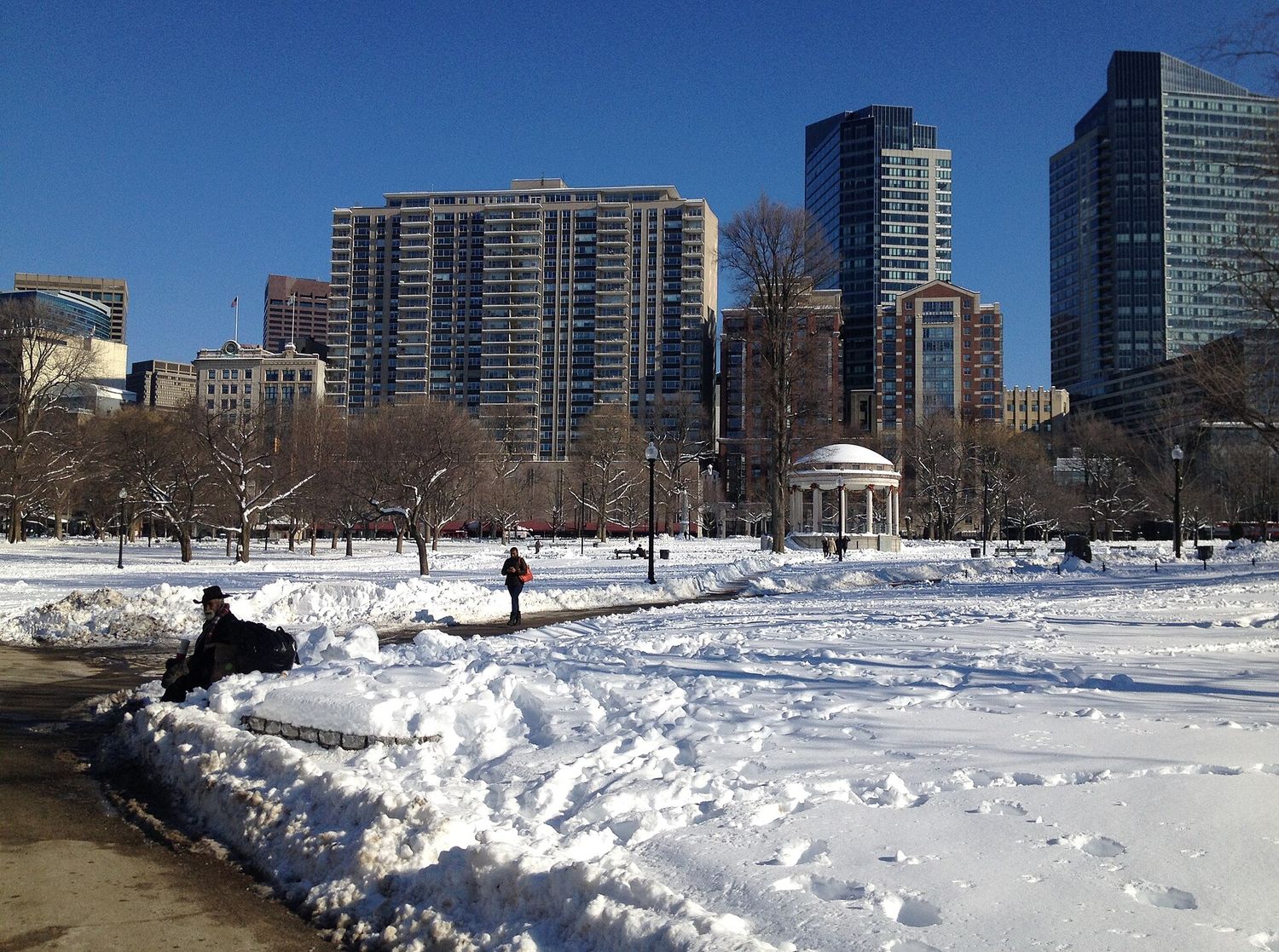
If your trip falls outside the season, you have not lost much: the Public Garden is at its most beautiful in October and wonderfully atmospheric under snow, and nearly everything else on this page — the ducklings, the bridge, the Washington statue, the flower beds — is there all year. There is a section on visiting out of season further down.
The story: one family, since 1877
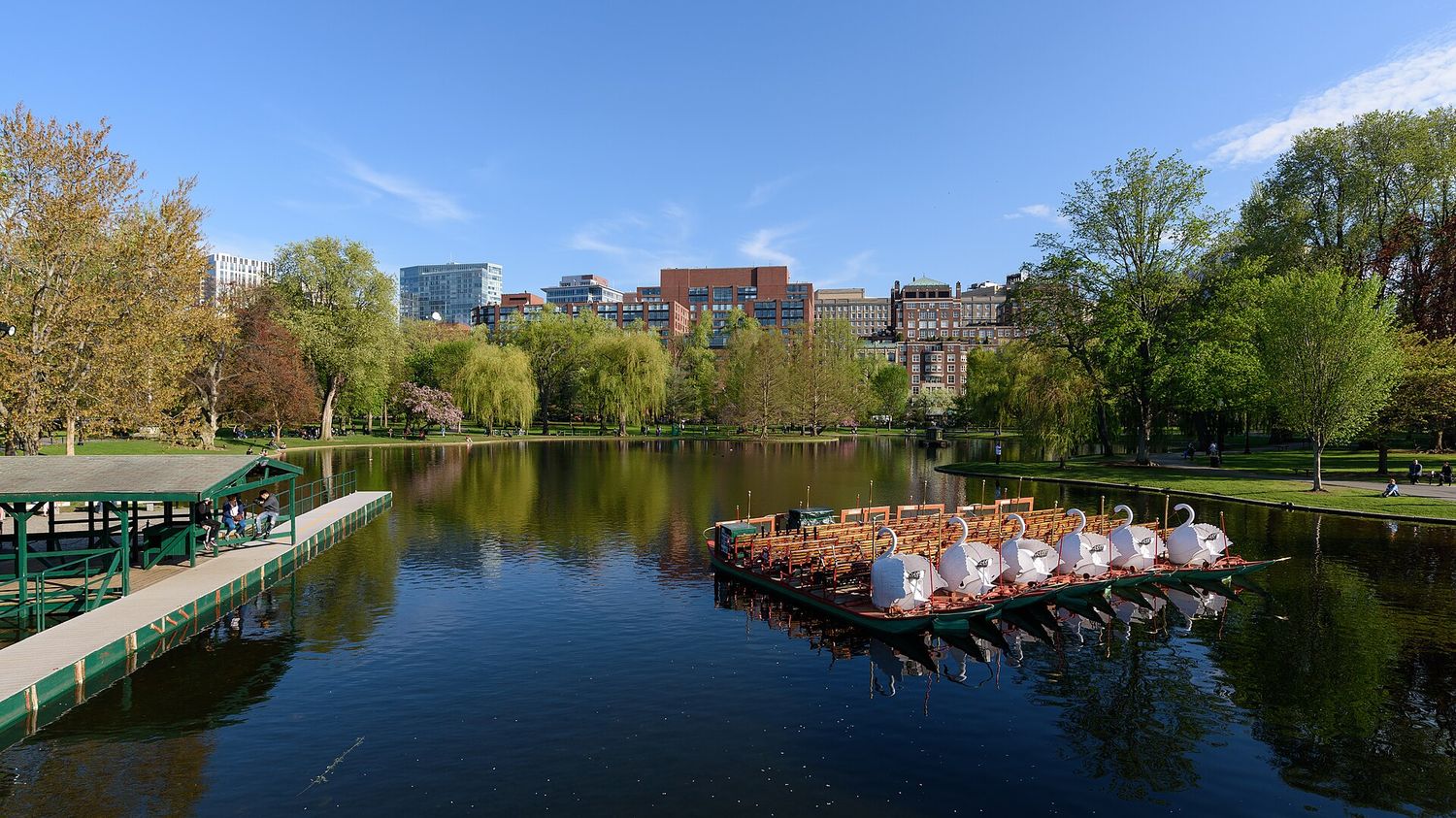
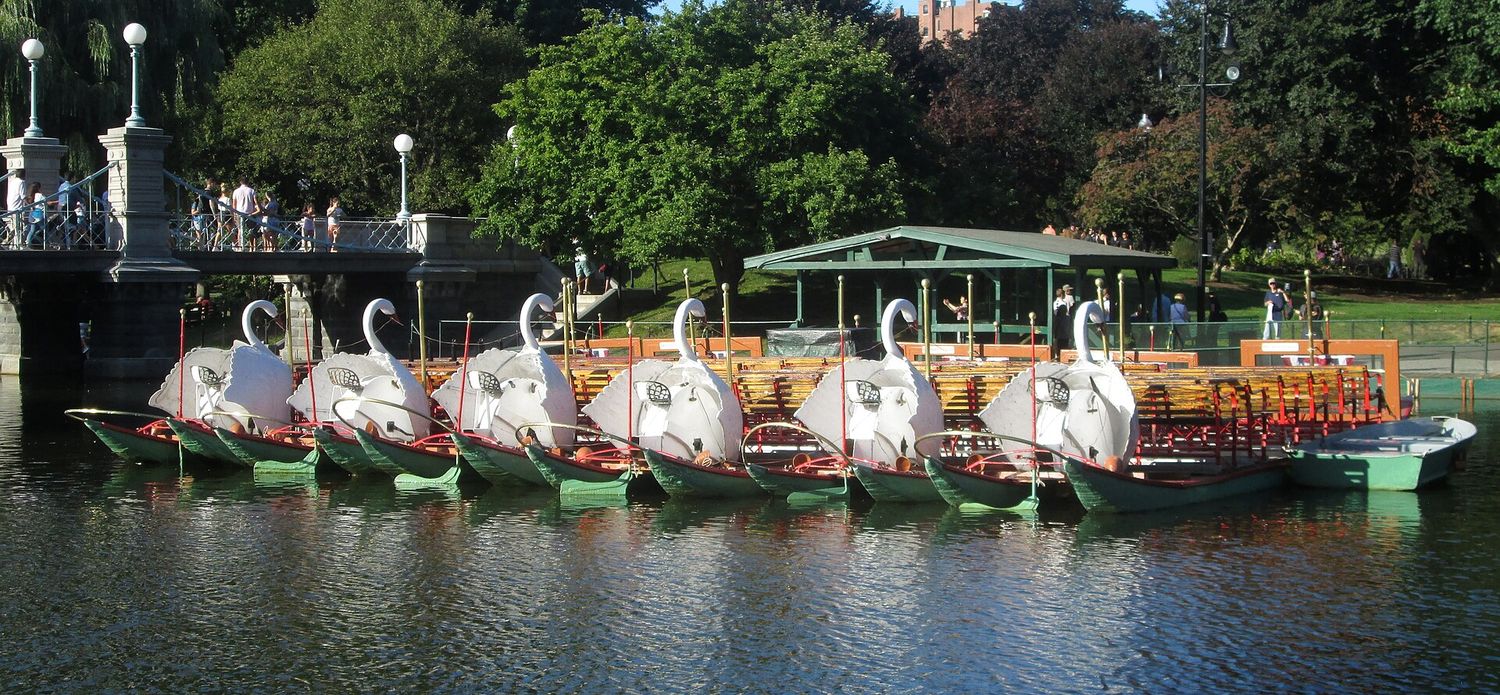
In the 1870s a shipbuilder named Robert Paget was granted a city license to hire out boats on the Public Garden lagoon. He had been experimenting with a new kind of boat driven by a paddle wheel worked with the feet, like a bicycle, and he needed a way to hide the pedaling driver. The answer came from the opera. Paget and his wife Julia had seen Wagner’s Lohengrin, in which the knight crosses a river in a boat drawn by a swan, and in 1877 he put a large carved swan at the back of his first boat. The driver sits inside it, pedaling, while passengers ride on the benches in front.
Robert Paget did not live long to enjoy it, and it was Julia who kept the business going and built it up. Their descendants have run it ever since. Today the boats are in the hands of the fourth generation of the Paget family, and the fleet stands at six boats, the oldest of which dates from 1910. The swans themselves have been rebuilt and repainted many times, but the design is essentially the one that first appeared on the lagoon in the 1870s.
In 1941 Robert McCloskey published Make Way for Ducklings, the picture book about a family of mallards who choose the Public Garden to raise their young, and in which the Swan Boats play a small part. The book won the Caldecott Medal, has never been out of print, and has sent generations of children — and their parents — to the lagoon to see the real thing.
The Swan Boats in books
McCloskey’s mallards are the most famous literary visitors, but not the only ones. In E. B. White’s The Trumpet of the Swan, published in 1970, Louis, a trumpeter swan born without a voice, learns to play a real trumpet and takes a summer job playing for the passengers on the Swan Boats, before checking in to a grand Boston hotel across the street. The book has its own devoted readership, and some families come to the lagoon because of Louis rather than the ducklings.
That literary afterlife is part of why the boats have survived. A fifteen-minute pedal around a small pond would not, on its own, keep a family business going for nearly 150 years. What keeps it going is that the Swan Boats have become part of how Boston tells its own story to children, and those children grow up and bring their own.
What the ride is actually like
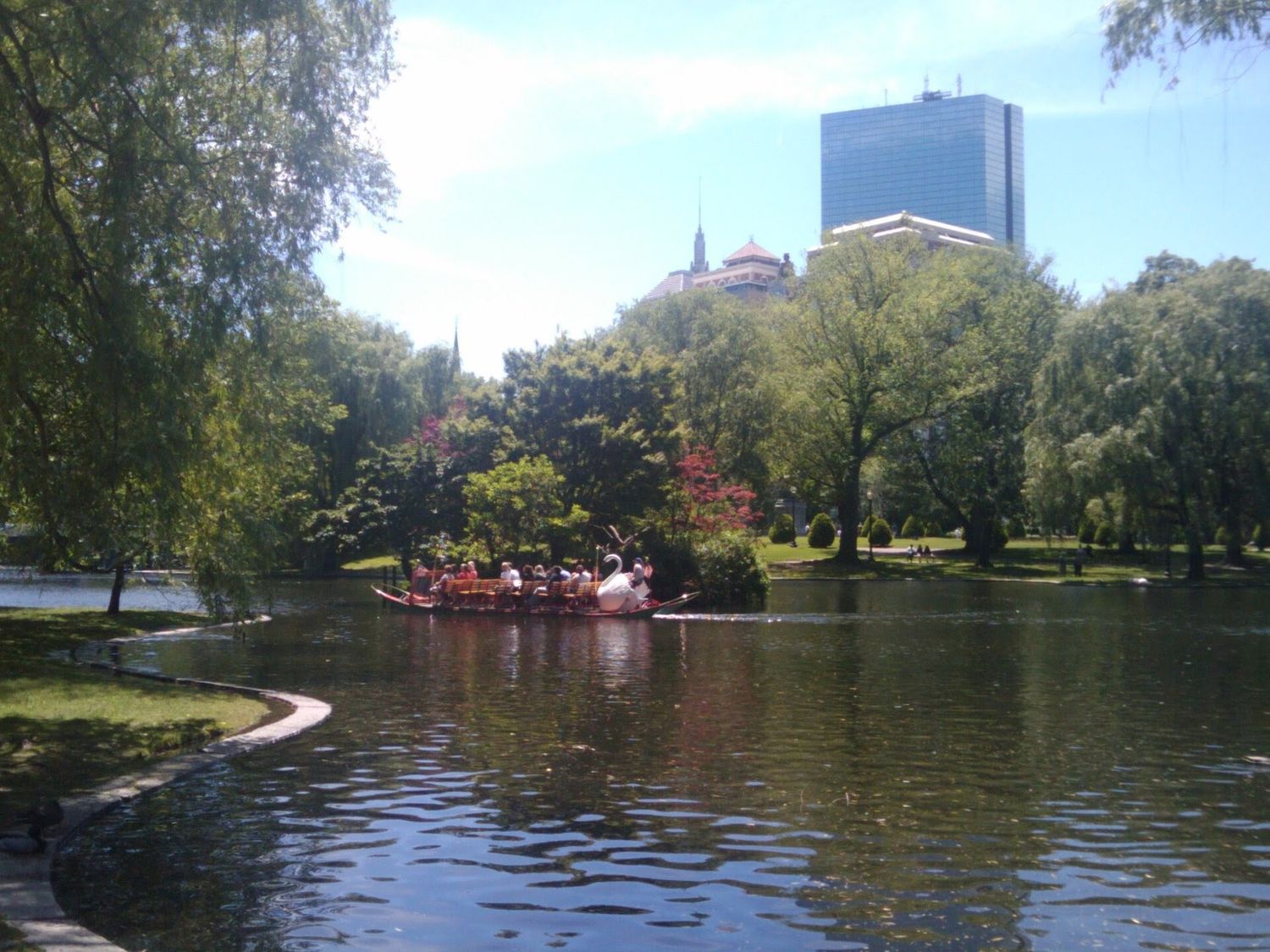
You board from a wooden landing at the lagoon’s edge and sit on one of six benches set across a wide, flat pontoon. The driver takes up position in the swan at the back and starts pedaling. There is no motor noise, only the swish of the paddle and the chatter of the other passengers, and the boat moves at a stately walking pace in a loop around the lagoon’s small island, passing under the footbridge on the way.
Along the way you see willows trailing into the water, the island where the ducklings’ fictional family nested, mallards cruising alongside hoping for scraps, the bridge overhead with people leaning on the railings and waving, and the towers of Back Bay rising behind the trees. On a sunny afternoon it is lovely. Fifteen minutes later, you are back where you started.
That is the whole experience, and it is best appreciated on those terms. The Swan Boats are not a tour and not a thrill. They are a small, gentle, very old-fashioned pleasure in the middle of a city, and their charm is that they have refused to become anything else.
Prices, and whether it is worth it
At $4.75 for adults, $3.25 for children aged 2 to 15 and $4.25 for seniors in the 2026 season, the Swan Boats are the cheapest paid attraction in central Boston. Put them next to the other boats on offer and the value is obvious.
| Ride | Adult price (2026) | Length |
|---|---|---|
| Swan Boats | $4.75 | About 15 min |
| Boston Duck Tours | About $62 with fees | 80 min |
| Harbor Islands ferry, round trip | $25 | Half a day with the island |
| View Boston (not a boat, but a comparable “must-do”) | $34 + $3 fee | An hour or so |
So yes — it is worth it, almost always. A family of four with two children under 16 pays $16 for the lot. The honest caveat is time, not money. On a summer weekend afternoon the line to board can stretch well back from the landing, and waiting forty-five minutes in the heat for a fifteen-minute ride is a poor trade. Go when the line is short, and if it is long, walk around the Garden and come back later.
Who it is not for: teenagers looking for excitement, anyone expecting commentary or history, and people who have ridden once already and do not have small children in tow. For them, the Public Garden itself is the attraction, and the Swan Boats are best enjoyed from the bridge.
Tips for riding
- Go at opening. The boats start at 10am, and the first hour is usually the quietest. Weekday mornings in May and early June are ideal.
- Avoid summer weekend afternoons if you can. That is when the longest lines form, especially on warm Saturdays.
- Check payment before you go. Look at the operator’s site for current payment options, and carry some cash as a backup — it is a small, traditional operation.
- Strollers stay on land. You will need to leave yours on the landing or fold it; there is no room on the benches.
- Ask about access. Boarding means stepping down from the landing onto the boat. If anyone in your party has limited mobility, ask the staff how they can help.
- Bring bread for yourself, not the ducks. Feeding the waterfowl is discouraged; bread is bad for them.
- Weather. The boats may pause in thunderstorms and heavy rain. A light drizzle usually does not stop them.
- Pair it with the ducklings. The Make Way for Ducklings statues are a two-minute walk from the landing, and for small children the ride and the ducklings together make a perfect hour.
The Public Garden around the lagoon
The Swan Boats sit at the heart of the Boston Public Garden, laid out in 1837 as the first public botanical garden in America on land reclaimed from the tidal flats of the Back Bay. It covers about 24 acres, and unlike the rougher, busier Boston Common across Charles Street, it is a formal Victorian garden of flower beds, specimen trees and curving paths. No ballgames, no rallies — just planting, and people sitting on benches admiring it.
How the Garden was made
In the early nineteenth century there was no Public Garden, only a stretch of tidal mud flats and salt marsh at the foot of the Common, where the Charles River’s estuary spread out into the Back Bay. The land was partly filled to build ropewalks, long sheds where rope was twisted for the city’s shipyards, and when those burned the city had to decide what to do with the ground. In 1837 a group led by the horticulturist Horace Gray won permission to plant a botanical garden there, and they started with greenhouses and flower beds on the new, raw fill.
It took decades, and several political fights, before the Garden was secure. Developers wanted the land for houses, and it was only in 1859 that the state confirmed it would stay open. That year the city held a design competition, and the plan by the architect George Meacham laid out the curving paths and the irregular, naturalistic lagoon you see today — deliberately shaped so that you can never see all of it from one spot. The lagoon was dug in the early 1860s, the bridge followed in 1867, and ten years later Robert Paget’s first swan was on the water.
What makes the Garden unusual is that the Victorian planting scheme never went away. Many American parks were redesigned in the twentieth century to save money on gardeners. The Public Garden still gets its bedding changed through the seasons, with the city’s own greenhouses and the Friends of the Public Garden keeping it in the style it was laid out in.
The lagoon bridge
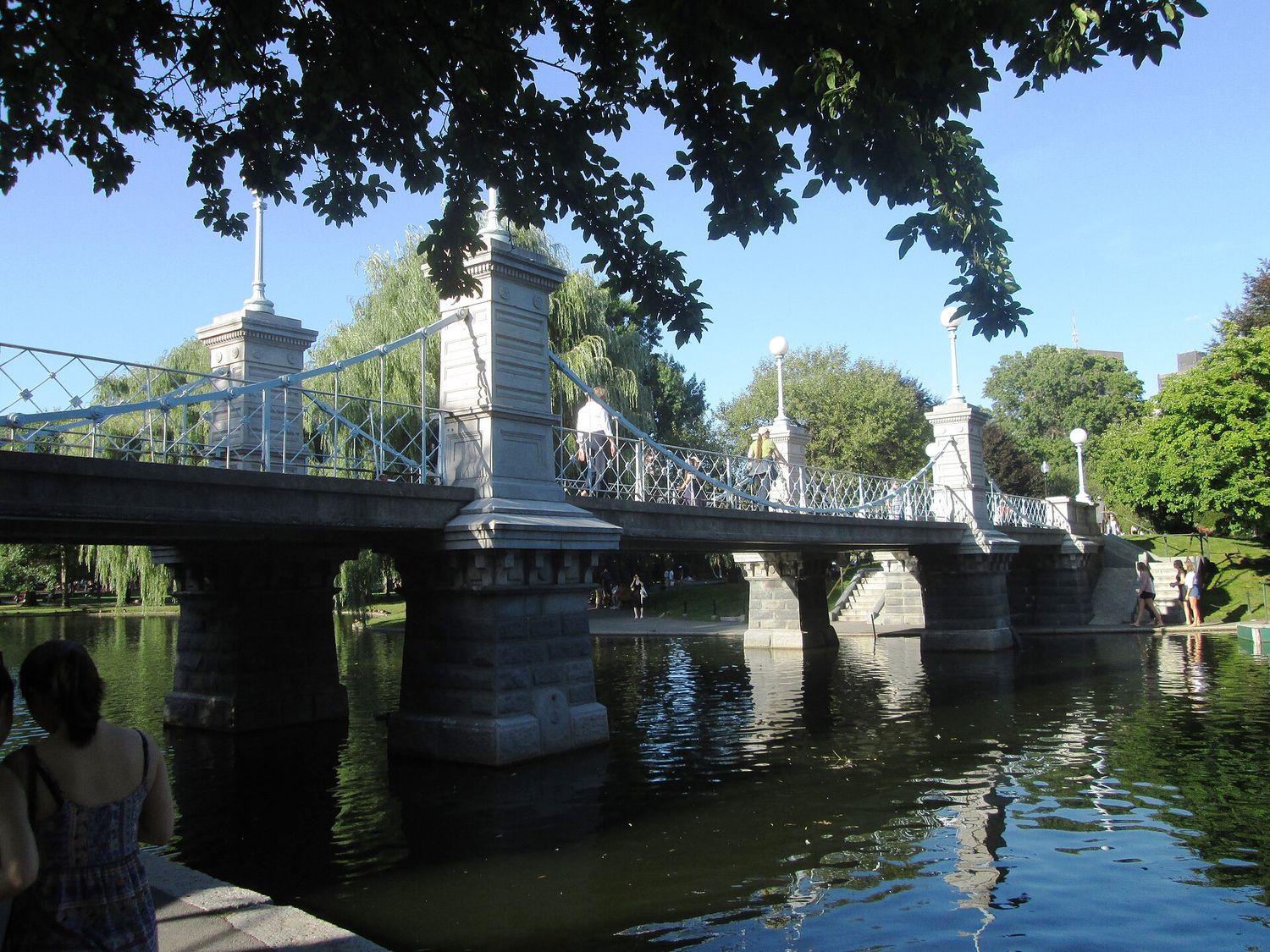
Built in 1867, the footbridge over the narrowest point of the lagoon is often called the smallest suspension bridge in the world. It was designed to look like one and originally worked as one, but it was reinforced with steel girders in the early twentieth century, and the cables have been decorative ever since. It is the best vantage point in the Garden: the Swan Boats pass directly underneath, the view down the lagoon is the one on a thousand postcards, and in October the willows and maples on the banks turn gold and red.
Make Way for Ducklings
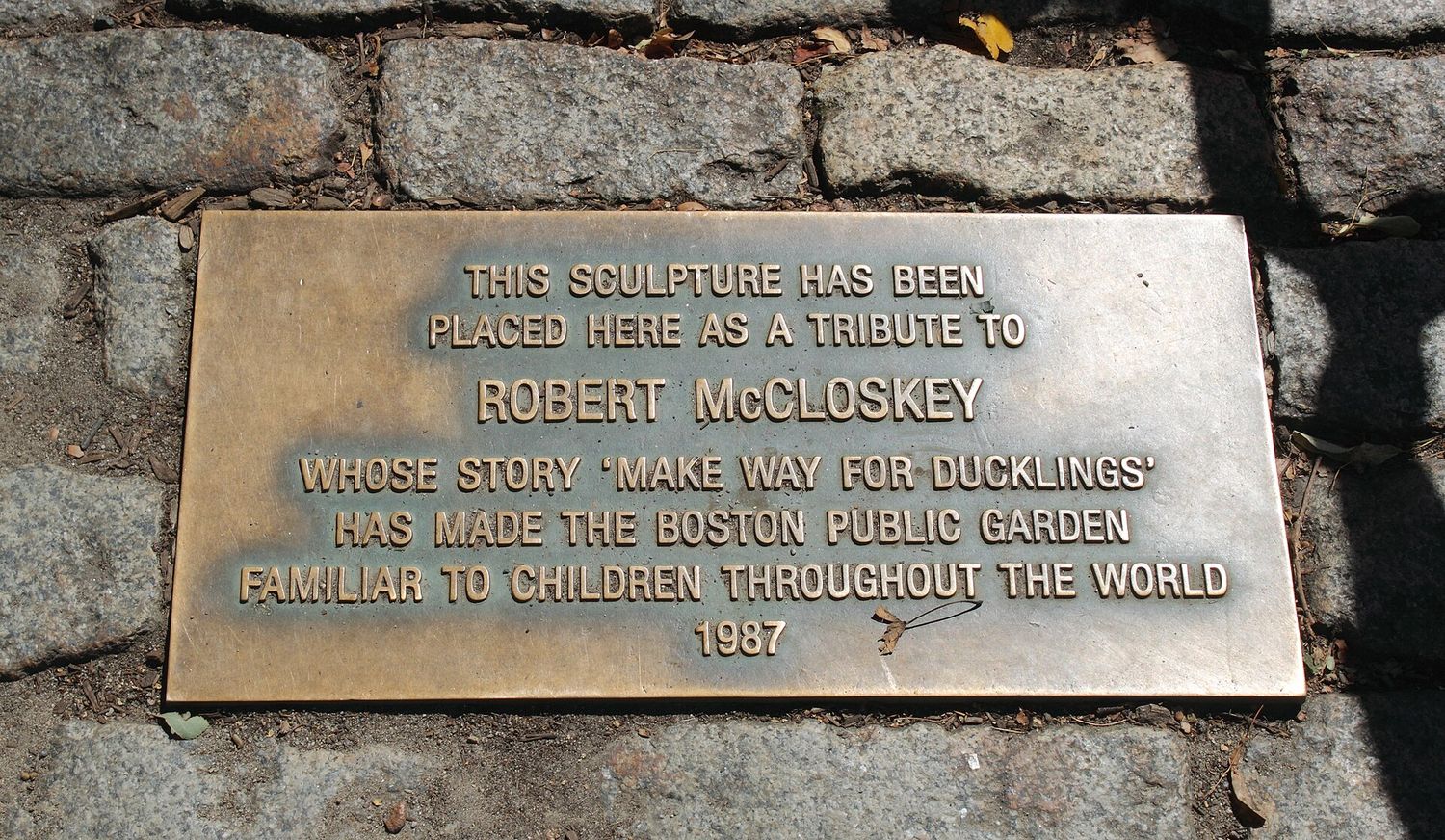
Near the Charles and Beacon Street gate, a line of bronze ducks marches across a strip of cobbles: Mrs. Mallard followed by her eight ducklings, Jack, Kack, Lack, Mack, Nack, Ouack, Pack and Quack. The sculptor Nancy Schön made them in 1987 as a tribute to McCloskey’s book, and they are among the most loved — and most climbed-on — public sculptures in America. Children are allowed to sit on them, and do. Local people dress them up for holidays, big games and the first day of spring; in October you may find them in Halloween costumes.
The ducklings also have a diplomatic history. In 1991 Barbara Bush gave a copy of the sculpture to Raisa Gorbachev as a gift to the children of the Soviet Union, and a set of McCloskey’s ducks has marched through a park in Moscow ever since. If you search for photos of the statue, be aware that some of what turns up is the Moscow copy, or other replicas elsewhere.
Every year on Mother’s Day, the Friends of the Public Garden hold Duckling Day, when families dressed as ducklings parade from Boston Common into the Garden, following the route of the family in the book. It is a delightful chaos and one of the best free family events in the city; check the Friends’ website for registration details each spring.
The statues and monuments
- George Washington on horseback, by Thomas Ball, dedicated in 1869, faces down Commonwealth Avenue from the Arlington Street gate. It is one of the finest equestrian statues in the country and the Garden’s grandest landmark.
- The Ether Monument, from 1868, commemorates the first public demonstration of ether anesthesia, at Massachusetts General Hospital in 1846. It is a strange and rather beautiful thing: a granite column topped with a figure of the Good Samaritan, celebrating a medical breakthrough.
- Smaller statues and fountains are tucked among the flower beds, including a bronze of the abolitionist Wendell Phillips on the Boylston Street side and the Bagheera fountain, named for the panther in Kipling’s Jungle Book.
The live swans
The Swan Boats are not the only swans on the lagoon. A pair of real mute swans spends the summer here, traditionally named Romeo and Juliet — the names stuck even after keepers discovered that both birds were female. They arrive in spring and move to winter quarters when the weather turns. Admire them from a distance; swans are protective and can be aggressive near their nests.
The flowers
The Garden’s beds are replanted through the year. Late April and early May bring tulips by the thousand; summer brings annuals in bold Victorian color schemes; in the fall the foliage takes over, with the trees at their best from mid-to-late October. It is worth walking the Garden in any season, but a spring visit that combines the tulips with the first weeks of the Swan Boat season is hard to beat.
An hour in the Garden with small children
For families with children under about eight, this is one of the easiest, cheapest and most reliably happy hours you can spend in Boston. A plan that works in season:
- Arrive at Arlington station around 9:45am and walk into the Garden past the Washington statue.
- Ride the first Swan Boat at 10am, before the line builds.
- Walk across the lagoon bridge and wave at the next boat as it passes underneath.
- Find the ducklings near the Charles and Beacon Street gate and let everyone climb on Mrs. Mallard. If you have the book with you, read it on a bench nearby.
- Cross Charles Street to the Common for the Tadpole Playground and, in summer, the free Frog Pond spray pool, which opens at 11am.
The whole thing costs a family of four around $16 and fills a morning without a single meltdown-inducing line, if you get the timing right. For a full day’s plan by age group, see our guide to Boston with kids.
Getting the photograph
The classic shot of the Swan Boats is taken from the lagoon bridge, looking along the water with a boat approaching and the willows on either side. Mid-morning light is kind from the bridge; late afternoon sets the boats against the light. For the boats and the bridge together, walk along the south bank toward the landing and shoot back across the water. And for the ducklings, crouch low: the statues are knee-high, and a picture taken from standing height makes them look like a row of bronze doorstops.
Visiting outside the season
If you are in Boston between September and mid-April, the lagoon is quiet and the boats are gone, but the Public Garden is far from closed. Here is what the off-season offers.
- October: the best month of the year for the Garden’s trees. Stand on the lagoon bridge in the late afternoon and you will see why Bostonians get sentimental about fall.
- Halloween: the ducklings in costume, and the Common and Beacon Hill full of trick-or-treaters.
- December: holiday lights in the trees of the Common, the Garden and the Commonwealth Avenue Mall, and the Christmas tree on the Common, an annual gift from Nova Scotia, lit in early December.
- January to March: snow on the willows and the bridge, and skating on the Frog Pond across Charles Street, where children under 58 inches skate free.
For more on what to do in each month, see our guide to the best time to visit Boston.
Nearby
- Boston Common, across Charles Street, with the Frog Pond, the Shaw Memorial and the start of the Freedom Trail.
- Beacon Hill, on the north side of the Garden, with the antique shops and cafés of Charles Street and the cobbles of Acorn Street. See our guide to Boston neighborhoods.
- Newbury Street, starting at the Arlington Street gate, for eight blocks of boutiques and cafés. Our shopping in Boston guide covers the tax rule that makes clothes cheap here.
- The Commonwealth Avenue Mall, the tree-lined promenade that runs west from the Washington statue through Back Bay.
- Cheers, on Beacon Street facing the Garden. Its exterior was used for the TV show’s opening shots; the interior bears no resemblance to the set. Take the photo, and drink somewhere else.
Getting there
Arlington on the Green Line comes up at the Garden’s southwest corner, a few minutes’ walk from the Swan Boat landing. Park Street (Red and Green Lines) is at the far side of the Common, a ten-minute walk away, and Charles/MGH (Red Line) is at the top of Charles Street, about the same distance. A subway ride is $2.40 by CharlieCard, contactless card or cash; check mbta.com for service changes. Driving is not recommended, but the Boston Common Garage, entered from Charles Street, is the closest parking.
Swan Boats Boston: frequently asked questions
When do the Swan Boats open for the season?
In mid-April. The 2026 season ran from 18 April to 7 September, and the operator says the boats will return in April 2027. Check swanboats.com for the exact opening date.
How much does a Swan Boat ride cost?
In the 2026 season, $4.75 for adults, $3.25 for children aged 2 to 15 and $4.25 for seniors. Confirm current prices before your visit, as they are set each season.
How long is the Swan Boat ride?
About fifteen minutes, in a loop around the lagoon’s small island and under the footbridge.
Are the Swan Boats open in the fall or winter?
No. They operate only from mid-April to early September. The Public Garden itself stays open all year and is especially beautiful in October.
What time do the Swan Boats run?
In 2026, from 10am to 4pm until 20 June, then 10am to 5pm for the rest of the summer.
Who operates the Swan Boats?
The Paget family, who have run them since Robert Paget launched the first boat in 1877. The business is now in its fourth generation, with a fleet of six boats, the oldest built in 1910.
Where are the Make Way for Ducklings statues?
In the Public Garden, near the gate at the corner of Charles and Beacon Streets, a short walk from the Swan Boat landing.
Are the Swan Boats worth it?
Yes, especially with young children. At under $5 for an adult they are the best-value ride in the city. Just avoid long summer-afternoon lines, which can make a fifteen-minute ride cost an hour.
The Public Garden is the second stone in a much longer string. From its western gate, the Commonwealth Avenue Mall leads on to the Fens, the Riverway, Jamaica Pond and the Arnold Arboretum, seven miles of connected parks in all. Our guide to the Emerald Necklace in Boston walks it park by park, with the T stops, the rowboats on Jamaica Pond and the sections worth skipping.
Related Boston Guides
For the new season’s dates and prices, see the official Swan Boats website.