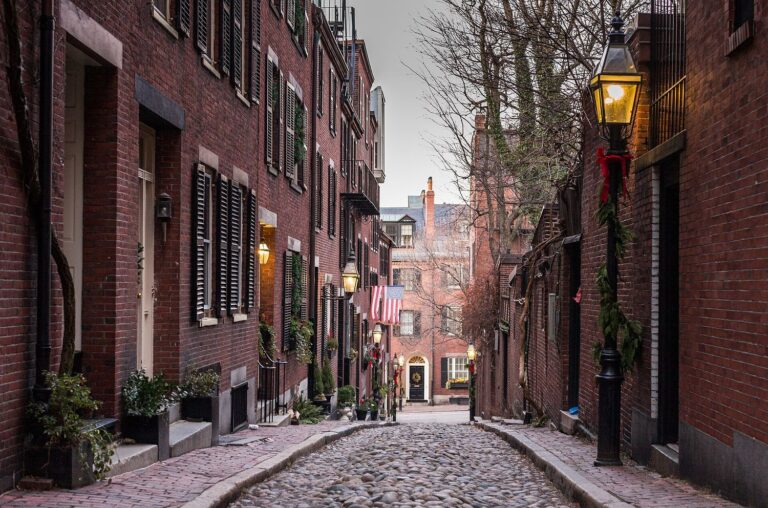
Boston has been burying people in the middle of town since 1630, and it never moved them. Walk down Tremont Street after dark and you pass three burying grounds in under ten minutes, their slate headstones carved with winged skulls and leaning at angles that look deliberate. Add a hotel where guests have been checking out permanently since 1855, a hanging elm, a molasses flood and a harbor fort with a woman in black, and it is no surprise that Boston ghost tours are one of the busiest things to do in the city once the sun goes down, especially in October.
This guide covers what the tours actually involve, the main operators and what they cost, which one suits which kind of visitor, the stories you will hear and the places they happen, a free self-guided ghost walk, Salem in October, and the tours that are not worth your evening. Prices were checked in September 2026 and ghost-tour pricing moves with the season, so confirm before you book, especially for any date near Halloween.
Boston ghost tours at a glance
| Tour | Format | Length | Price (checked Sept 2026) | Best for |
|---|---|---|---|---|
| Ghosts & Gravestones | Trolley plus two burying-ground walks, costumed guide | 90 minutes | From $37.40 online | First-timers, families with children 6 and over |
| Ghosts & Gravestones Nightwalk | Walking only | About an hour | From $27.85 online | Couples, people who like to be on foot |
| Independent ghost walks | Walking, lantern-lit, Boston Common to downtown | About an hour | Around $30 | Budget, a short evening |
| Ghost pub crawls | Walking with bar stops | 2–2.5 hours | From around $36, drinks extra | Groups of adults |
| Boston by Foot, The Dark Side of Boston | Walking, nonprofit volunteer docent | About 90 minutes | Check bostonbyfoot.org | History first, ghosts second |
| Self-guided (this page) | Walking | 2–3 hours | Free | Anyone curious and not easily spooked |
What a Boston ghost tour actually is
Set your expectations before you pay. A ghost tour in Boston is a history tour told in the dark, with the grisly parts left in. You will hear about executions on the Common, grave robbers, plague, murders, a hotel room that was turned into a storage closet, and a lot of colonial-era dying. You will almost certainly not see a ghost. The good guides are excellent storytellers who know exactly which parts of the legend are documented and which were made up in the 1970s, and they will tell you which is which if you ask.
The format decides the evening more than the operator does. Trolley tours cover more ground and suit people who cannot walk two miles; walking tours are more atmospheric, because a story told outside the actual building lands harder than one told through a window. Pub crawls are mostly pub crawls. And tours with costumed guides and actors lean into jump scares, which some people love and others find embarrassing. Decide which of those you are before you choose.
Almost every tour starts around Boston Common and downtown, because that is where the oldest graves and the oldest stories are. Few cross into the North End, which is a pity, because Copp’s Hill and the molasses flood site have some of the best material in the city.
The main Boston ghost tours compared
Ghosts & Gravestones
The best-known ghost tour in the city is Ghosts & Gravestones, run by the same company as the Old Town Trolley. It lasts 90 minutes: a ride through downtown in a darkened trolley, with a guide in period costume as a gravedigger, and two walking sections of about 20 minutes each inside historic burying grounds. That last part is the selling point. Most walking tours tell their burying-ground stories from the railings, while this one takes you in among the stones.
Tours leave from the Marriott Long Wharf at 200 Atlantic Avenue, on the corner of State Street, starting at 6pm; arrive 15 minutes early because they leave on time. Online tickets started at $37.40 when we checked, and walk-up prices are higher. Children under 6 are not allowed, and the operator rates it PG-13 for loud noises and frightening content. There is also a Nightwalk version, entirely on foot, from $27.85. The nearest T stop is Aquarium on the Blue Line.
Verdict: it is theatrical and a bit hammy, and history buffs may find the effects distracting. But it is well run and does something no walking tour can, and for families with children aged about 8 to 14 it is the one to book.
Independent ghost walks
Several smaller companies run lantern-lit ghost walks of about an hour, usually starting near the Common at 139 Tremont Street and taking in the Central Burying Ground, the Granary, King’s Chapel, the Omni Parker House and the Old State House. Booking listings showed prices around $30 per person when we checked, with nightly departures around 8pm in season. These vary more in quality than the big operator, depending almost entirely on the guide you get. Read recent reviews for the guide’s name, not the company’s star rating.
Ghost pub crawls
Ghost-and-pub tours, from around $36 plus whatever you drink, run two to two and a half hours and stop at old taverns along the way. Boston has the taverns for it. But be honest about what you are booking: the ghost stories are the filler between rounds. If you want the bars, book the crawl. If you want the stories, book a walk and go to the bar afterwards.
Boston by Foot
Boston by Foot is a nonprofit whose volunteer docents lead walking tours across the city, and its Dark Side of Boston tour is the pick for people who care more about what actually happened than about atmosphere. Expect crime, punishment, disease and scandal, with sources. Prices are not on its home page, so check the booking page for the current fare and dates.
The stories and the places: a haunted map of Boston
These are the places every tour stops at, and the stories you will hear there. Knowing them in advance makes you a better audience; it also means you can visit most of them by day, for free.
The Central Burying Ground, Boston Common
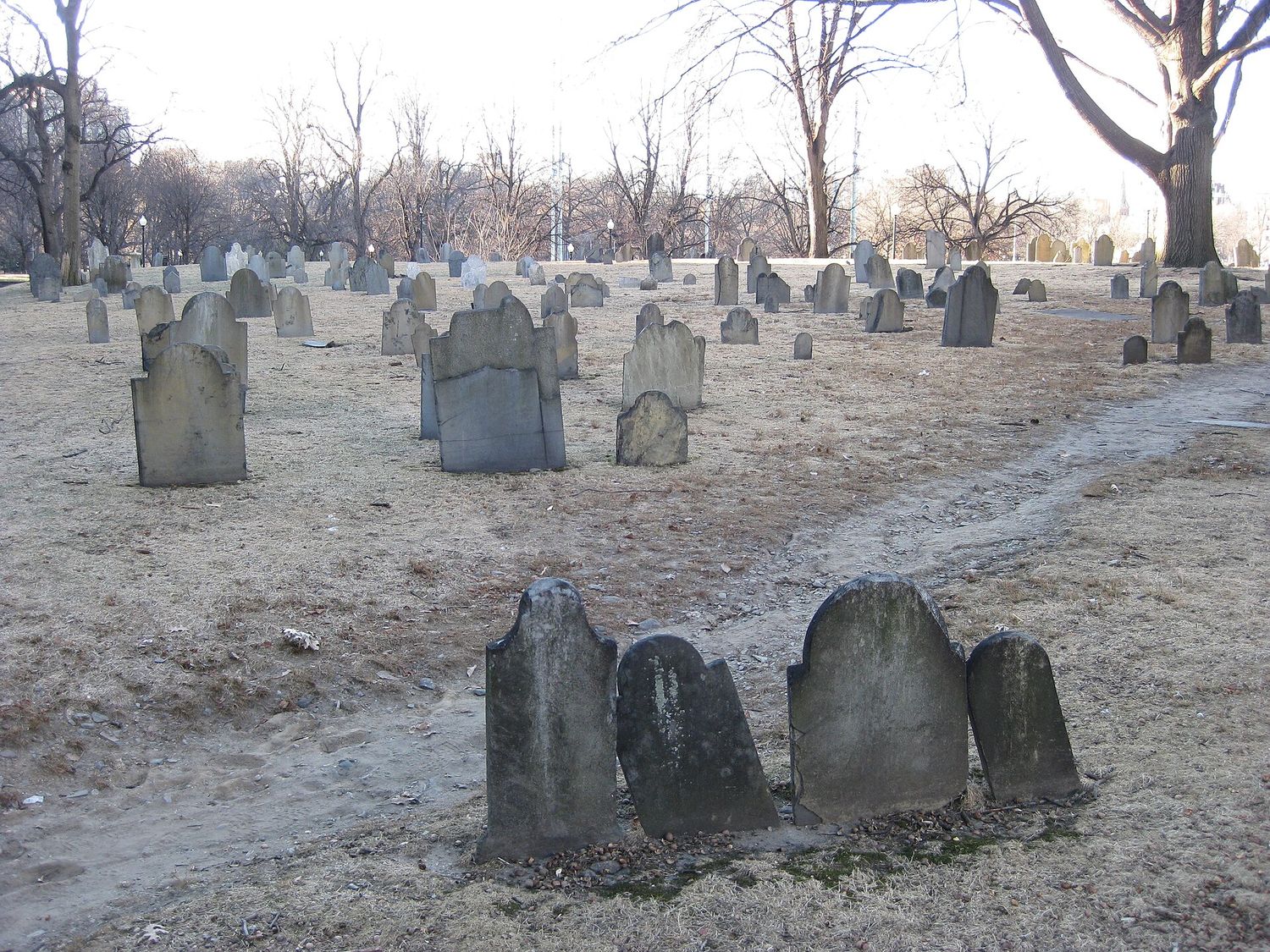
On the Boylston Street edge of Boston Common, the Central Burying Ground opened in 1756 and holds the painter Gilbert Stuart, whose portrait of George Washington is on the dollar bill, in an unmarked grave. British soldiers who died during the occupation are buried here too. The best-known story is from the 1970s, when a visitor claimed a girl in a white dress tugged at his collar and his car keys went missing; every guide tells it, and it is the kind of story that is better heard than read. The Common itself was the town’s place of execution, and the Quaker Mary Dyer was hanged there in 1660. Her statue stands outside the State House.
King’s Chapel Burying Ground
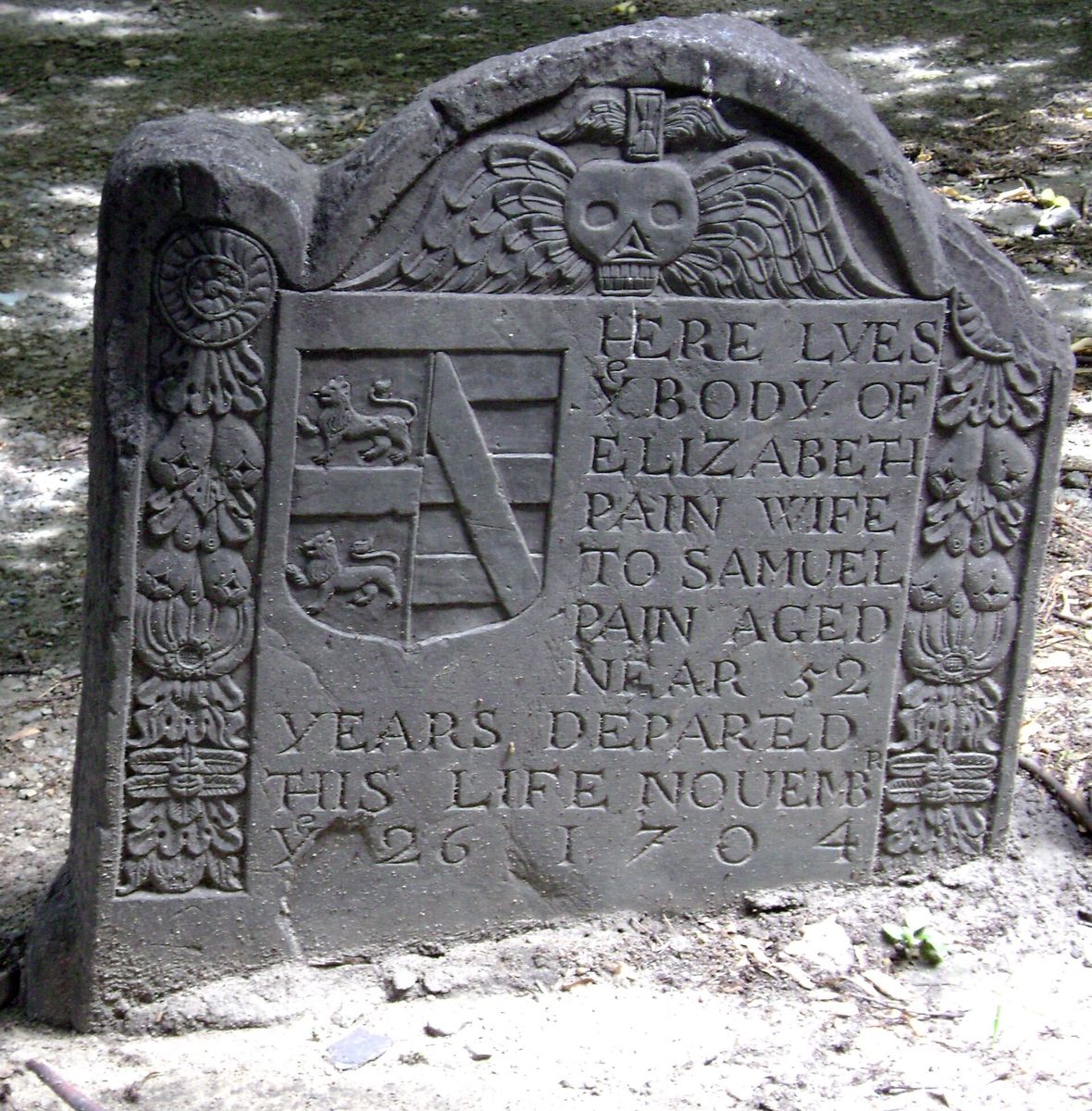
This is the oldest burying ground in Boston, in use from 1630, with John Winthrop, the colony’s first governor, among its dead. The winged skull is everywhere here, the Puritan reminder that death comes for everyone and heaven is optional. The stone for Elizabeth Pain, who died in 1704, carries a coat of arms and a famous legend: that Nathaniel Hawthorne saw it and invented Hester Prynne of The Scarlet Letter. The chapel beside it is included in the $35.10 Boston 250 Pass if you want to see the inside by day.
The Omni Parker House
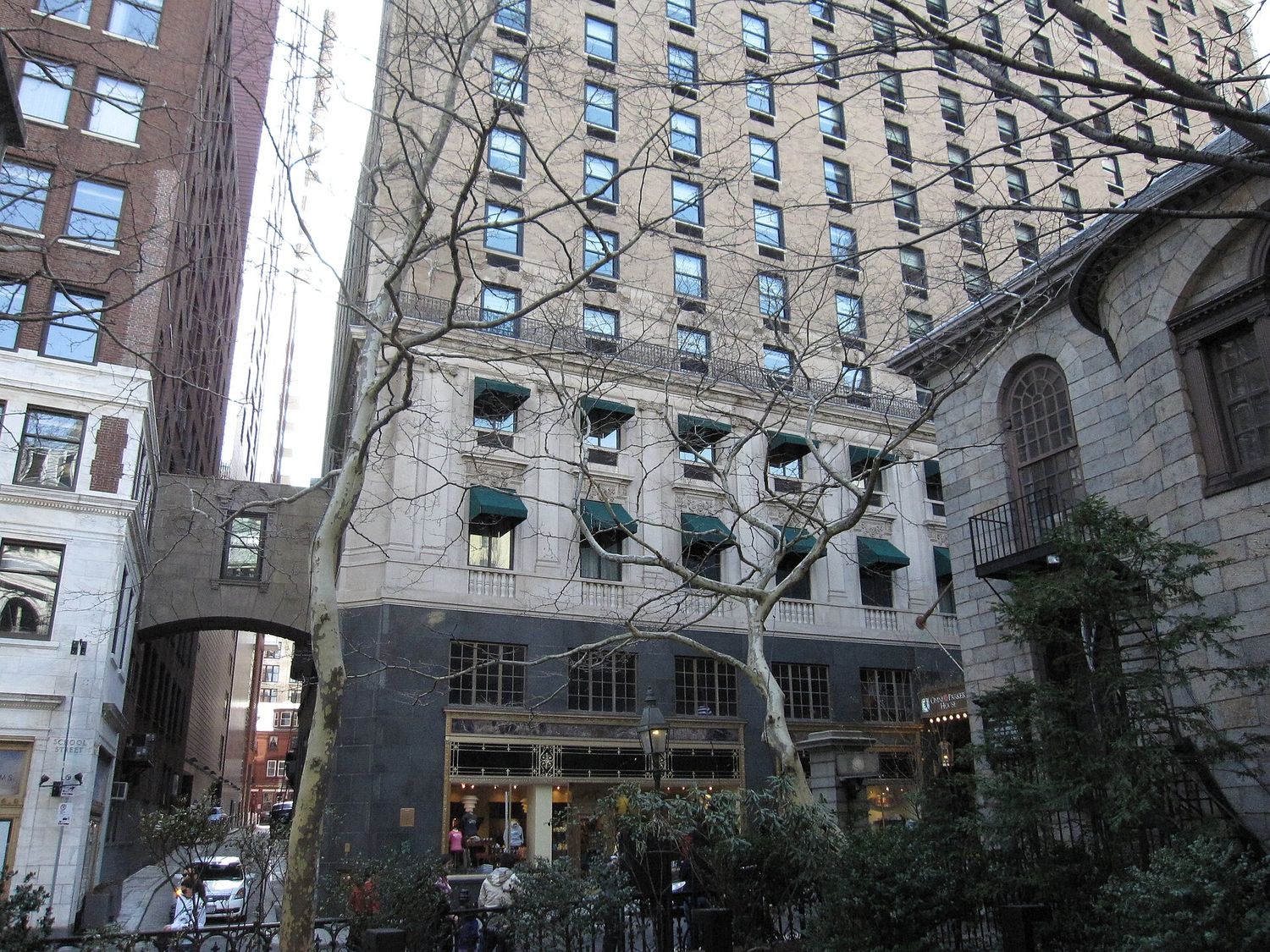
Across School Street from King’s Chapel, the Omni Parker House opened in 1855 and is the hotel with the most ghost stories in Boston. Staff and guests have reported its founder, Harvey Parker, wandering the tenth floor, checking on his guests. Room 303 has a reputation involving a death and unexplained sounds, and the hotel is said to have turned it into a storage room for years. Charles Dickens stayed here, and a mirror he rehearsed in hangs in the building; some guests swear it does not always show what is in front of it.
The Parker House also invented the Boston cream pie and the Parker House roll, which means the cheapest way into its stories is to sit at the bar or order a slice of pie. That is a better use of $15 than most things sold as a haunted experience.
The Granary Burying Ground
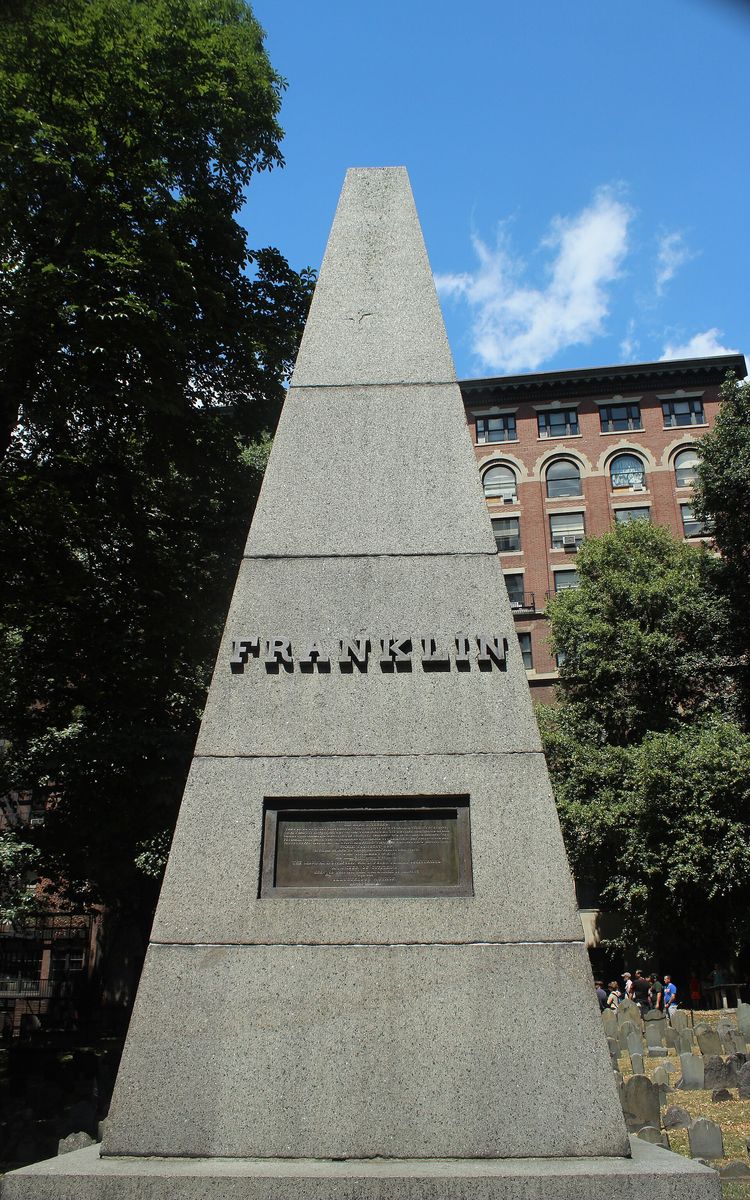
Up Tremont Street, the Granary holds Paul Revere, Samuel Adams, John Hancock, the five victims of the Boston Massacre and Benjamin Franklin’s parents under the granite obelisk. Guides also point out the grave said to be Mother Goose’s, though historians think the nursery rhymes arrived much later. The Granary is one of the stops on the Freedom Trail, so if you have walked the trail by day you will recognize it; at night it is a different place.
Copp’s Hill and the North End
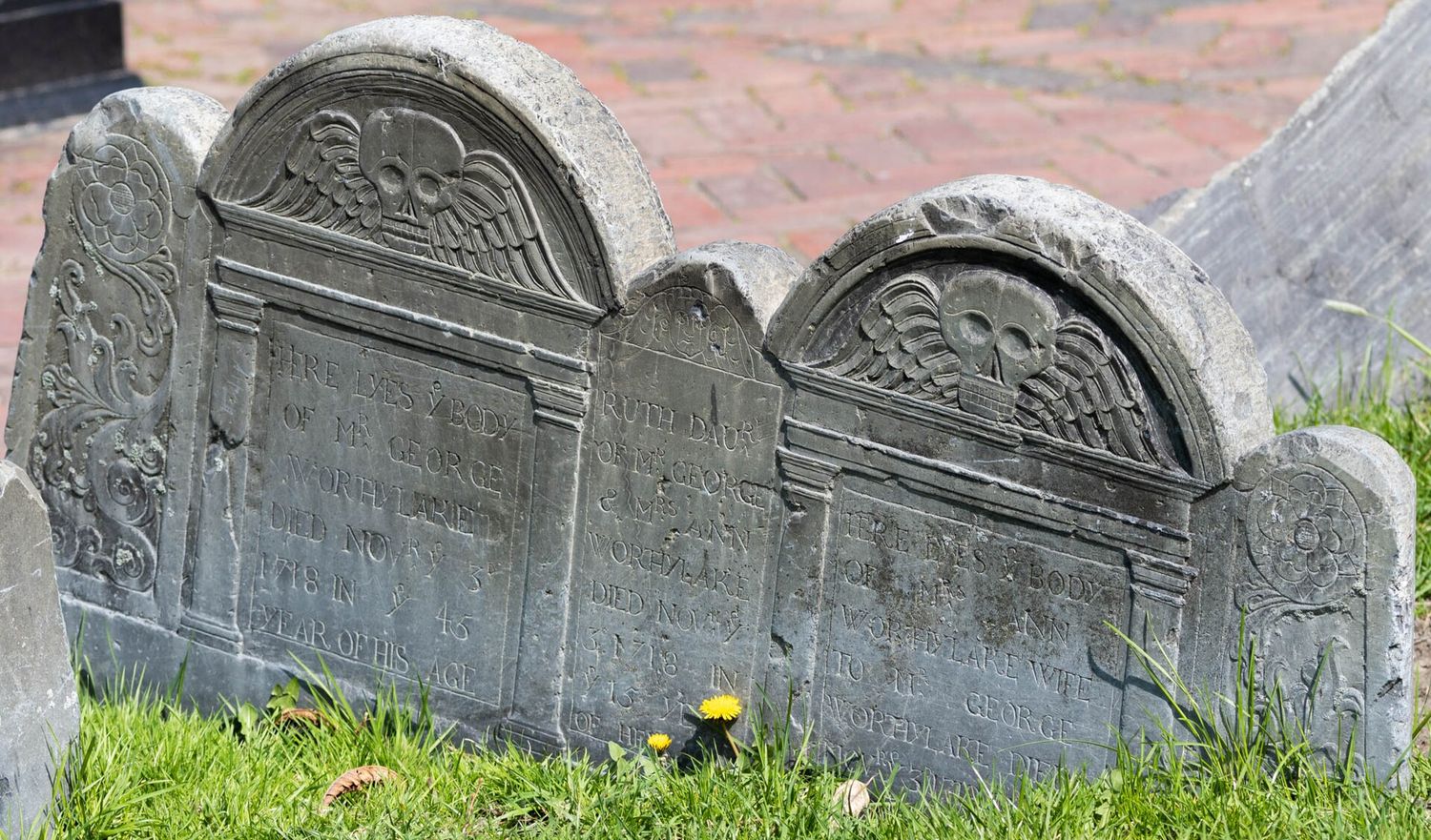
Copp’s Hill Burying Ground, opened in 1659, sits at the top of the North End looking across to Charlestown. Its best story is true: George Worthylake, the first keeper of Boston Light, drowned with his wife and daughter in 1718 while rowing back to the lighthouse, and the teenage Benjamin Franklin wrote a ballad about it that he sold on the streets. The family share one triple stone. Guides will also show you headstones said to have been used by British soldiers for target practice, which may or may not be true.
Down the hill toward the water on Commercial Street is the site of the Great Molasses Flood. On 15 January 1919 a storage tank burst and a wave of molasses swept through the neighborhood, killing 21 people. North Enders have claimed for a century that on hot summer days the air still smells faintly sweet. A small plaque marks the spot at the edge of Langone Park.
Fort Warren and the Lady in Black
Out on Georges Island, the Civil War fort holds Boston’s most famous ghost story: a Confederate prisoner’s wife who disguised herself as a man to free him, was caught, and was hanged in black robes. Most historians doubt she existed. You cannot get there at night, and the Harbor Islands ferries stop after the Indigenous Peoples’ Day weekend in October, so this one is for a summer day trip.
How to read a Puritan gravestone
Every ghost tour spends time in the burying grounds, and the stones are more interesting than most guides have time to explain. Ten minutes of knowing what you are looking at turns a field of gray slate into a timeline.
Skulls, then cherubs, then urns
The carving at the top of a stone, the tympanum, tells you roughly when it was made. The oldest stones, from the late 1600s into the middle of the 1700s, show the death’s head: a skull, usually with wings, sometimes with crossed bones or an hourglass beside it. It is not meant to be frightening. It is a Puritan sermon in stone, a reminder that the body rots and the soul flies, and that you, reading it, are next. Around the middle of the eighteenth century the skull softens into a soul effigy or cherub, a rounder face with wings, as religious attitudes relaxed after the Great Awakening. By the early 1800s both have given way to the urn and willow, a neoclassical symbol of mourning that looks like it belongs on a Wedgwood vase. You can see all three in the Granary in a single glance.
The small symbols
- Hourglass, sometimes winged: time is running out, or has.
- Crossed bones, coffins and picks: the plain facts of burial, carved without euphemism.
- Coats of arms, like the one on Elizabeth Pain’s stone: a family claiming status, and a sign the stone was expensive.
- Vines, gourds and rosettes in the side borders: decoration, and on some stones references to renewal and resurrection.
- “Here lyes ye body of”: the “y” in “ye” is really a thorn, an old letter for “th”, so it reads “the”.
The stones are not where the bodies are
This is the fact that makes ghost-tour guides grin. In the nineteenth century the city tidied its old burying grounds, straightening crooked stones into neat rows so the grass could be cut, and in doing so moved many of them away from the graves they marked. The tidy lines you see in the Granary are a Victorian rearrangement. The people are still in there, often in family tombs beneath your feet, but the stone with a name on it may be several yards from the person it names. Keep to the paths.
A free self-guided Boston ghost walk
You do not need a ticket to hear these stories where they happened. This route is about two miles and takes two to three hours at an easy pace with stops. Do the burying grounds in daylight, since the gates are not open at night, and finish in the North End as it gets dark.
- Central Burying Ground, Boylston Street side of the Common. Start here at the opposite end of town from everything else. Boylston station on the Green Line is across the street.
- Boston Common. Walk north across the Common, past the site of the old hanging elm near the Frog Pond.
- Mary Dyer’s statue outside the State House on Beacon Street.
- The Granary Burying Ground on Tremont Street.
- King’s Chapel and its burying ground, at Tremont and School Streets. Find Elizabeth Pain.
- The Omni Parker House across the street. Look at the lobby, have a slice of Boston cream pie, or both.
- The Old State House, where the Boston Massacre happened outside on 5 March 1770. A ring of cobblestones marks the spot.
- Copp’s Hill Burying Ground, a 15-minute walk through the North End along Hanover and Salem Streets.
- The molasses flood plaque at Langone Park on Commercial Street.
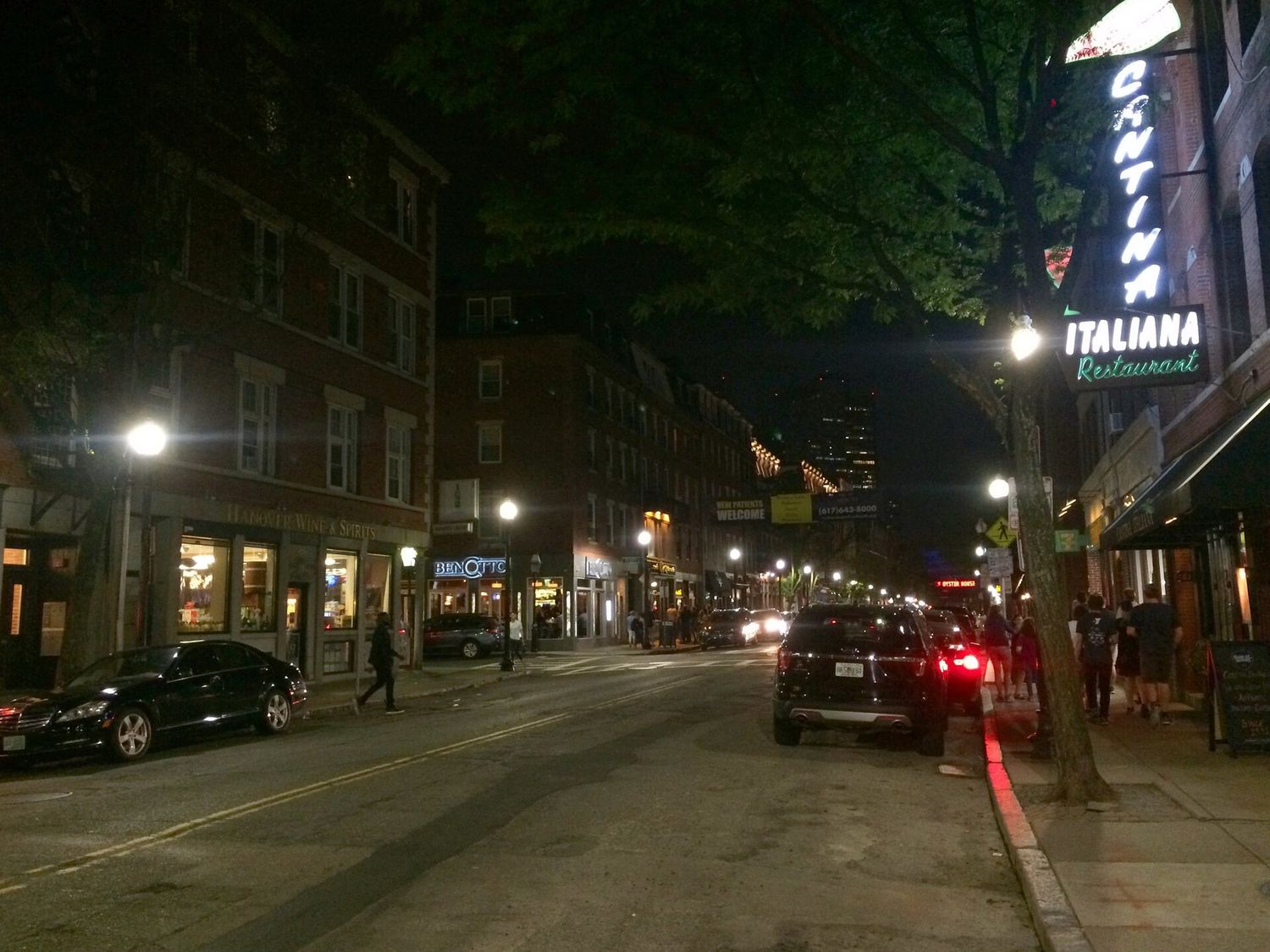
End on Hanover Street, where the restaurants and pastry shops stay open late. Our Boston food guide covers the North End, and our hidden gems guide has more of the city’s stranger corners.
A Boston ghost evening, planned
Here is how to put the pieces together into one evening, in two versions, with the cost for two adults at September 2026 prices.
The ticketed version
- 4pm. Walk the Granary and King’s Chapel burying grounds while they are open and there is still light to read the stones.
- 5pm. Cross School Street to the Omni Parker House for a drink or a slice of Boston cream pie in the place where it was invented.
- 5:30pm. Walk ten minutes down State Street to the Marriott Long Wharf and check in 15 minutes before a 6pm Ghosts & Gravestones departure.
- 7:30pm. The tour ends back at the waterfront. Walk ten minutes to the North End for dinner on Hanover Street.
Two Ghosts & Gravestones tickets bought online cost from $74.80. Add food and drink to taste.
The free version
- 2:30pm. Start at the Central Burying Ground on the Common and follow the self-guided route above.
- 4:30pm. Reach Copp’s Hill in the long late-afternoon light and look across the water to Charlestown and the masts of USS Constitution.
- 5pm. Walk down to the molasses flood plaque at Langone Park, then back up to Hanover Street as it gets dark, for dinner and a cannoli.
Admission costs nothing. In November and December, when the sun sets before 4:30pm, start an hour earlier so you are not reading headstones by phone light. It is the better choice for anyone who prefers a story to a jump scare.
Which Boston ghost tour should you book?
| If you are… | Book | Why |
|---|---|---|
| A family with children 8–14 | Ghosts & Gravestones | Costumes, a trolley, inside the burying grounds, 90 minutes |
| A family with children under 6 | Nothing; do the self-guided walk by day | Ghosts & Gravestones will not take them, and walks run too late |
| A couple | An independent ghost walk, then a drink at the Parker House | More atmosphere, less theater, cheaper |
| A group of friends | A ghost pub crawl | Honest about what it is |
| A history buff | Boston by Foot’s Dark Side of Boston, or the self-guided walk | Sourced stories, less performance |
| On a tight budget | The self-guided walk | Every stop is free to see |
| In Boston in late October | Book whatever you choose at least a week ahead | Tours near Halloween sell out |
Salem in October: worth it, with conditions
For many visitors, a ghost tour means Salem, and in October the town hosts Haunted Happenings, a month-long festival that runs from 1 to 31 October 2026 with a Grand Parade on the first day. Salem is about 30 minutes from North Station on the commuter rail, and the MBTA adds extra weekend services in October. There are more ghost and witch tours per square mile there than anywhere else in New England.
The honest caveat: on October weekends, and on the last weekend before Halloween in particular, Salem is packed shoulder to shoulder, trains are standing-room only, and restaurants have long waits. The witch trials of 1692 are a serious and grim story that a lot of the costume-shop commerce around them does not handle well. If you want Salem at its best, go on a weekday early in the month, visit the Peabody Essex Museum ($20 adults, free for 16 and under), and take a tour that deals with the history rather than the Halloween. Our day trips from Boston guide covers how to get there and back.
When to go and what to bring
- Season. Ghost tours run most of the year but are busiest from September through Halloween, and several operators cut back their schedules in the winter. October is the month, and also the month tours sell out and cost the most. See our best time to visit Boston guide for the wider picture.
- Weather. Most tours go ahead in rain. A waterproof hood is better than an umbrella on a crowded sidewalk, and October evenings average around 47°F, so bring a warm layer. If the weather is truly bad, our guide to things to do in Boston when it rains has indoor alternatives.
- Shoes. Brick sidewalks, cobbles and uneven burying-ground paths in the dark. Wear something with grip.
- Getting back. The T stops running around 12:30 to 1am. Evening tours finish well before that, but pub crawls may not. Check the MBTA for your last train.
- Tickets. Book online. The big operator’s online price is lower than walk-up, and in October you may not get a walk-up place at all.
What is not worth it
- Any tour sold mainly on “real paranormal investigation.” Handing out ghost-detecting gadgets is theater. It is fine as theater; it is not worth a premium.
- A ghost pub crawl if you do not drink much. You will pay the same and spend a lot of the evening waiting outside bars.
- Salem on the last Saturday before Halloween if you do not like crowds. Go on a weekday, or do Boston’s own burying grounds instead.
- Booking a hotel room at the Parker House just for the ghosts. It is a good historic hotel, but the lobby and the bar give you the atmosphere for the price of a drink. See our where to stay guide if you are choosing a hotel on its own merits.
Frequently asked questions
What is the best ghost tour in Boston?
For most first-time visitors, Ghosts & Gravestones, because it is the only one that takes you inside two burying grounds after dark and covers the most ground in 90 minutes. For history lovers, Boston by Foot’s Dark Side of Boston tour or a well-reviewed independent walk. For a free option, the self-guided route on this page covers the same places by day.
How much do Boston ghost tours cost?
Most cost between $30 and $55 per person. Ghosts & Gravestones started at $37.40 online when we checked in September 2026, with walk-up prices higher, and its walking-only Nightwalk from $27.85. Independent walks were around $30 and ghost pub crawls from about $36 before drinks.
Are Boston ghost tours suitable for children?
Ghosts & Gravestones does not allow children under 6 and rates the tour PG-13. Children from about 8 to 14 usually love it. For younger children, visit the burying grounds by day and tell the stories yourself, leaving out the worst parts.
Is the Omni Parker House really haunted?
It has more reported ghost stories than any other hotel in Boston, from its founder, Harvey Parker, on the tenth floor to the story of room 303. Whether you believe them is up to you. The bar and lobby are open to anyone, and it is a pleasant place for a drink after a tour either way.
Can you visit Boston’s burying grounds at night?
Not on your own. The historic burying grounds are open by day, and Ghosts & Gravestones includes walking sections inside them as part of the tour. Other ghost walks tell the stories from the gates and railings. For the full, free experience, go by day.
Should I do a ghost tour in Boston or in Salem?
Boston’s stories are older and its burying grounds are more impressive; Salem has the witch trials and the October festival. If you have one evening in Boston, do the Boston tour. If you have a free day in October, Salem is 30 minutes away by train, but go on a weekday.
If you want the history without the jump scares, the Freedom Trail Foundation’s Lantern tour walks the same downtown streets by lantern light on fall evenings. Our comparison of Freedom Trail tours covers it alongside the daytime walks and the free Park Service programs.
The burying grounds are just as compelling by daylight. Our guide to the Granary Burying Ground covers the hours, the famous graves and the stories behind the stones, along with King’s Chapel, Copp’s Hill and Boston’s other historic burial grounds.