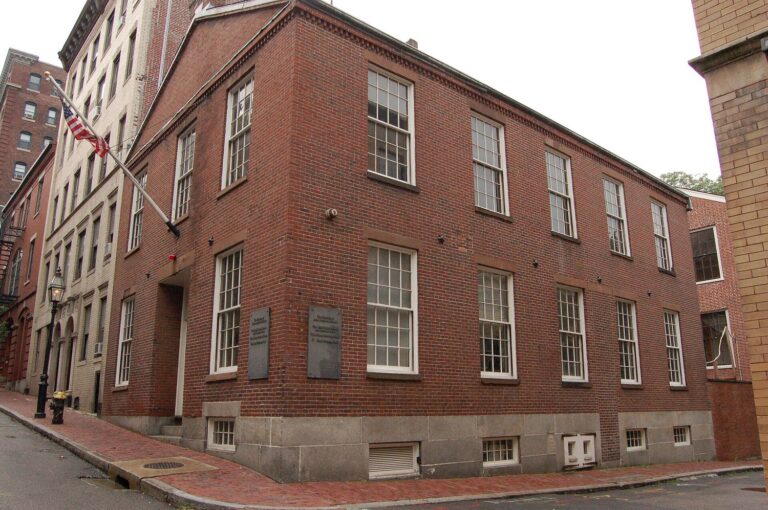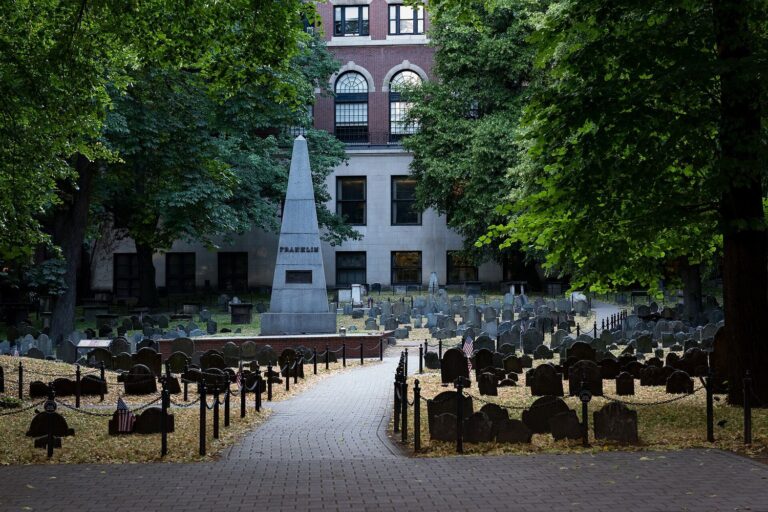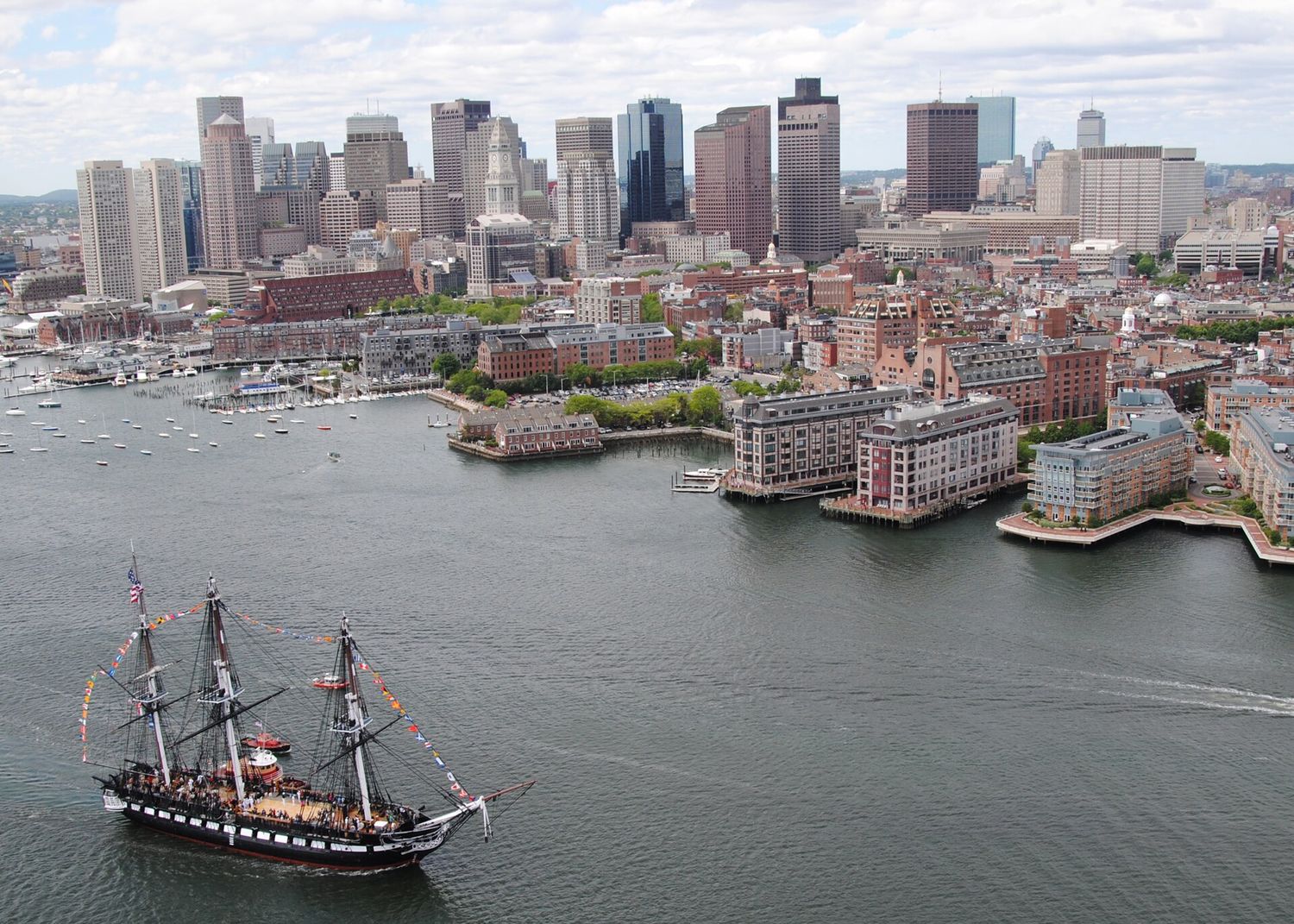
Most famous old ships end their days as museums. USS Constitution never quite did. The frigate that came off a North End slipway in October 1797 is still a commissioned ship of the United States Navy, her crew are active-duty sailors, and a few times a year she leaves her pier and heads down the harbor to fire a salute. Type USS Constitution Boston into a map and the pin lands on Pier 1 of the Charlestown Navy Yard, stop 15 of the 16 on the Freedom Trail, and the warship tied up there costs nothing to board.
This guide is about making that free visit count. It covers the ship’s story, what happens at the security screening and on each deck, the hours (shorter than most people expect), the USS Constitution Museum and how its suggested admission works, the rest of the Navy Yard, the turnaround cruises and how the public gets on one, and the ferry that makes Charlestown easy. Hours, fares and prices were checked in November 2026 on the museum’s, the National Park Service’s and the MBTA’s own sites; confirm before you go, because a working warship keeps its own calendar.
Why a ship from 1797 still has a crew
In 1794 Congress passed the Naval Act and paid for six frigates, the ships that would form the core of a young United States Navy. Constitution was the one built in Boston, at Hartt’s shipyard on the North End waterfront, to a design by Joshua Humphreys, and George Washington chose her name from a list of ten. Her timbers came from as far apart as Maine and Georgia. The toughest of them, southern live oak, was cut at Gascoigne Bluff near St. Simons Island, Georgia, and enslaved laborers did much of that cutting, a history the USS Constitution Museum has acknowledged. Paul Revere, whose North End house is three Freedom Trail stops back, supplied her copper bolts and spikes. She was launched on October 21, 1797, and christened by Captain James Sever.
She went to work almost at once. In the Quasi-War with France at the end of the 1790s she was the flagship of the station off Santo Domingo and took several prizes in the Caribbean. In 1803 she became Captain Edward Preble’s flagship in the Mediterranean, in the war against Tripoli, and the plan to destroy the captured frigate Philadelphia in Tripoli’s harbor was worked out on her decks.
The War of 1812, and how she got her nickname
Her reputation was made against the Royal Navy. On August 19, 1812, cruising off the Gulf of St. Lawrence under Captain Isaac Hull, Constitution met HMS Guerriere. The British frigate fired first, and some of her shot fell into the sea while some glanced off Constitution’s side. Hull’s broadsides brought down Guerriere’s mizzenmast, damaged her foremast and cut away most of her rigging, and in about half an hour it was over. Guerriere was too badly wrecked to bring home and was burned. The Navy’s own history says it was in this fight that sailors saw cannonballs bounce off the hull, and the ship has been “Old Ironsides” ever since.
Four months later, off the coast of Brazil and under Commodore William Bainbridge, she fought the British frigate Java. Constitution had her wheel shot away early in the action and still dismasted her opponent, and Java, too, had to be burned. In February 1815 she took on two British ships at once: Cyane struck her colors in less than an hour and Levant surrendered soon after, although a British squadron later took one of the prizes back. Over the course of the war she slipped through the British blockade of Boston seven times. For a young navy these were morale-changing victories, and the Guerriere fight in particular turned the ship into a national celebrity.
Saved by a poem, then by pennies
By 1830 she was worn out. In September that year the Boston Advertiser reported, wrongly, that the Navy meant to scrap her, and two days later the same paper printed a short poem by a young Oliver Wendell Holmes. “Old Ironsides” was reprinted across the country, the public outcry did its work, and instead of being broken up she was rebuilt. On June 24, 1833, she became the first ship to enter Charlestown’s brand-new granite dry dock, the same Dry Dock 1 you can stand beside today.
She served on for much of the century: a 30-month voyage around the world that began in 1845, patrols off West Africa against slave traders in the 1850s, and years as a training ship for midshipmen at Annapolis. By the 1890s she had been decommissioned and was serving as a receiving ship at Portsmouth, New Hampshire, and in 1905 public pressure saved her from destruction a second time.
The best-remembered rescue came in the 1920s. Schoolchildren all over the country were encouraged to bring in their pennies for “Old Ironsides,” and the penny campaign raised $148,000, although the estimated cost of the restoration climbed past $745,000. When she came out of dry dock in March 1930, about 85 percent of the ship had been replaced. She was recommissioned on July 1, 1931, and the next day she set off on a tour of 90 ports on the Atlantic, Gulf and Pacific coasts, where thousands of Americans saw up close the ship they had helped to save.
Sailing again
In 1954 Congress directed that she be restored “as far as may be practicable” to her original condition, and in 1960 she was named a National Historic Landmark. On July 21, 1997, to mark her 200th birthday, she set sail under her own power for the first time in 116 years, on sails that schoolchildren’s pennies had again helped to buy. She was designated America’s Ship of State in 2009. On August 19, 2012, exactly two hundred years after the Guerriere fight, she sailed again, and from 2015 to 2017 she spent two years back in Dry Dock 1, where she was given new copper sheathing on her lower hull.
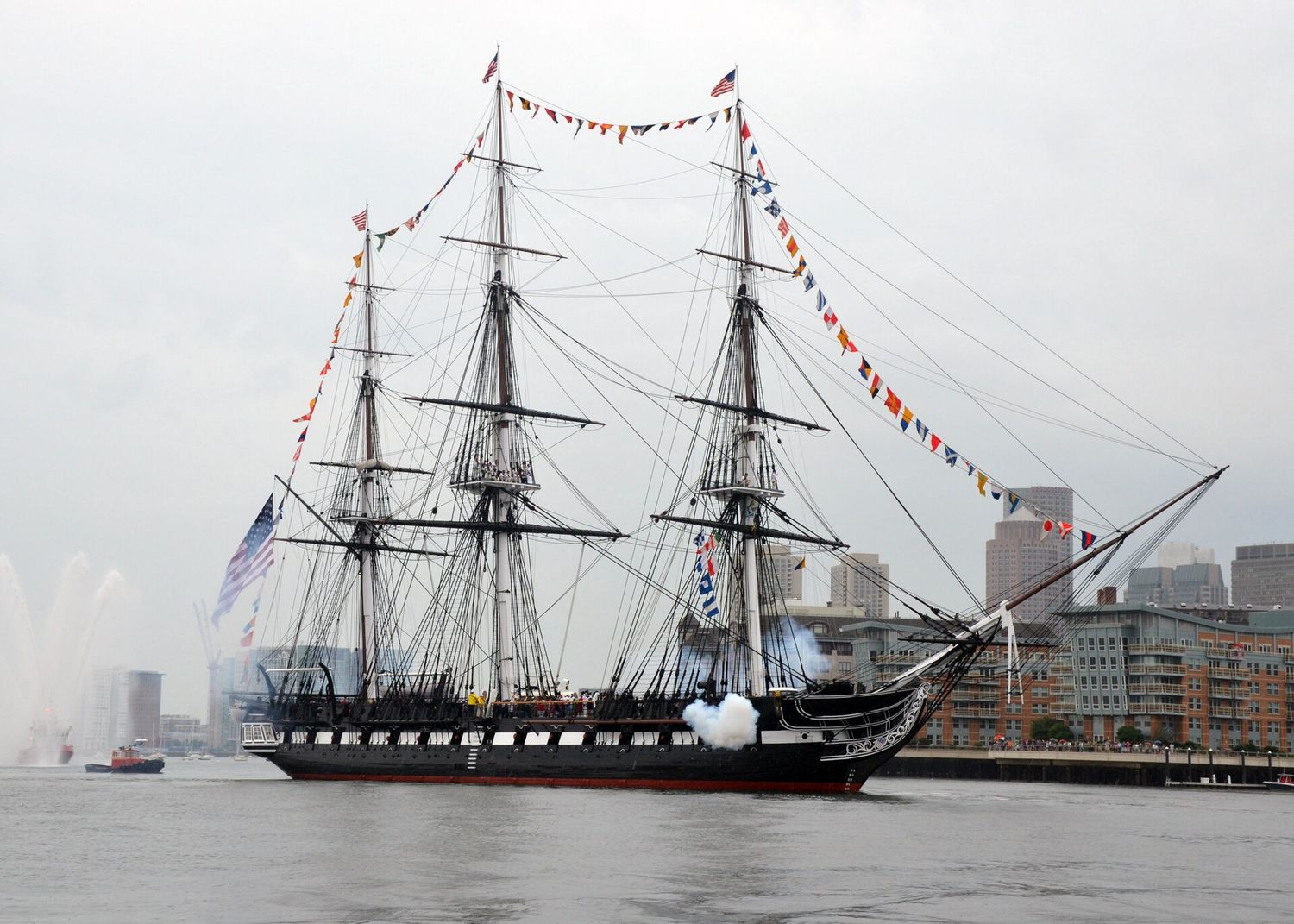
The highlight of her 2026 came on July 11, when she led the Parade of Sail at Sail250 Boston, firing a salute as the tall ships came in, alongside the Coast Guard’s barque Eagle. Boston was the final stop of the Sail250 series, which had also visited New Orleans, Norfolk, Baltimore and New York.
“Oldest,” and how much of her is original
The Navy’s history command calls her the world’s oldest commissioned warship afloat and the oldest vessel that can still sail under her own power, and the wording is careful for a reason. Britain’s HMS Victory, Nelson’s flagship at Trafalgar, is about three decades older and also still in commission, but she has sat in a dry dock in Portsmouth since 1922. Constitution floats.
As for what’s original, be realistic. With 85 percent of her renewed by 1930, and later restorations replacing more, very little of what you touch on board was there in 1812. That bothers some people. It shouldn’t. The shape Humphreys drew, the name and the story are all intact, and a wooden ship has always been something repaired plank by plank for as long as it stays in service.
What happens when you visit
The security screening
Boarding is free and first come, first served: no tickets, no booking, no timed entry. What there is, because this is an active-duty Navy ship, is a security screening much like an airport’s. You’ll be asked to take off bulky jackets, jewelry, watches and belts, and every bag, backpack or piece of luggage is inspected. Adults need a federal or state photo ID, such as a driver’s license or a passport. Visitors under 18 don’t need ID but go through the same screening. If you’re visiting from abroad, bring your passport.
The practical lesson is to travel light. A small day pack is no problem; a carry-on suitcase on the way to the airport, or a winter coat with full pockets, just means more to unload in front of a line of people. The line moves at the speed of the screening, so on a busy summer day aim to be there when the ship opens at 10am.
The spar deck
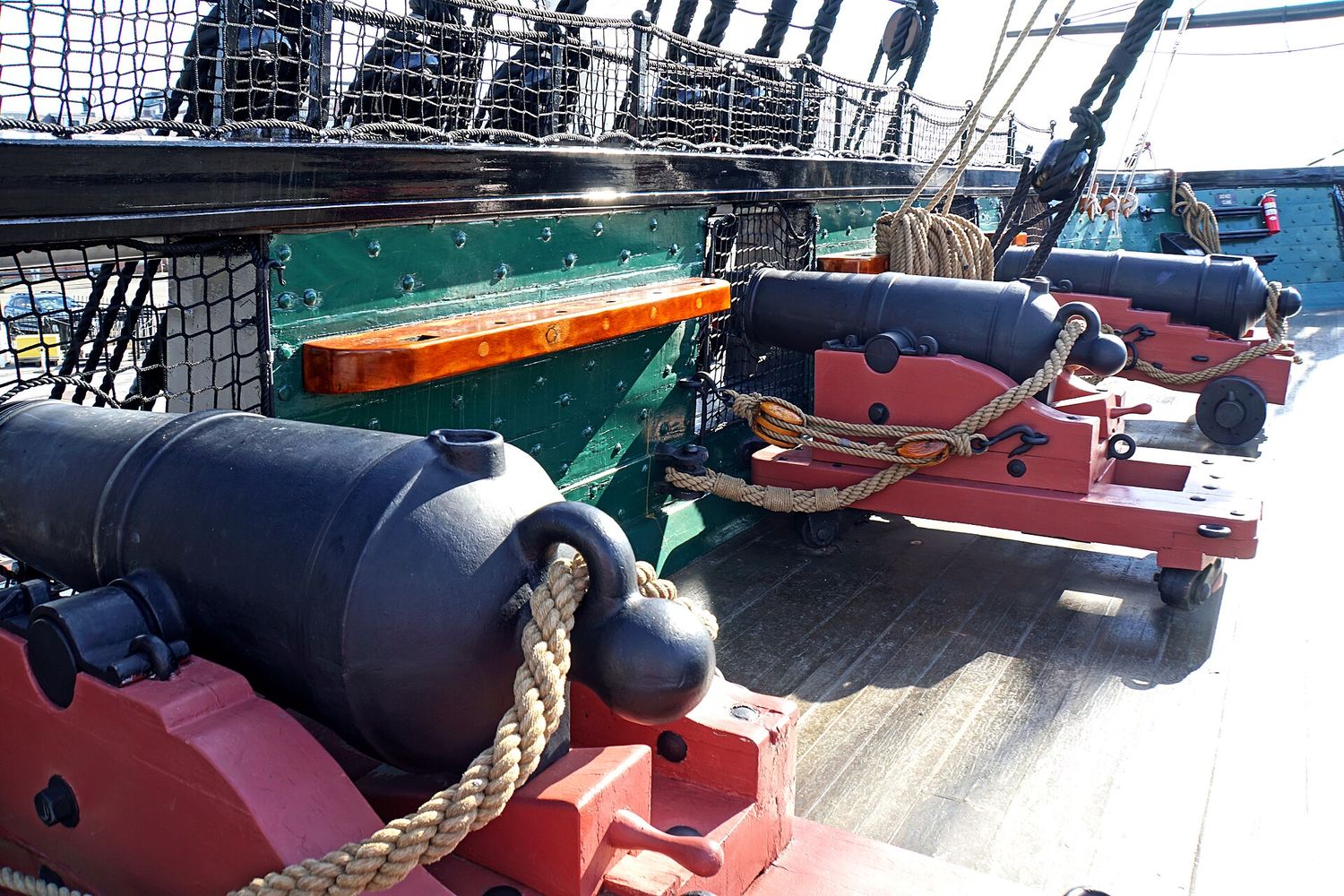
You come aboard onto the spar deck, the open top deck, and the first impression is of rope: lines running up into the three masts, more of it coiled on deck, netting along the rails. Lining each side are the carronades, short, stubby guns that did their damage at close range. In 1812 she carried 22 of them up here, 32-pounders, 11 to a side. Every gun on the ship today is a replica; most were cast in 1930 for the great restoration, and two of the spar-deck carronades date only from 1983.
Find the wheel and remember that she lost one to a British shot in the Java fight. Then walk to the rail on the city side and look across the water to the North End, where Hartt’s shipyard stood. More than two centuries after her launch, Constitution is still berthed within sight of the place she was built.
The gun deck
Steep, ladder-like steps take you below to the gun deck, and this is the deck to linger on. The long guns stand in a row down each side, run out to their ports on red-painted carriages, with the ship’s white-painted beams close overhead. In the War of 1812 she carried 30 of these, long 24-pounders, 15 to a side. Hidden inside the forward long gun on each side is a modern 40mm saluting gun, fitted during her 1970s restoration so that the ship could fire ceremonial salutes again.
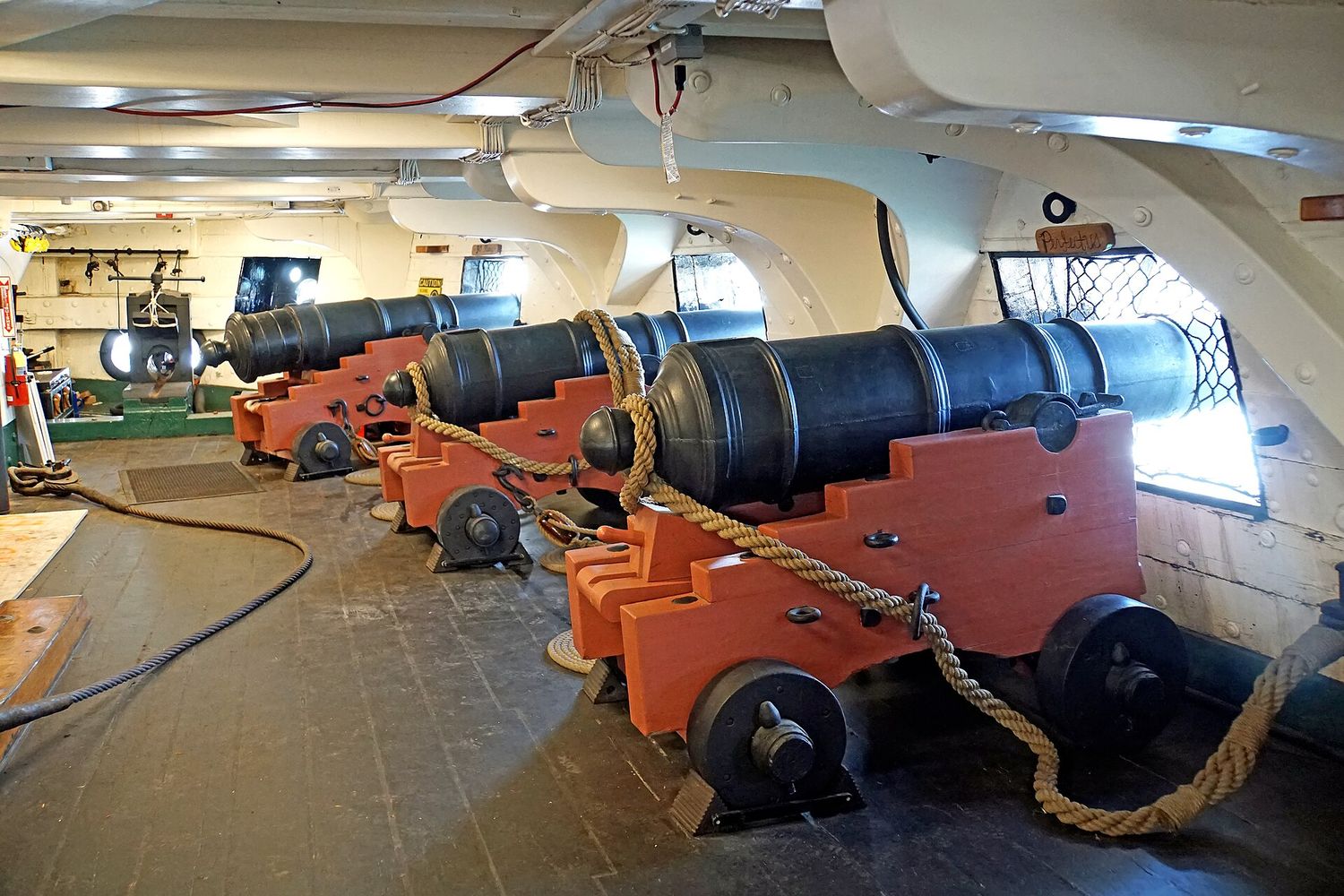
Stand there for a minute and picture it full. Hundreds of men lived, slept, ate and fought in spaces like this one, with the guns among them, and the cramped reality of it says more than any amount of rigging. Mind your head on the beams.
How long to allow
Give the ship 30 to 45 minutes, longer if you like to linger below or get talking to the crew. The sailors on board are active-duty Navy, assigned to the oldest commissioned warship in the US fleet, and asking them what you’re looking at is part of the visit.
Accessibility, strollers and service animals
Because the ship is kept in her 1812 configuration, a visit is limited to people who can walk aboard and around the spar deck unassisted, and going below means climbing steep, ladder-like steps. Wheelchairs, walkers, scooters and strollers aren’t allowed on board and have to be left on the pier, so families with a baby should bring a carrier. Service animals may tour the spar deck on a leash or harness; proof of the animal’s status isn’t required by law, but it makes the screening quicker. The museum, by contrast, is physically accessible to wheelchairs, walkers, scooters and strollers on both of its floors.
Hours, closed days and the off-season trap
The ship is open Wednesday to Sunday, 10am to 4pm, and closed on Mondays and Tuesdays. It also closes for Martin Luther King Jr. Day, Thanksgiving, Christmas Day and New Year’s Day. Those are the standard hours that the museum and the National Park Service both list. The Navy sets them and can change them, and on the days she goes out for a cruise she is away from her pier for several hours, so check before you go.
Everything else in Charlestown keeps its own schedule, and in the off-season the overlap is narrower than most visitors expect. This is what was posted for the 2026–27 off-season:
| Site | Off-season hours | Good to know |
|---|---|---|
| USS Constitution | Wednesday to Sunday, 10am to 4pm | Closed Mondays, Tuesdays, MLK Day, Thanksgiving, Christmas Day and New Year’s Day |
| USS Constitution Museum | Daily, 10am to 5pm | Closed Thanksgiving, Christmas Day and New Year’s Day; closes at 2pm on December 24 |
| Navy Yard Visitor Center (NPS) | Wednesday to Sunday, 10am to 4pm, October 12 to May 28 | Entered through a security checkpoint; photo ID may be required |
| USS Cassin Young | Closed November 12 to May 28 | Opened by park staff in season only |
| Bunker Hill Monument and Museum | Wednesday to Sunday, 1pm to 4pm, October 13 to May 28 | Last climb 30 minutes before closing; 25 people at a time |
| Navy Yard grounds | Open 24 hours | Good for a walk after the ships have closed |
Read across the rows and the trap is plain. On a Monday or Tuesday between mid-October and late May, the ship, the visitor center and the monument are all closed, and the destroyer is closed every day from mid-November. Only the museum and the Navy Yard’s grounds stay open. If your trip falls early in the week in the off-season, move Charlestown to Wednesday or later. The monument’s 1pm opening, meanwhile, suits a morning on the ship very nicely.
For the summer schedule, look at the National Park Service’s Boston National Historical Park hours page, which lists each site’s seasonal hours, and the museum’s visit page, which shows the ship’s and the museum’s hours side by side.
The USS Constitution Museum
The ship belongs to the Navy. The museum a short walk away is a separate non-profit, and the two are easy to confuse because they share a name and most of their visitors. The museum tells the part of the story the ship can’t: who the sailors were, how they lived on board, and what became of their families back home.
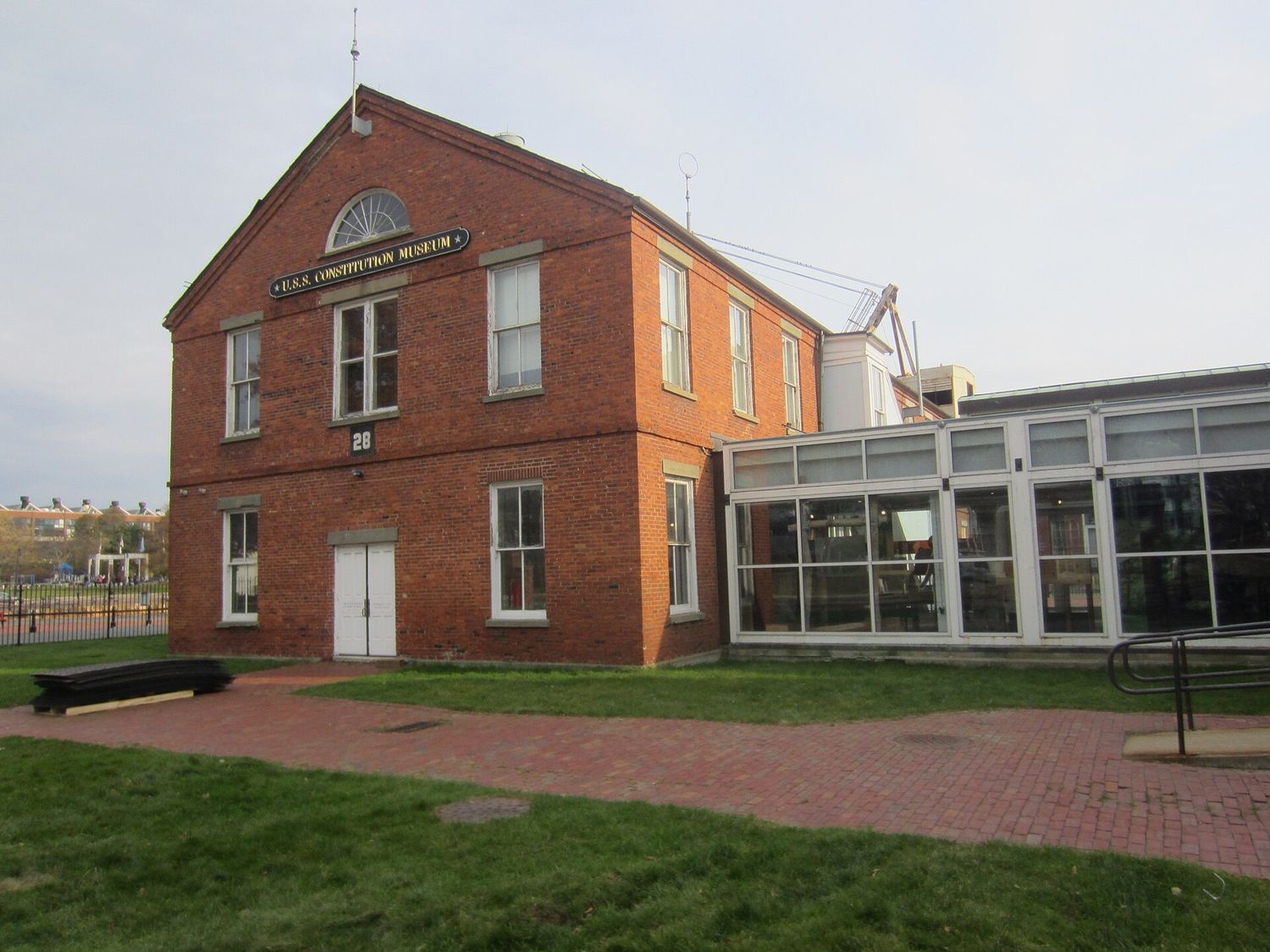
Admission works by suggestion rather than a fixed price. The museum lists three tiers per person: Pay it Forward at $25, Standard at $15, and Reduced at anything from free to $10. It relies on those donations to keep its doors open, and the Standard rate is a fair price for what’s inside; because the Reduced tier starts at nothing, money needn’t keep anyone out. The museum also offers several discounted and free admission programs for individuals, families and groups, listed on its hours and admission page.
Two permanent exhibits fill most of the space. “Old Ironsides” in War and Peace walks through three centuries of the ship’s life, from her building and the War of 1812 to her diplomatic voyages and the long work of preserving her. All Hands on Deck: A Sailor’s Life in 1812 is the one aimed at families. You join the 1812 crew and try your hand at jobs like scrubbing the deck and balancing aloft to furl a sail, while following the stories of real crew members and their families, pieced together from pension records, letters, diaries and census returns. Our guide to Boston with kids rates it among the best family hours in the city, and it costs whatever you decide to pay.
Two special exhibitions were showing in November 2026. Exploring Old Ironsides: New Perspectives has large-scale photographs by the Boston-based photographer Greg M. Cooper, who has spent more than 20 years photographing the ship, from views of her under way in the harbor to close-up details revealed in dry dock. Art of the Ship, in the museum’s theater, gathers artwork depicting the ship from the museum’s own collection. Special exhibitions change, so check the museum’s exhibits page if one of them is the reason you’re going.
A few practical points. Everyone checks in at the admission desk before going into the exhibits, and food and drink stay out of the galleries. Do the ship first: it closes at 4pm and the museum at 5pm, so the museum is the better one to leave until last. The exception is a cold or wet day with young children, when an hour in All Hands on Deck makes the real gun deck mean a great deal more.
Around the Navy Yard
The Charlestown Navy Yard opened in 1800 and built and repaired the Navy’s ships for 174 years, until it closed in 1974. Part of it is now run by the National Park Service as a unit of Boston National Historical Park, and most of its old brick and granite buildings have become offices, homes and shops. The grounds are open around the clock, so the yard makes a good walk even after the ships have closed, and our guide to the best views in Boston explains why the end of the piers is worth the detour.
Dry Dock 1
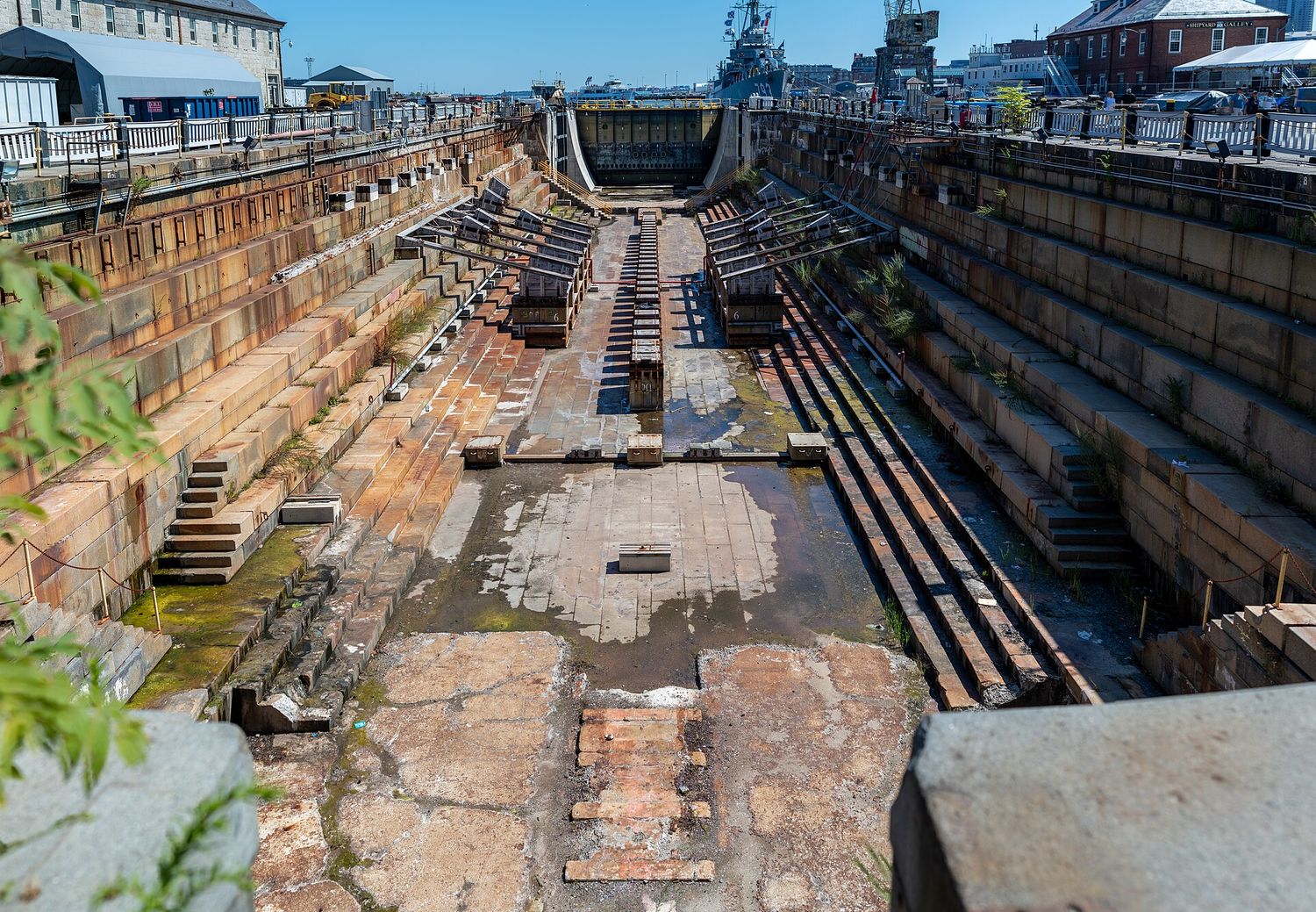
A short walk from the ship is Dry Dock 1, a long granite basin with stepped sides that opened on June 24, 1833, with Constitution as its first ship. She came back to it for the 2015–2017 restoration, so the same dock has held her nearly two centuries apart. When it is empty you can look down to the floor and see the rows of blocks a hull rests on, and get a sense of how much of a ship sits below the waterline.
USS Cassin Young
Moored at the same pier is a ship from another war. USS Cassin Young is a Fletcher-class destroyer, built in 1943 in San Pedro, California, one of 175 of her class built during the Second World War. This yard built dozens of similar destroyers during the war, and Cassin Young herself came here for repairs and modernization in the 1950s. She is a National Historic Landmark, and park staff open her to visitors in season only: she is closed from November 12 to May 28. In summer she is the better ship for anyone more interested in radar and steel than rope and oak, and the 146 years between the two ships are half the point of seeing both.
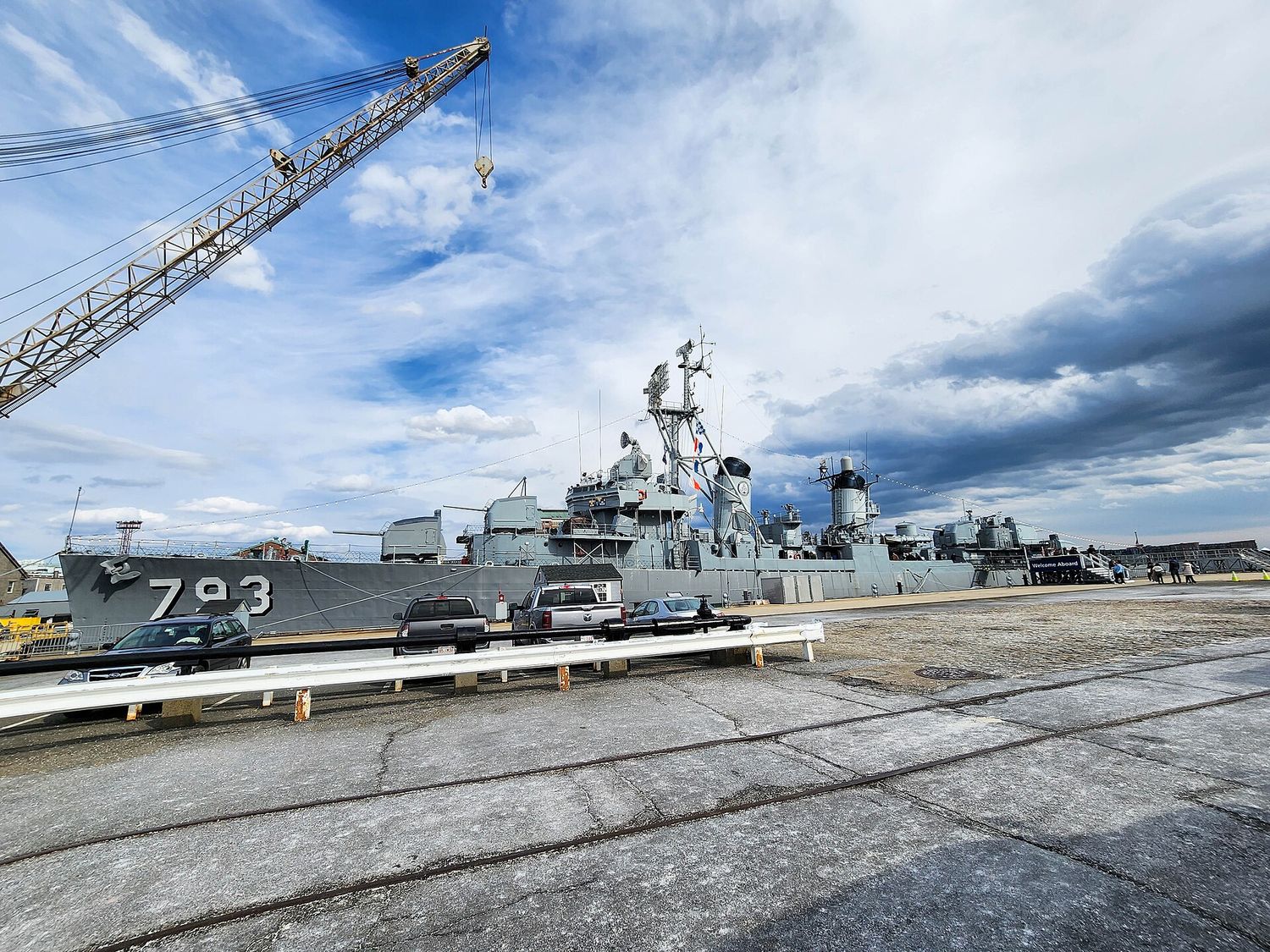
The rest of the yard
Look out for the Commandant’s House, among the earliest buildings in the yard; the long Ropewalk, built in 1837 to make rope for the Navy; and the view from the end of Pier 1 back across the harbor to the North End and the site of Hartt’s shipyard. The Navy Yard Visitor Center, run by the National Park Service behind a security checkpoint, is the place to pick up a map and ask what’s open. From mid-October to late May it keeps the same Wednesday-to-Sunday, 10am-to-4pm hours as the ship.
Turnaround cruises: watching her sail, and getting aboard for one
A few times a year Constitution leaves Pier 1 with her crew and invited guests, goes down the harbor, fires a 21-gun salute off Fort Independence on Castle Island, and comes back to her berth. In 2026 there were nine of these underways on the museum’s published schedule: the commissioning of USS Massachusetts on March 28, a crew turnaround on May 28, the Bunker Hill commemoration on June 17, the Fourth of July, the Sail250 parade on July 11, two days in late August for Chief Petty Officer Heritage Week, a cruise honoring Gold Star families on September 25, and the ship’s own birthday on October 21.
Only one of them is open to the public. For the Fourth of July cruise, the ship’s commander holds a public lottery for places on board, usually in early spring and at the Navy’s discretion; every other underway is by invitation. If you’d like to try for a place on the next Fourth of July cruise, watch the museum’s underway page from late winter, and remember that every date can change or be canceled at the Navy’s discretion.
Watching from shore is free. The ship usually leaves the Navy Yard at about 10am and is back between 1pm and 2pm. The salute off Castle Island in South Boston comes at around 11 to 11:30am, and crowds gather there to see it; the Harborwalk gives you other vantage points along the way. If you’re in town for the Fourth, our guide to Boston events covers the rest of the day.
Getting to Charlestown and back
The Freedom Trail’s red line will take you there on foot. From Old North Church it climbs to Copp’s Hill Burying Ground, drops to the waterfront, crosses the Charlestown Bridge over the Charles River and leads into the Navy Yard. It’s an exposed stretch, windy in winter and hot in August, and the point where a long day on the trail starts to feel long. Our guide to how long the Freedom Trail takes breaks the walk into sections.
The easier way, and a very pleasant ten minutes on public transport, is the MBTA’s Charlestown Ferry, route F4, from Long Wharf (South), beside the New England Aquarium, to the Navy Yard. The crossing takes 10 minutes and costs $2.40, the same as a subway ride ($1.10 reduced fare). On a November weekday, boats leave Long Wharf every 15 minutes in the morning and evening rush and every half hour in the middle of the day, from 6:30am to 8pm; on Sundays they run every half hour from 10am to 6pm. You can pay with the mTicket app, a paper ticket or CharlieTicket, a contactless card or phone, or cash, but a plastic CharlieCard won’t work on the ferry. Bikes are allowed on board. Holiday timetables differ, so check the F4 timetable for your day. Our guide to Boston Harbor and the islands covers the city’s other boats.
Coming back, the ferry drops you at Long Wharf, a short walk from Aquarium station on the Blue Line and from Faneuil Hall. MBTA bus 93 runs between downtown and Sullivan Square by way of Bunker Hill Street, and the Orange Line’s Community College station is the nearest subway stop to the Bunker Hill Monument. North Station, for the Orange and Green Lines and commuter rail, is at the Boston end of the Charlestown Bridge. Our guide to getting around Boston covers fares and passes.
Driving is possible but rarely worth it for anyone staying downtown. If you do drive, the museum suggests putting the Nautica Parking Garage, 88 Constitution Road, into your GPS, since the museum itself has no street address.
Bunker Hill, lunch and a Charlestown afternoon
The Freedom Trail ends on the hill above the Navy Yard, at the Bunker Hill Monument, the granite obelisk that commemorates the battle of June 17, 1775. In the off-season the monument and its museum open Wednesday to Sunday from 1pm to 4pm; the last climb is 30 minutes before closing, and only 25 people can be up at a time. Put the ship and the monument together and a winter day in Charlestown more or less plans itself:
- 10am: through security and aboard Constitution (Wednesday to Sunday only).
- 11am: the USS Constitution Museum, starting with All Hands on Deck if you have children with you.
- Noon: Dry Dock 1 and the end of Pier 1, for the view back to the North End.
- 12:30pm: lunch.
- 1:30pm: up the hill to the Bunker Hill Monument and its museum.
- 3pm: the ferry from the Navy Yard back to Long Wharf, or the Orange Line from Community College.
For lunch, the obvious historic choice is the Warren Tavern, which gives 1780 as its founding date and calls itself the oldest tavern in Massachusetts; check its hours on its own site before you walk over. If you’d rather eat before you cross the river, the North End is right behind you, and our guide to Boston food covers its best tables. In summer the timings loosen: check the Park Service’s hours page for the season’s monument and visitor center hours, and add USS Cassin Young once she reopens.
Is it worth it? The honest version
The ship: yes, without much argument. It’s free, it takes under an hour, and it is the one stop on the Freedom Trail that is still in military service. Even visitors with no interest in sailing ships usually find the gun deck worth the climb down, if only to see how little room the crew had.
The museum: yes for families, optional for everyone else. Children under about 12 get the most out of All Hands on Deck, and the Standard $15 is fair for what it gives them. Adults short on time can do the War and Peace exhibit in half an hour and move on.
USS Cassin Young: in season, for enthusiasts. Anyone interested in the Second World War, or in how much warships changed in a century and a half, will enjoy her. Skip her if your feet are sore and the monument is still ahead of you.
What isn’t worth it. Paying for a sightseeing cruise mainly to see Constitution from the water, when a $2.40 ferry brings you into the Navy Yard a short walk from her. Planning Charlestown for a Monday or Tuesday between October and May. And turning up at 3:30pm hoping to do the ship, the museum and the monument before they close: the ship shuts at 4pm, and the screening comes first.
If you’re building a whole day on the trail, our guide to all 16 Freedom Trail stops shows where the ship fits, and our list of free things to do in Boston has more places that, like this one, cost nothing at all.
Frequently asked questions
Is it free to visit USS Constitution?
Yes. Boarding the ship is free, first come, first served, with no tickets. The USS Constitution Museum nearby has suggested admission tiers of $25, $15, and free to $10 per person.
Do you need ID to board USS Constitution?
Adults need a federal or state photo ID, such as a driver’s license or a passport. Visitors under 18 don’t need ID, but everyone goes through an airport-style security screening, so bring as little as you can.
What days is USS Constitution open?
Wednesday to Sunday, 10am to 4pm. The ship is closed on Mondays and Tuesdays and on Martin Luther King Jr. Day, Thanksgiving, Christmas Day and New Year’s Day. The museum is open daily from 10am to 5pm, except Thanksgiving, Christmas Day and New Year’s Day.
Can you go below deck on USS Constitution?
Yes, if you can manage steep, ladder-like steps. The gun deck, one level below the spar deck, is the highlight. Wheelchairs, walkers, scooters and strollers have to stay on the pier.
Can the public sail on USS Constitution?
Only through the lottery the ship’s commander holds for the Fourth of July cruise, usually in early spring. Every other underway is by invitation. Anyone can watch from the Navy Yard or from Castle Island, where she fires her 21-gun salute.
Why is USS Constitution called Old Ironsides?
During her battle with HMS Guerriere on August 19, 1812, sailors saw British cannonballs bounce off her oak hull. The nickname stuck, and Oliver Wendell Holmes’s 1830 poem “Old Ironsides” made it famous.
How do you get to USS Constitution from downtown Boston?
Take the MBTA Charlestown Ferry (F4) from Long Wharf (South) to the Navy Yard: ten minutes and $2.40. Or walk the Freedom Trail from the North End across the Charlestown Bridge.
The Freedom Trail’s last stop stands on the hill above the Navy Yard. Our guide to the Bunker Hill Monument covers the 294-step climb and its afternoon-only hours from mid-October to late May, the free museum across Monument Square and the battle the obelisk remembers.
Constitution’s best-known recent outing was the Sail250 Boston Parade of Sail on July 11, 2026, which she led into the harbor at the head of the tall ships. Our guide to America 250 in Boston covers that summer, what is still on view from the anniversary, and the dates to know in 2027.