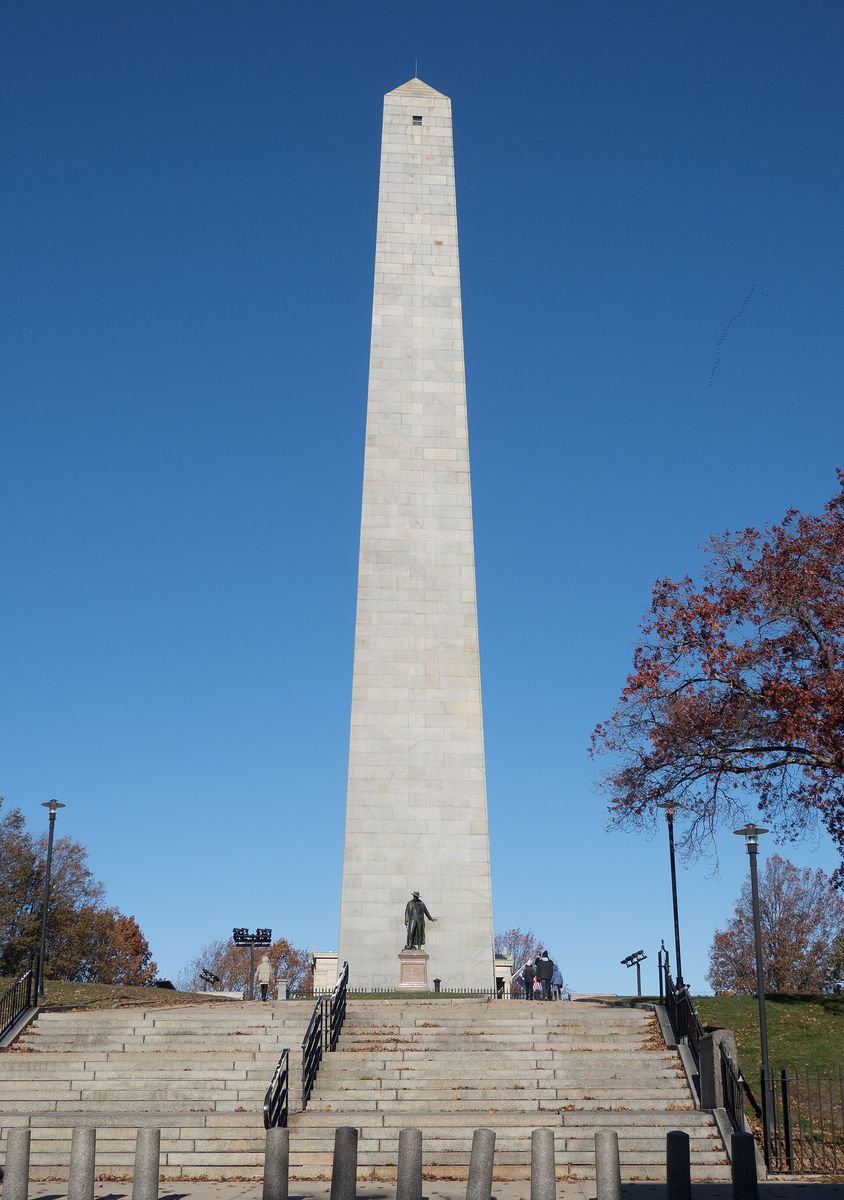
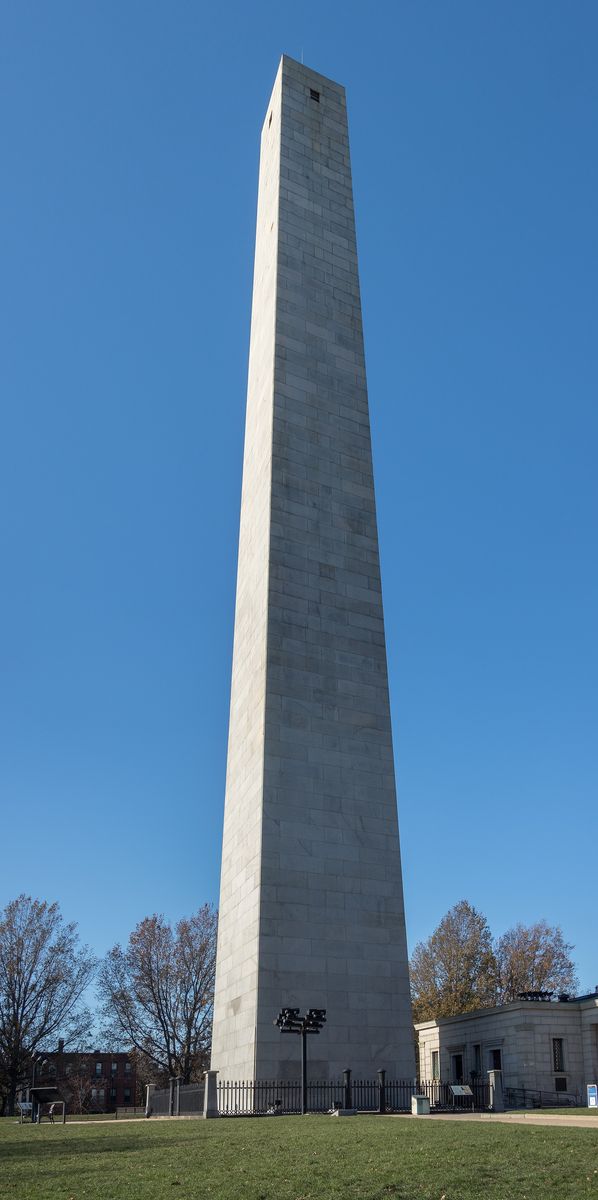
Someone, at some point, decided that climbers deserved encouragement, so the step count is painted on the wall every 25 steps of the way up. You will be glad of it. There are 294 steps in all, wound tightly around a hollow core inside a 221-foot granite obelisk, and nothing but your own legs to get you to the top. The Bunker Hill Monument is the last of the 16 stops on the Freedom Trail, it costs nothing to climb, and from the small square room at the summit you look down over the rooftops of Charlestown to the Zakim Bridge and the towers of downtown Boston.
This guide covers the climb itself and when you can make it (only in the afternoon, for most of the year), the free museum across Monument Square, the battle of June 17, 1775, that the obelisk commemorates, the long and nearly bankrupt story of building it, the June commemorations, and how to get up the hill. Hours were checked in November 2026 against the National Park Service’s own listings; check them again before you go, because the monument can close for weather.
Climbing the monument
Admission is free and there are no reservations. You go in through the Bunker Hill Lodge, the low granite building at the foot of the obelisk, and the climb starts from there. Only 25 people are allowed inside the monument at a time, so on a busy afternoon you may have to wait for climbers to come down before you can go up.
The stairway is a tight spiral of 294 steps wrapped around a hollow central cone, which also serves to ventilate the shaft. Narrow openings on the north side let daylight in as you climb, their ledges covered in mesh, and the painted numbers count you up in 25s. There is no elevator: the top can be reached only by the stairs. For safety reasons, service animals can’t be accommodated inside the monument, although the Lodge and the base of the obelisk are accessible by the ramp at the Massachusetts Gate entrance.
At the top is a square observation room about 11 feet across, with a single square window in each face of the obelisk. It is a view through windows rather than from an open deck, and when a group of climbers arrives at once, nobody lingers for long. On a clear day, though, it is as good a free view as Charlestown offers: straight down over the row houses and church roofs of the neighborhood, across the river to the cable-stayed Zakim Bridge and TD Garden, and beyond them the towers of downtown and the Back Bay.
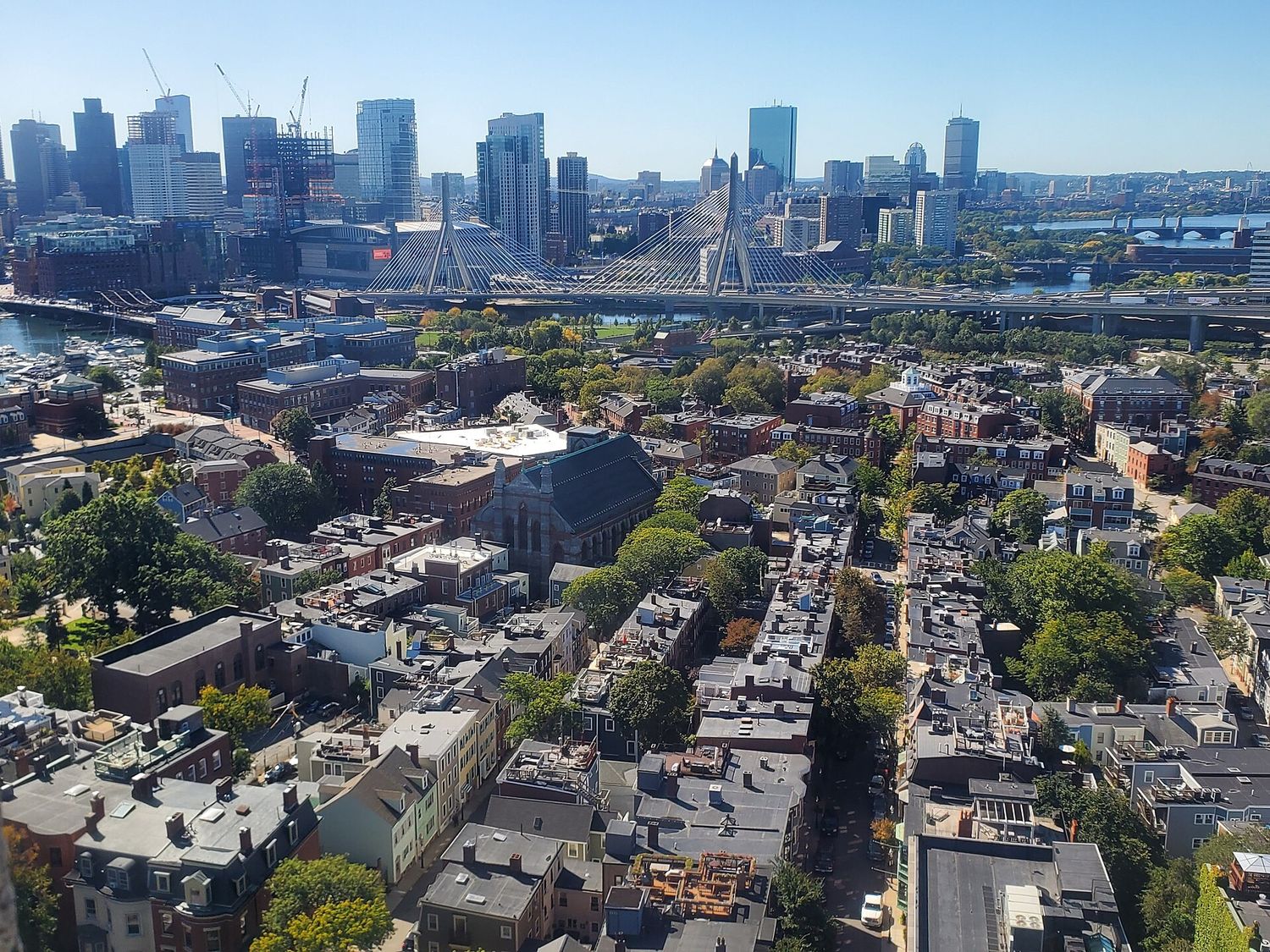
Pace yourself. The steps are steep and the spiral is tight, so take it slowly, carry water in summer and wear proper shoes. If you are claustrophobic or your knees won’t take it, you can still see the view: the Park Service runs 360-degree live webcams from the top, which show it to you from the bottom of the hill, or from your hotel room.
Hours
The monument and the Bunker Hill Museum keep the same hours, and both are closed every Monday and Tuesday, whatever the season:
| Season | Days | Hours | Last climb |
|---|---|---|---|
| Off-season, October 13 to May 28 | Wednesday to Sunday | 1pm to 4pm | 3:30pm |
| Summer, May 29 to October 12 | Wednesday to Sunday | 10am to 5pm | 4:30pm |
Both are also closed on Thanksgiving, Christmas Day and New Year’s Day, and the monument may close for climbing because of the weather or other safety concerns. Check the Park Service’s Bunker Hill Monument page on the day you go.
That 1pm start in the off-season catches people out. A Freedom Trail walker who reaches Charlestown at 11am on a November morning finds the monument closed for another two hours. The fix is easy: see USS Constitution first. The ship’s standard hours start at 10am, Wednesday to Sunday, the Park Service puts the walk up from the Navy Yard at 10 to 15 minutes, and a morning on the ship followed by an afternoon climb fits together very neatly.
The battle on Breed’s Hill
The name is the first thing to get straight. The battle of June 17, 1775, is named for Bunker Hill, the highest hill on the Charlestown peninsula, but most of the fighting took place on Breed’s Hill, the lower hill closer to the Charles River and to Boston. That is where the monument stands, on the site of the earthen fort the militia built the night before the battle.
In June 1775, two months after the fighting at Lexington and Concord, the British army was besieged in Boston by New England militia camped around the town. When the colonial leaders learned that the British planned to occupy the unfortified hills around Boston, they moved first. Around midnight on June 16, hundreds of militiamen with picks and shovels, led by Colonel William Prescott, General Israel Putnam and Colonel Richard Gridley, began digging a redoubt on top of Breed’s Hill and strengthened a fence of stone and wooden rails that ran north toward the Mystic River.
At first light, British ships off Charlestown opened fire on the new fort. General Thomas Gage ordered General William Howe to take it, but the British had to wait until midday for the tide to rise before boats could ferry roughly 2,400 troops across the Charles. Around 3:30pm Howe advanced, sending troops against the redoubt, the breastwork and the rail fence, and another force along the beach of the Mystic River. Colonial officers had planted stakes in the ground ahead of their lines to show the men the point at which to open fire.
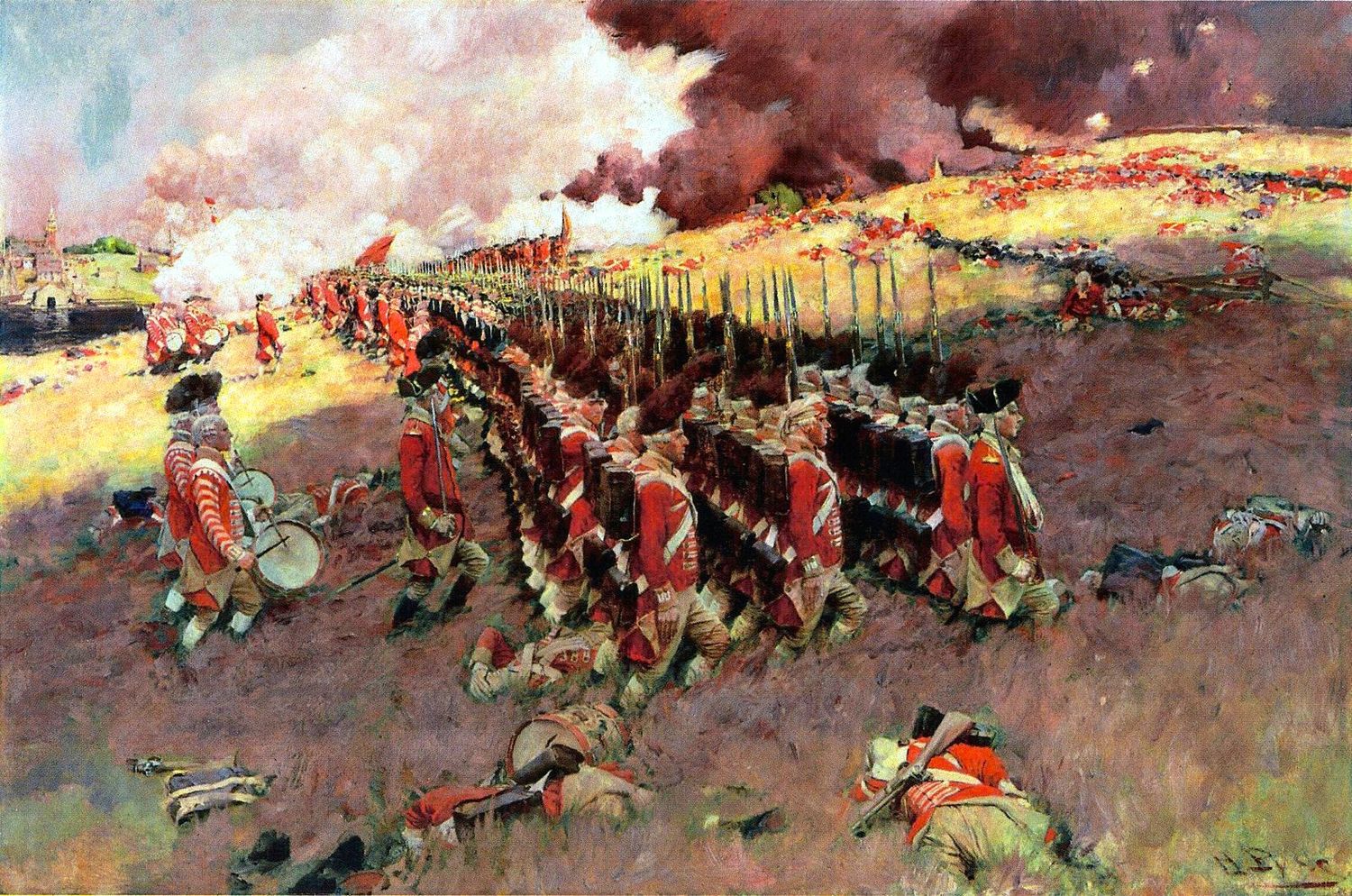
The first assault was thrown back, and so was the second. British gunners, meanwhile, set Charlestown itself ablaze with red-hot cannonballs to drive out the colonial marksmen firing from the edge of the town. Howe regrouped, brought in reinforcements and sent in a third assault, which carried the redoubt, and the colonists were driven off the hill. The whole battle lasted about two hours.
Technically it was a British victory. In every other sense it was a calamity for them. The Park Service puts British casualties at 1,054, against an estimated 450 colonial losses, and Charlestown was destroyed, its residents forced to move away or start again. Among the colonial dead was Dr. Joseph Warren, a leader of the patriot cause in Boston, who became a martyr to it. News of the battle, the Park Service notes, helped to unite the thirteen colonies.
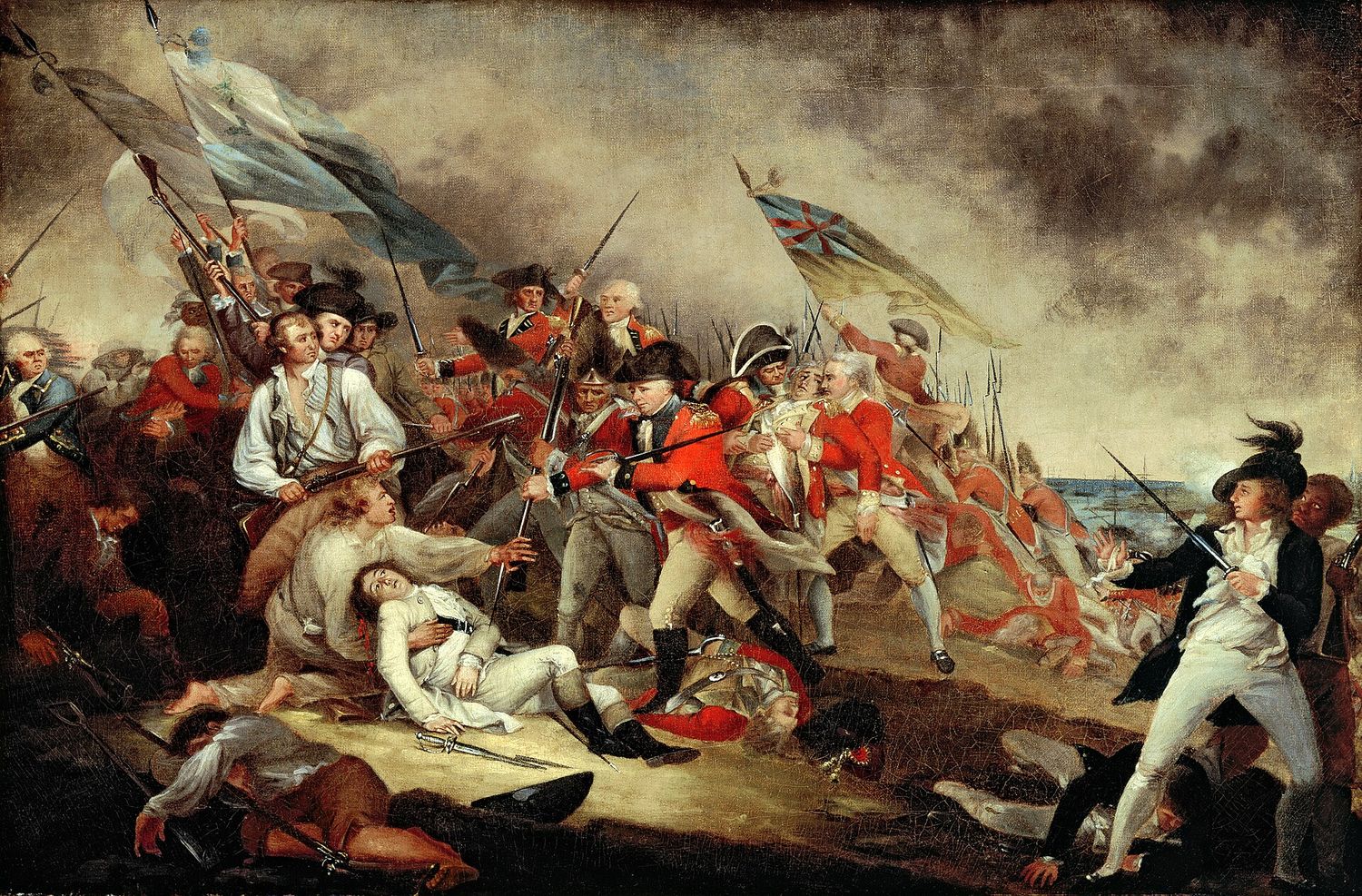
Two more things are worth knowing before you stand on the hill. About 150 patriots of color, Native American and African American, fought in the battle, according to the Park Service. And the famous order “Don’t fire until you see the whites of their eyes” has been credited to Putnam, Prescott, John Stark and Gridley in different accounts, which is usually a sign that nobody said it; most historians now treat the line as legend. The stakes in the ground, on the other hand, were real.
Seventeen years, a sold-off battlefield and a ladies’ fair
The Bunker Hill Monument Association was founded in 1823 by prominent citizens of the Boston area who wanted to preserve part of the battlefield and mark the place where the militia had dug in. On June 17, 1825, the battle’s fiftieth anniversary, an immense crowd watched the Marquis de Lafayette and Daniel Webster lead the cornerstone ceremony; about 40 veterans of the 1775 battle were there, along with 190 more from the Revolutionary War. Within days the association settled on a granite obelisk. The winning design came from Horatio Greenough, then 22, who took his inspiration from the ancient Egyptian obelisk in Rome’s Piazza San Giovanni, and the association appointed Solomon Willard as architect and superintendent.
The granite came from the association’s own quarry in Quincy. A horse-drawn railway, which the Park Service describes as the first commercial one, carried the blocks three miles to the Neponset River, and ships brought them up the coast to Charlestown. Then the money ran out, and kept running out. Work began in May 1827, stopped in December 1828, started again in 1834 and stopped once more in 1835. In 1839 the association sold 10 acres of the very battlefield it had bought in 1825 to pay its debts, and it cut the planned height to about 160 feet.
Women got it moving again. Sarah Josepha Hale, a magazine editor and advocate for women’s rights, took up the challenge of finishing the monument at its full height and proposed a week-long Ladies’ Fair at Quincy Market, which was held in September 1840. It raised more than $30,000, about a quarter of the monument’s total cost. Two more private donations followed, work restarted in May 1841, and with a new steam engine on site, 135 feet of obelisk went up in about a year. The capstone was set in July 1842, seventeen years after the cornerstone. The bill came to more than $120,000, and one workman died during construction, falling when the tower stood 40 feet high. The market hall where the fair was held is still there, in the middle of the Faneuil Hall Marketplace.
The monument was dedicated on June 17, 1843. Webster spoke again, President John Tyler attended, and a parade more than two miles long marched out from downtown Boston to a crowd of over 100,000. Only 13 veterans of the battle were among the guests, against about 40 at the cornerstone ceremony.
After the dedication
By 1919 the Commonwealth of Massachusetts owned the monument. During the Second World War, to protect the Charlestown Navy Yard below the hill from sabotage, visitors were barred from using cameras or viewing scopes, and the obelisk itself was closed from 1942, although the entrance building stayed open. Interest was slow to return: the monument had about 20,000 visitors a year by the early 1950s, and a federal study in 1956 found the obelisk, the grounds and the entrance building in disrepair. In 1975 the monument passed to the National Park Service, which runs it today as part of Boston National Historical Park. It had been named a National Historic Landmark in 1961.
The stone needs constant care. Masons began repointing the capstone and the top ten courses of the shaft in 2021, and in 2023 the Park Service carried out a $1.4 million preservation project to stop chronic water infiltration at the top, in time for the battle’s 250th anniversary in 2025. During the pandemic, when the monument was closed, the Park Service put a live camera feed from the top online, and its 360-degree webcams still show the view today.
Inside the obelisk
The obelisk is a heavier thing than it looks from the bottom of the steps. It is made of about 6,700 tons of granite, laid in 78 horizontal courses, each 2 feet 8 inches tall, on a granite foundation 12 feet deep. At ground level it is about 30 feet square, tapering to 15 feet square near the top, and its walls are 6 feet thick at the base and 2 feet thick at the summit. It stands on the southeastern corner of the redoubt the militia dug on the night of June 16, 1775.
Inside, the stair climbs a hollow shaft 18 feet across at the base, spiraling around the central cone that supports the steps and ventilates the column. The observation room at the top is about 11 feet across and 17 feet high, and the pyramid-shaped capstone above it is 3½ feet tall. In the 19th and early 20th centuries the room held two cannons salvaged from the battle; one was later moved down to the entrance building, and the other went to Minute Man National Historical Park. After dark, lamps light the outside of the obelisk, so it is worth a look if you are in Charlestown in the evening.
It was not the first memorial on the hill. A monument to Joseph Warren was dedicated on the site in 1794, and for part of the 20th century a 9-foot marble replica of that earlier memorial stood inside the obelisk.
The Lodge, the museum and Monument Square
The Bunker Hill Lodge
Every climb begins in the Lodge, the granite building beside the obelisk, which dates from 1902. Its vestibule has a floor of multicolored marble mosaic, and in the small rotunda beyond, under a coffered plaster dome and walls of Siena marble, stands Henry Dexter’s large statue of Joseph Warren, made in 1857 for an earlier entrance building, which makes the man who died on this hill the first person you meet on the way up. In season, rangers give talks outside and inside the Lodge, and in summer the Park Service runs a series called Decisive Day Talks; check the park’s site for the next season’s schedule.
The Bunker Hill Museum
Across the street from the grounds, at 43 Monument Square, the Bunker Hill Museum occupies the old Charlestown branch of the Boston Public Library. Its exhibits cover the battle, the building of the monument, how the battle has been remembered and the history of Charlestown itself, with numerous artifacts and several dioramas that take you back to the day of the fighting. Admission is free, there is an elevator to all floors, and the Park Service suggests allowing 30 to 60 minutes. It keeps the monument’s hours.
Go to the museum before you climb if you can, and certainly if you have children with you. The dioramas make sense of the ground you are about to look down on, and the redoubt, the rail fence and the burning town are much easier to picture from the top once you have seen them laid out in miniature.
Prescott, the square and the names of the dead
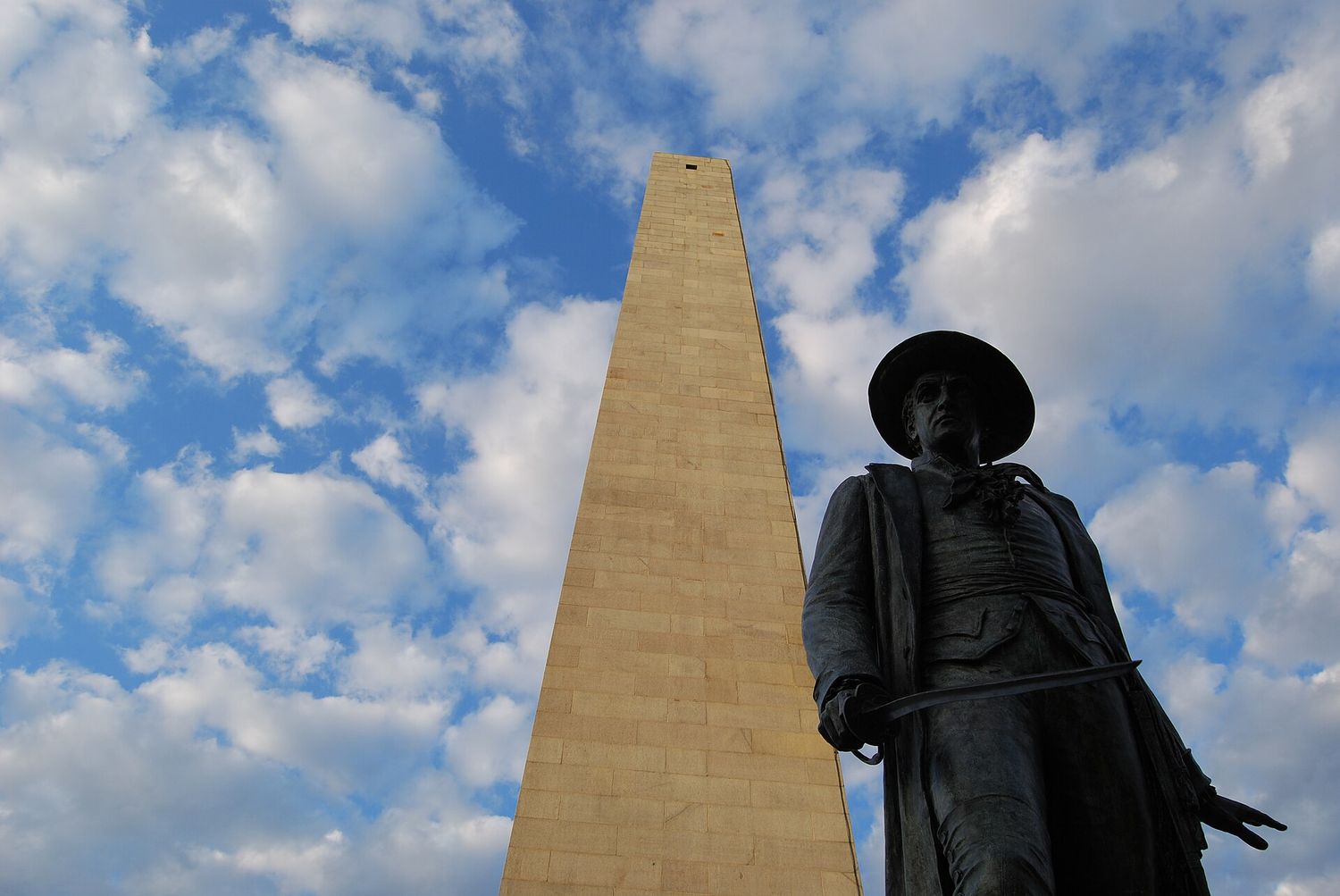
At the foot of the obelisk stands William Wetmore Story’s bronze of Colonel William Prescott, sword in hand, dedicated on June 17, 1881. The houses around Monument Square form a historic district of their own, and they make the walk around the grounds one of the pleasantest few minutes in Charlestown. A few blocks away, in Winthrop Square, bronze tablets installed by the city in 1889 list the names of the provincial militiamen who were killed in the battle. It is a quiet spot, and an affecting one.
For something to eat, the Warren Tavern gives 1780 as its founding date and calls itself the oldest tavern in Massachusetts; check its hours on its own site before you walk over.
Bunker Hill Day and the June commemorations
June 17 is Bunker Hill Day, a legal holiday in Suffolk County, and Charlestown marks it with the Bunker Hill Day parade, organized by the Battle of Bunker Hill Parade Committee. In 2025 the parade was held on Sunday, June 15, running from Vine and Bunker Hill Streets down Main Street to the Charlestown Militia Training Field; in 2026 it stepped off at 12:30pm on Sunday, June 14, from Hayes Square. The Park Service has called the monument grounds and the Massachusetts Gate prime spots for watching it.
The Park Service also runs a week of programs around the anniversary. In 2026 that meant events from June 11 to 17, the monument lit up from June 13 to 17, and a memorial garden of 1,500 American and British flags. The 250th anniversary, in June 2025, brought a week of events from June 8 to 17 that included a naturalization ceremony for new citizens, a memorial flag garden, the parade and events marking 200 years since the cornerstone was laid. For the 2027 program and parade, check the Park Service’s Boston pages and the parade committee in the spring, and our guide to Boston events for what else is on.
Getting there
On foot, the Freedom Trail brings you up from the Charlestown Navy Yard: out through Gate 1, along Chelsea Street, then up Chestnut Street and Adams Street to Monument Square, where stairs climb to the grounds. The Park Service puts that at a 10 to 15 minute walk from the Navy Yard, and the walk from North Station, across the Charlestown Bridge, at about 20 minutes. Our Freedom Trail map shows the whole route.
By bus, MBTA route 93 runs from downtown toward Sullivan Square; the Park Service suggests getting off at the Constitution Road stop and following the Freedom Trail up Chestnut and Adams Streets. Community College station on the Orange Line, at Austin Street and Rutherford Avenue, is another option; check the MBTA’s trip planner for the walk from there.
The ferry is the most enjoyable way to arrive. The MBTA’s F4 boat from Long Wharf reaches the Navy Yard in about 10 minutes for $2.40, and from Pier 4 you walk up through the yard and out of Gate 1 to join the trail. Our guide to getting around Boston covers fares and passes.
Don’t drive to the monument itself: there is no parking near it. The Park Service points drivers to the Nautica Parking Garage on Constitution Road, a 10 to 15 minute walk away. And if a car is the only option, it is worth remembering that the ferry, the bus and your own feet will all get you there with less fuss than hunting for a space in Charlestown.
Is the climb worth it?
On a clear day, and if your knees are up to it, yes. It’s free, the view on a good day is a fine one, and reaching the top under your own steam after 294 steps carries a satisfaction no elevator ride to an observation deck can match. Manage your expectations about the view, though. It is seen through four windows in a small room you will be sharing, not from an open-air platform, and for a full wrap-around panorama of the city our guide to the best views in Boston has better options.
Skip the climb in fog or heavy rain, when there is nothing to see, and think twice in a summer heat wave, when 294 steps in an enclosed stairwell are hard work. It is also not for anyone who dislikes tight spaces: the spiral is narrow and the room at the top is small. The webcams are a perfectly good substitute, and the Lodge and the base of the monument are accessible to everyone.
Don’t skip the museum. It is free, it has an elevator, and its dioramas explain the battle better than anything else on the hill. Too many people climb the obelisk, take a photo of the view and leave without crossing the street.
And mind the clock. In the off-season the last climb is at 3:30pm, so a Freedom Trail day that starts at Boston Common at 10am has to keep moving to make it. Our guide to how long the Freedom Trail takes helps with the timing, and our guide to all 16 Freedom Trail stops puts the monument in the context of everything that comes before it.
Frequently asked questions
How many steps are in the Bunker Hill Monument?
There are 294 steps, in a tight spiral stairway that wraps around a hollow central cone. The number of steps climbed is painted on the wall every 25 steps. There is no elevator.
Is the Bunker Hill Monument free?
Yes. Climbing the monument is free, and so is the Bunker Hill Museum across Monument Square. No reservations are needed.
Is there an elevator in the Bunker Hill Monument?
No. The top can be reached only by the 294 stairs. The Lodge and the base of the monument are accessible by the ramp at the Massachusetts Gate entrance, and the museum has an elevator to all floors.
When is the Bunker Hill Monument open?
From October 13 to May 28, Wednesday to Sunday from 1pm to 4pm. The rest of the year, Wednesday to Sunday from 10am to 5pm. It is closed on Mondays and Tuesdays and on Thanksgiving, Christmas Day and New Year’s Day, and the last climb is 30 minutes before closing.
Why is it called the Bunker Hill Monument if it’s on Breed’s Hill?
The battle took its name from Bunker Hill, the highest hill on the Charlestown peninsula, but most of the fighting happened on neighboring Breed’s Hill, where the militia built their redoubt. The monument stands on Breed’s Hill, on the site of that redoubt.
Do you need a ticket to climb the Bunker Hill Monument?
No reservations are needed. You go in through the Bunker Hill Lodge at the base of the obelisk, and only 25 people are allowed inside the monument at a time, so you may have to wait your turn on a busy day.
How tall is the Bunker Hill Monument?
The granite obelisk is 221 feet tall. Its cornerstone was laid in 1825, the capstone was set in July 1842, and it was dedicated on June 17, 1843.